
The new route
Monday April 11th 2005, Author: James Boyd, Location: none selected

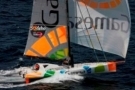
Will Oxley spent most of the last two months in Doha 2006's relatively spacious navigation area in the stern of her starboard hull as he and Brian Thompson's maxi-catamaran crew made their non-stop circumnavigation of the globe in the Oryx Quest.
For the Australian former BT Global Challenge skipper turned professional navigator who later this year will set sail aboard Grant Wharington's Australian entry in the Volvo Ocean Race, the Oryx Quest represented two firsts: the first occasion sailing around the world on a new course - starting from and finished in the Middle East (as was the case for all the crews involved) but also his first time sailing a maxi-catamaran in anger.
Compared to boats such as the Skandia maxi Oxley sailed on last year, the maxi-catamaran represented a very different proposition.
"One of the things is that they just go faster," says Oxley, "but the most difficult thing is the sea state. If you have some sort of cross swell and it starts banging you just have to slow the boat up so much earlier. We had some discussion in the Sydney-Hobart that maybe that is how they have to sail the maxis [monohulls], but we haven’t done any pounding like this thing [ Doha 2006] pounds and you really have to slow the thing right down. So it was interesting, but quite constraining because they don’t like to gybe very often because of the battens... So it was like 'we don’t like to gybe and we don’t want to go upwind and we don’t want any strong winds and we have a very narrow range in which we want to go downwind. And we don’t like light airs. Make it happen!"
It should be pointed out that while this holds true of the first generation G-Class multihulls such as Doha 2006, the new generation maxi-cats like Bruno Peyron's Orange II (see our forthcoming interview with designer Gilles Ollier) have much improved all-round performance.
Working with the crew and bearing in mind his lack of experience on board fast multihulls, Oxley developed a system whereby he would tell the crew the rough concept of what they were trying achieve and what the wind would do and let the crew get on with it. "A lot of the time I didn’t set a course. It was like 'we need to go that way, sail the boat how you need to sail it and I’ll just make it happen. It worked quite well, but it is a slightly different mentality. There is nothing wrong with it, I have learned a lot. It was fantastic to sail with people of the calibre of Thomas Coville and Jacques Vincent".
During the course of the race, Oxley conjured up two new sets of polars for 'slow mode' in light airs and 'slow mode' in heavy airs for those occasions when the sea state started to endanger the boat. "You’d run each of the polars and look at the different solutions, but I learned that when a multihull sailor says they don’t want to sail upwind they mean they don’t want to sail less than 90° TWA. When they say they don’t want any strong winds, they mean anything more than about 24 knots and when they say we don’t want it to be too rough, they don’t want any more than 0.5 sea state! I jest, but you have to be much more careful in how you position the boat".
Oxley believes that one of the next developments in routing software will be where you can carry out routing based upon the forecast sea state as well as wind conditions. While this would be particularly useful for the maxi-multihulls it will also be for the new generation maxi-monohulls and also possibly even the Volvo Open 70s, now that these boats are all travelling at previously unheard of speeds.
A general sentiment of Doha 2006's crew was that a trimaran would be better suited to the Indian Ocean stage of the course and could hold it's own in the Southern Ocean. This is likely to be even more the case for the Quest Qatar, Tracy Edwards' round the world race with stops in 2007 that will see the boats having to negotiate land more often. Doha 2006 in comparison was designed to win The Race on the more conventional predominantly downwind course, which she duly did in the hands of Grant Dalton as Club Med, but was not the ideal tool for the job of winning the Oryx Quest.

The challenge of the Indian Ocean
After the start, Oxley's maxi-cat baptism came quickly. "It was fast and furious out of here. The first night we were doing 30 knots of boat speed. Maxi-cats are not particularly manoeuvrable because you have got to sail particular angles and we were dodging Iranian islands with military bases on them and oil rigs and ships and shipping lanes."
Down the Indian Ocean they had encountered considerable amounts of flotsam such as logs that they believed to have been the result of the devastating Boxing Day tsunami. Compared to the Atlantic, the Indian Ocean presented them with two sets of Doldrums. "They move by about 200 miles [north-south] depending upon the season," says Oxley. "There was one a little bit north of the Doldrums and the other a little bit south. In the Atlantic you get the easterly waves, in general everything is moving from east to west. Here the clouds were moving both ways. So you’d think 'I can go behind that one', but the clouds would jump back."
Into the southern Indian Ocean and the boats were presented with a meteorological situation similar to that of the south Atlantic with a high pressure area blocking their path to the Southern Ocean. Oxley was pleased with their strategy here. " Geronimo was sailing high and trying to cut the corner and it was obviously very rough. We sailed more conservatively and a little slower and set up to give the high a wider berth. So they were closer to the finish but we were always south of them." Thus Doha 2006 was first into the Southern Ocean and first to pick up the strong westerlies. But by this time Geronimo had suffered damage to her crossbeam that would ultimately cause her to withdraw from the race.
Into the Southern Ocean and Doha 2006 was in her element. "We managed to position ourselves in front of a low and we had a terrific run because you have flat seas from the front and it is just easy sailing. You could not believe how easy it was particularly having gone the other way," says Oxley reminiscing about his Global Challenge days. The maxi-cat was able to rack up 500+ mile daily runs repeatedly, their fastest 24 hour run being 610 miles.
They dived south to keep the favourable conditions, but were forced to come north to avoid the ice hazard that the Vendee Globe fleet had experienced.
A new era in Southern Ocean racing
Traditionally there is very little data about the position of icebergs in the Southern Ocean, but since the Vendee Globe this has changed and safety in future round the world events, particularly the Volvo Ocean Race, will benefit greatly from this latest development. "It has changed the face of Southern Ocean racing," says Oxley.
In essence there are now satellite systems available that can spot icebergs in the Southern Ocean. "The Vendee was the first time it had been used. And we managed to convince the Canadians and the European Space Agency to redirect their satellites. It took us three or four weeks and they took 10 days to reconfigure it," says Oxley.
The system uses satellite-based radar to scan the sea to pick up three dimensional objects. The resolution of the scans can be altered to pick up objects of different sizes, the narrowest being around 50m. "We went for 200m on the basis that we could then see the bergy bits," says Oxley. The satellite radar scans would be sent through to Doha 2006's routers - Chris Bedford's company Sailing Weather Services - who would then send the location of the bergs through to Oxley on board the boat as a list of lats and longs, the size of the target and a figure for their confidence in the data. (To read more about this system - click here).
Using this information Doha 2006 zigzagged her way across the Pacific avoiding the worst areas of bergs. They saw no ice, except for on one occasion on radar, but in a position where Oxley says he was expecting it. For reasons of safety they also provided this data to Cheyenne and Daedalus.
From getting into the Southern Ocean to Cape Horn Oxley says they rode just two weather systems but approaching South America they had had to head north to stay above a depression that was heading down the west side of the continent. By Cape Horn they had fallen off the back of this and were into light winds, enabling them to tackle the tricky passage through Le Maire Strait.
The passage north of the Falklands was the most unpleasant of the trip due to the large sea coming from the northwest and some massive squalls. One particularly unpleasant squalls they had been tracking on radar was so big that its down draft had whipped up the sea state before it struck. "We literally smoked the yankee, dropped the reef in and bang, 50 knots and hail, bigger than peas. We had to put crash helmets on. And the temperature dropped by about 10degs because of the air."
Once around the turning mark of Los Lobos off Urugary their passage across the South Atlantic was relatively straightforward. They could have dived further south and made better time but by this stage Cheyenne, their main competition, had dismasted and the game had changed to getting Doha 2006 across the finish line without breaking.
The trials of the Indian Ocean
Past the Cape of Good Hope and a massive area of high pressure was barring their route north. In a monohull with competition breathing down your neck there would have been no discussion - head around its northwestern flank enduring upwind conditions and head seas, says Oxley. But in a multihull with no threat to their lead the other alternative was sailing along the bottom of the high past the Kerguelen Islands (ie closer to Australia than South Africa) before heading north. Aside from sailing many more miles, there was a danger from this strategy that the high would simply roll over the boat leaving them becalmed.
Discussion over the tactics here resulted in four different weather routers being consulted - all of whom disagreed... Fortunately the ultimate solution was made easier as Cyclone Hennie developed to the north of the high making the northwest option unfeasible and the forecast models finally tallied in showing the prospect of the high splitting in two.

Cyclone Hennie
In the end Doha 2006 sailed along the south side of the high and watching out for the split to occur using up to the minute wind radar data, they were able to zip up the east side of the high's western segment. "We shot through in six hours," says Oxley.
With the high dealt with the next job was attempting to side step cyclone Hennie as sailing too close to its eastern side would again cause them to sail upwind. In this respect Tony Bullimore's crew on Daedalus were much more fortunate and were able to make up considerable ground by using the strong following winds on the west side of cyclone Isang, (a system that in its infancy Doha 2006 had used to propel them north through the Doldrums).
Generally the cyclone area to the south of the Doldrums was decidedly dicey says Oxley. While both Doha 2006 and Daedalus came away unscathed the next cyclone to develop, Juliet, saw 95 knot winds gusting to 120. "And it developed just like that - just to the east of where we went through."

2005 cyclone tracks in the southern Indian Ocean
After the hurdles of the southern Indian Ocean so they decided to stick to the west of the Maldives to avoid encountering tsunami flotsam but generally their progress was slow and they ended up falling into a large patch of zero wind. While the first half of their circumnavigation saw them averaging 19.3 knots over the ground over the last nine days of the voyage their average speed was just nine knots. "That's 220 miles a day - what a good 40ft monohull will do," said Oxley.
Patience was the order of the day but proved frustrating for many of the maxi-multihull stalwarts unused to sailing for so long in so little wind making such little speed. This was not helped by their slow progress once back into the Gulf.
"The models have no handle on the Gulf of Oman and the Persian Gulf in certain conditions. We had a strong southeasterly which didn’t appear on any of the models. And the southeasterly stopped the northwesterly getting to us," says Oxley of their final 24 hours at sea. "All the models had this beautiful thing that was straight in and that died out and we were sitting there off this Iranian island. We did one gybe and these guys came out in a little power boat and waved at us and they go ‘Iran - dom dom’. And then one goes ‘daga, daga, daga’ [like a machine gun] and we went ‘okay…we’ll move away… at 0.5 knots’. And then we got buzzed by an aircraft. And then we had to cross a shipping lane at 3 knots. It was very difficult, but we kept our sense of humour..."
Oxley says his maxi-multihull baptism was interesting, but he is now looking forward to the increased competition of the Volvo Ocean Race.
Most Read
Most Commented
Comments
Businesses
Pro businesses
Editor's choice
Member blogs
-
 Ned Collier Wakefield: MOD70 round BarbadosWell that was intense. 12 hard fought for seconds for the win. In idyllic conditions, Tony Lawsons MOD ...
 -
 Mini Transat leg 2 reportThe second leg of the Mini Transat started on 31st October, just over a month after ...
 -
Leg 1 reportI’ve been working towards the Mini Transat now for three years. In 2013 I was part ...
Business blogs
-
 The Island Sailing Club in Cowes, Isle of Wight, is delighted that Prince Michael of Kent ...
 -
Peta Stuart-Hunt chats with the 25 year-old British solo sailor Lizzy Foreman before she sets sail ...
-
The 2015 Student Yachting World Cup (SYWoC), an ISAF-recognised event hosted and run by students for ...
Editor's Choice
All time favourites...
-
 Three legs down into Ian Walker’s
 -
 Winning all but two races at
 -
 For the first time in its
Latest Comments
Add a comment - Members log in