
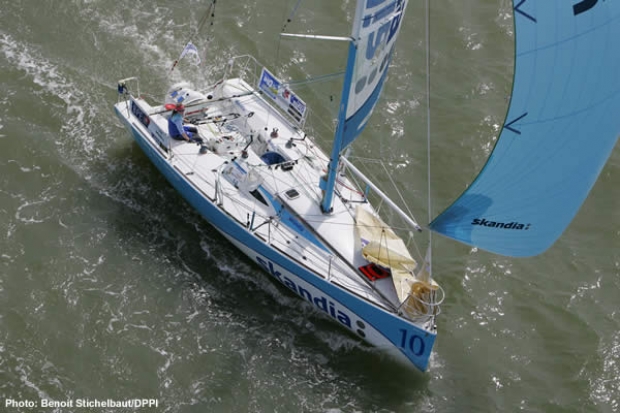
Too much fun
Thursday April 14th 2005, Author: James Boyd, Location: none selected
Sam Davies is currently in the middle of the Atlantic half way through the Figaro class' first ever singlehanded transatlantic race, the Trophee BPE. This morning's position update showed
Skandia pulling up to fourth place just 40 miles short of the race leader but still with 2,250 miles to go until the finish of the race in Cienfuegos on the south side of Cuba.
As mentioned in today's report on the race, Sam has been benefitting from her southern strategy that she began before she'd even passed through the Azores last weekend.
"We’ve been really lucky with the weather and a couple of times before the Azores I was a bit behind and I spotted an opportunity: if I was further south on the last approach to the Azores, I could make up quite a few miles if I could keep the spinnaker up longer than everyone else because they were at a higher angle. So I did that and that earned me some miles - a fast day and night sailing.
"I learned from last year in a similar scenario in the Transat AG2R [the Figaro's biennial two handed transatlantic race]. This time ever since the Azores I’ve had a feeling that going south was good, so as soon I was out of the shelter of the islands I turned a bit left and it was good because the more left you went, the faster you went because it was a higher angle to the wind. So I just sailed as high and as fast as I could to go as far south as possible, keeping the spinnaker up. I tried dropping the spinnaker for an hour and it was completely hopeless. Now I am benefitting from the south but it is getting a bit more complicated because there is a depression coming across and there are some little depressions off the end of it's cold front. So we’ll have to see what happens and we’ll have to work out how to position ourselves for that in about three days time."
Skandia's gain in the last 24 hours has been due to her position relative to the high pressure system currently over the Azores. "We’re basically running away from the high pressure as it spreads out. We’re not in any risk of there being in no wind, but we are right on the big curve of the high pressure and the curve - as the wind turns from the easterly Trade Winds to the southerly winds that are associated with the next low that is coming along. Because I am nearer south I am nearly hooked into the Trade Winds which are stronger and more east, I have a better angle of wind and more force of wind. Bostik and Credit Mutuelle are nearly there but they are right in the curve so the isobars are further apart where they are and they have a lighter wind for the moment."
The million dollar question is how long will it stay favourable to the south on Sam's side of the course? "It is difficult to tell. It stays to my advantage for a while as far as I can see it, but maybe I am biased and that is my rose tinted opinion about it. It seems that the furthest south boat is better because the further north you are the more you have the wind forward of the beam. Cercle Verte will almost certainly be under a genoa, when I will be under spinnaker, which has to be a benefit for me. And it will be a bit stronger if I am further south, until we get to this cold front. At present every model I get shows a different thing happening on the cold front, so it will be a challenge to find the best passage through while keeping the most wind. The guys to the north could come out with the luck of the draw there." Fingers crossed that south continues to pay.
With the high being north of its present position at the start and only moving over the Azores once the boats had passed through the Trophee BPE competitors have been extremely fortunate with the weather and have enjoyed fantastic sailing conditions. "We are so lucky," Sam agrees. "It is brilliant. It is fast with the spinnaker up and thank goodness for the decision of the Classe Figaro - which I was actually a bit against - to allow an asymmetric spinnaker, because I have been under asymmetric spinnaker all the time since three days out from St Nazaire [the start]. The sail I have - which the North Sails France guys designed with consultation from me and Gildas [Morvan, skipper of Cercle Verte] who is also with North Sails - we told them we wanted a spinnaker we could use for when we are in our bunks. And even when I did my 24 hours average of 10 knots, four hours of that I was actually in my bunk asleep – not four hours all at once, but in spots. The asymmetric is so much more stable than a conventional spinnaker."
That Davies has slept for four hours in a day demonstrates how different the pace of life is in a transatlantic race to the shorter sharper annual Solitaire du Figaro in which skippers strap themselves in on the helm and rarely get off it.
"In the Figaro race, that’s when you race for four days and then you can get into your bed, so this is a bit different and I have taken a different approach. I have been steering a lot, because I love it, it is such fun, hooning along surfing down the waves and also with the big waves you can get a bit more speed because you don’t collapse the spinnaker so much. But sleep is so important. If you are well rested you have a sensible head on rather than a tired head on and it is easier to see things clearer and to make decisions. Some decisions you have to make from quite a long way out, so I have decided to take the strategy that I would be pushing the pilot a little bit more than pushing me on the helming.
"Having said that I am not helming too much right now, because I have helmed so much and it has all been on port gybe that my right wrist is absolute agony. Now if I helm for any length of time it just hurts too much and I am not good at helming left handed on port gybe. So I am trying to restrict myself a little bit to get my hand better so that I don’t only have one usable arm at the finish..."
When she was steering more often Sam says she might have been on the helm intermittently for between six and eight hours a day, mainly during daylight hours when it is easier and you can anticipate waves, etc. "In the day we also have to do the radio vacations and get the forecast and eat, etc." In this race it is compulsory for each competitor to call in to Race HQ twice a day - if they don't they are awarded a 30 minute time penalty for each call they miss. She is also the regular communication with her team at Offshore Challenges, in particular Charles Derbyshire and Josie Robinson.
Thankfully the autopilot has been working without a glitch. "The pilot is fantastic. It is a lot about balancing the helm. I steer the boat trimmed differently to when the pilot is on, because I can cope with a lot more pressure on the helm and I can anticipate it. If you well balance the sails before you put the pilot on, it can cope with anything. I haven’t done that too much before because in the Mini the pilot was just hopeless so I just hand steered as much as possible. This time I have played around with it and it is quite satisfying. Sometimes I think the pilot is better than I am. But I have not had a single bug and it hasn’t crashed on me once. Maybe I’ve jinxed it now."
Generally the boat has been standing up well, for which Sam pays tribute to her shore crew Erwan. The only potential problem may be the spinnaker gear. "The spinnaker poles we have in the Figaro class are not designed for the pressure that we are putting on them with the asymmetrics, especially if you do the occasional wipe-out, which I have been known to do. The fitting at the end of the spinnaker pole is all completely bent and jammed shut. You have to hammer it to open or close it. But I have a spare spinnaker pole so I have one pole for the asymmetric and then I have another which I can gybe with. The ring on the mast is completely compressed so it is more of an oval. And the volume up button on the Iridium phone doesn’t work so I’ve changed phones. And I think my right boot leaks..." Okay, enough...
Iridium satellite phones are also normally banned in the Figaro class, but they are allowed for the transatlantic races such as this. "Compared to my only other singlehanded Transat which was the Mini it is really different having weather information and being able to look at what is happening and being able to make decisions about where to go rather than just pointing and hoping it."
Sam has previously competed in the Mini Transat, the Transat AG2R and the Transat Jacques Vabre short handed transatlantic races and in theory this should help her with the different pace in this race compared to the Figaro, but this doesn't seem to have been the case she feels. "I hoped it would, but these guys are pretty experienced. They have done long doublehanded races, but not singlehanded long races. There are obviously a lot of people who are very tired and are not able to make good decisions because they are too tired and too confused. I had one morning when I felt like that, but that was a long time before the Azores. Other than that I have felt quite on top of it rather than scrambling to try and keep up with myself."
Perhaps as a result of this, Sam says is enjoying immensely. "I thought I would, but it has been ages since I’ve done such a long race. I’m almost enjoying it more than I expected. I have fully got into the rhythm. I thought I would be a lot more stressed than I am because the AG2R was a really stressful race and I think it was because we were in the lead early on and this race I feel I have put less pressure on myself. And it is fun and I am still doing just as well."
The conditions have no doubt also helped her mood. "That has helped a lot, but it is not the easiest weather in which to try and sleep, so I am quite pleased I have a good handle on the pilot, because that could be quite stressful things in this race if you didn’t have good balance for the pilot and the boat was all over the place. Then it would be a nightmare to sleep and I would be really really tired."
Most Read
Most Commented
Comments
Businesses

Pro businesses
Editor's choice
Member blogs
-
 Ned Collier Wakefield: MOD70 round BarbadosWell that was intense. 12 hard fought for seconds for the win. In idyllic conditions, Tony Lawsons MOD ...
 -
 Mini Transat leg 2 reportThe second leg of the Mini Transat started on 31st October, just over a month after ...
 -
Leg 1 reportI’ve been working towards the Mini Transat now for three years. In 2013 I was part ...
Business blogs
-
 The Island Sailing Club in Cowes, Isle of Wight, is delighted that Prince Michael of Kent ...
 -
Peta Stuart-Hunt chats with the 25 year-old British solo sailor Lizzy Foreman before she sets sail ...
-
The 2015 Student Yachting World Cup (SYWoC), an ISAF-recognised event hosted and run by students for ...
Editor's Choice
All time favourites...
-
 Three legs down into Ian Walker’s
 -
 Winning all but two races at
 -
 For the first time in its
Latest Comments
Add a comment - Members log in