
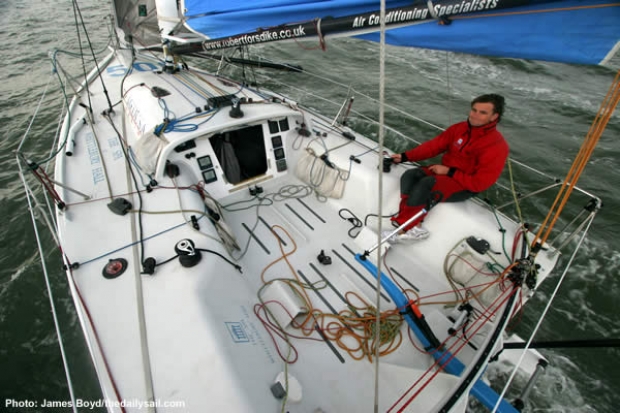
Mini Transat preview
Friday September 9th 2005, Author: James Boyd, Location: Transoceanic
One of our favourite events in the yachting calendar gets under way on Saturday week (18 September): the biennial Transat 6.50 Charente-Maritime/Bahia, otherwise known as the Mini Transat. Alongside the Figaro class, the Mini is where many great names in singlehanded offshore sailing have cut their teeth, from Ellen and Mark Turner (1997) to Bruno Peyron (competed in the first Mini Transat in 1977 and who plans to enter again in the 30th anniversary race in two years) to Michel Desjoyeaux, Yves Parlier (winner in 1985), Laurent Bourgnon (second 1987), Isabelle Autissier (third 1987), Thierry Dubois (winner 1993), Yvan Bourgnon (winner 1995), Bernard Stamm (third 1995), Thomas Coville (second 1997)...the list goes on and on.
The attraction of the event is not hard to grasp: 21 footers are a lot cheaper than Open 60s - although a full-on Mini program with a newly-built boat is in fact not much cheaper than a Figaro campaign. Yet it places the same demands on sailors who must master the unique skill-set required for solo offshore racing: the racing side (helming, trimming, navigation, tactics, strategy, weather forecasting, etc), seamanship (you have to keep the boat in one piece for the duration of a trans-oceanic race and be able to fix things and improvise if they go wrong or break) as well as managing personal issues like finding time to sleep, eat and drink while continuing to race.
If anything the Mini solo sailing experience is more extreme than that of an Open 60 as VHF communication is allowed, but cellphones, satphones and computers (email and internet) are all banned. Competitors are allowed short wave radio receivers with which they can listen to the radio forecast in French and get the names of the leaders, but otherwise there is no communication. While Open 60 sailors are regularly nattering on the satphone to their shore crew, spouses, the press, etc - Mini sailors lead a very much more solitary existence and a common feature of them arriving at the finish of each leg is a) they have not the remotest notion of where they have come, other than they suspect they have done extremely badly because they missed xyz shift or xyz broke and b) they cannot stop talking... This is hardly surprising - when was the last time you spent one day on your own without seeing or talking to anyone, let alone two weeks?
While there is a very full Mini calendar throughout its two year cycle none of the races are anything close to approaching the distance of the Mini Transat itself and therefore competitors face the fresh challenge of creating the right pace for themselves to best deal with the prolonged time they are at sea. This is undoubtedly where experience pays in this event.
A development class par excellence, the Minis have all the modern Open 60 toys such as canting keels and this time round wingmasts - and more besides. For example all manner of moving keels have been tried from ones which merely cant side to side, to others which cant and slide fore and aft (as Nick Bubb's Simon Rogers design has) to ones which swing side to side and articulate fore and aft on a kind of collapsible parallelogram to ones mounted on a large ball joint at the hull and can swing the appendage through a conical area.
Minis are also a blast performance-wise with the ability to fly huge gennikers off the end of their 3m articulating bowsprit (adding almost 50% to the length of the boat). Being pint-sized they are also much more managable for one person to sail - although still extremely hard work.
As ever the Mini fleet is divided into two classes - the 'protos' (ie one-off prototypes and the boats expected to win) and the 'series' boats (ie production boats with a series run of 10 or more). The 'series' Minis are slightly detuned for example the maximum bottom of keel to top of mast distance as specified in their rule is 12.6m compared to 14m for a 'proto'.
For some reason we always equate Mini sailors with students - they tend to be young, have questionable hygiene, the ability to run on minimal sleep, are happy to live out of a space the size of a broom cupboard for weeks on end and range from being penniless to completely overrun with debt. In reality this tends to be true of the young blades who typically sail 'protos'. The series sailors are normally more even-keeled, older amateur sailors, taking time out from their professional careers to sail the Mini Transat. Obviously there are exceptions in both fleets and a feature of the last two races has been the advent of more competitive and modern Series boats such as the Pogo II or the Magnan-designed Super Calin or the Lombard Clase Zero with ever more race-tuned skippers sailing them.
Divided into two legs, the 2005 Mini Transat is being sailed on the same course as it has since 2001, with the first leg running from La Rochelle to Puerto Calero, Lanzarote while the second leg starts on 8 October and will see the boats crossing the Equator before finishing around 26 October in Salvador de Bahia, Brazil.
This year 72 boats are allowed to compete including up to six wildcard entries officially known as 'Derogations to the Qualification Calendar' or DCQs. These must either come from countries outside the European Union or - and this is a new and unusual rule for the 2005 race - must be sailing a brand new (ie 2005 built) proto. The DCQs are handpicked by the organisers and the class association, Classe Mini. In fact this year there are only three DCQs. The non-EU one is former BT Global Challenge competitor Elaine Chua from Singapore, while the new proto slots have gone to David Lancry (who competed in 2003) and Vendee Globe competitor Bernard Gallay, a prop forward-sized former rugby player who is perhaps not best suited physically for his new Manuard 21 footer.
While two years ago we were bemoaning the system for getting a place in the Mini Transat - too many good people ended up on the waiting list - this year for some reason there doesn't appear to be this same problem. At present three sailors remain on the waiting list: Jacques-Arnaud Seyrig, Australian Mark Bloom and Japan's Hideto Takimoto. Several competitors who had qualified have fallen by the wayside due to financial or personal reasons opeing up additional spots n the starting line for many of those who just a few weeks ago were on the waiting list and had more or less given up on the prospect of competing in this year's race. Most notably these include Slovenian Mini sailors Andraz Mihelin and Kristian Hajnsek.
One recent absentee is Britain's Clemency Williams who was fully qualified to do the race, but after much soul-searching decided to pull out. "Neither myself nor the boat were ready due to the time spent off the water this year. Due to the accident, I just lost three months which means I never caught up with the preparations and I haven’t spent enough time on the water ironing out all the problems." While trailing her Mini to a regatta this year she suffered a severe car crash, severely damaging the boat. She would like to do the race again in 2007, but says she will see how things pan out.
Another absentee is New Zealand Chris Sayer who finished third aboard Navman in 1999 but who didn't make the official entry list in 2003 and raced unofficially alongside the fleet.
After the issues of 2003, this time round potential entrants have perhaps got wise to the difficulties of gaining entry to the Mini Transat. Since the heavy weather race in 1999, the qualifiers have been made more stringent and potential competitors now have to sail 1,000 miles singlehanded non-stop on one of two pre-determined courses (La Rochelle to southern Ireland and back or Barcelona along the south coast of France around Isola Giannutri (off Italy) and back) in addition to 1,000 miles in official class events (these can be single or double-handed) on the boat they propose to sail in the Mini Transat.
In addition to this has been the problem of getting a spot even if you do qualify. There are now almost 400 members of Classe Mini and only 72 spots in the Mini Transat and to give some example of how numbers have been swelling in the 2001 season there were 110 boats that actively competed in official Classe Mini events, compared to 2003 when there were 165...
As entry into the Mini Transat is on a first come, first served basis, most serious competitors understand that to get a spot on the start line it is necessary to be qualifed a year in advance of the start. When the entry list for this year's Mini Transat was first compiled at the Salon Nautique in Paris last December, nine months prior to the start, all but a small handful of places had already been filled.
While French competitors remain in the majority, the size of the non-French fleet continues slowly to grow. In addition to competitors already mentioned there are four from both Spain and the UK, one from Austria, the USA, Belgium and Italy. Cian McCarthy is once again representing Ireland.
Mini Transat entries from the UK continue slowly to grow. This year there are three British sailors - Nick Bubb, Phil Sharp and Plas Menai sailing instructor Stephen Simpson plus one Anglicised Swiss competitor, Tobias Hochreutener. All are racing in the 'proto' class, Bubb on a newly built Simon Rogers design, Whittlebury Hall, Phil Sharp on Bubb's previous boat, a Seb Magnen design now called Le Gallais, Stephen Simpson on Paul Peggs' 1999 generation Mark Mills-designed Blue One, while Hochreutener is sailing a 2002 Mergui design called Complete Freight.
Bubb and Sharp, both 20 something former dinghy sailors, are each capable of a top five place in the race while Hochreutener's narrower less extreme Mini should do well in the lighter conditions the boats are expected to experience for the majority of the second leg.
This year's Mini has a decided absence of sailing rock stars - there are no Andrew Capes or Jonathan McKees looking for some solo offshore therapy to purge themselves of America's Cup, Olympic or Volvo campaigns. However this has done nothing to dull the competition which is hotter and better prepared than ever.
 Aside from Bubb and Sharp it is thought that there are around 10-15 boats capable of winning this year's race. Among the top French entrants is
Orange II boat captain Yves Le Blevec (fifth in 2001 - photo right) racing the 1995 generation Finot-Conq
Dephemerid'eux and Corentin Douget on the 2003 Manuard on
E Leclerc/Bouygues Telecom, winner of this year's Transgascoigne race. Tanguy de la Motte (below), formerly part of Ellen MacArthur's shore team, is also campaigning a boat to his own design and is expected to be top five material. Aloys Claquin on
Vecteur Plus, a 1999 Magnen design (sistership to Phil Sharp's boat) has posted consistently good results recently, but it is thought he may enjoy the lengthy nature of the Mini Transat.
Aside from Bubb and Sharp it is thought that there are around 10-15 boats capable of winning this year's race. Among the top French entrants is
Orange II boat captain Yves Le Blevec (fifth in 2001 - photo right) racing the 1995 generation Finot-Conq
Dephemerid'eux and Corentin Douget on the 2003 Manuard on
E Leclerc/Bouygues Telecom, winner of this year's Transgascoigne race. Tanguy de la Motte (below), formerly part of Ellen MacArthur's shore team, is also campaigning a boat to his own design and is expected to be top five material. Aloys Claquin on
Vecteur Plus, a 1999 Magnen design (sistership to Phil Sharp's boat) has posted consistently good results recently, but it is thought he may enjoy the lengthy nature of the Mini Transat.

All those sailing the new generation of Sam Manuard designs are expected to do well provided the going isn't light. These include the two Slovenians, Mihael Mergui on Marcel Forever and Bernard Gallay, who's new boat is fitted with the wing section from a Finot Open 7.50 and won the Odyssey de Ulysses race in the Med, admitted doublehanded with the boat's designer.
Spanish sailor Alex Pella on the 2002 Lombard Open Sea/Team Work is also expected to be right up there having finished third overall in 2003.
Also worth watching is the progress of Belgium sailor Peter Paureyssens, racing the Pogo 2 Wellments in the Series class, who has regularly been finishing among the top protos.
To view the complete entry list - click here
More photos of the Brit entries on the following pages...
Next week - Phil Sharp and Nick Bubb provide a video guided tour to their boats and we will be looking at some of the latest technical innovations within the Mini class

Most Read
Most Commented
Comments
Businesses

Pro businesses
-
Netherlands
-
-
United Kingdom
-
Italy
Editor's choice
Member blogs
-
 Ned Collier Wakefield: MOD70 round BarbadosWell that was intense. 12 hard fought for seconds for the win. In idyllic conditions, Tony Lawsons MOD ...
 -
 Mini Transat leg 2 reportThe second leg of the Mini Transat started on 31st October, just over a month after ...
 -
Leg 1 reportI’ve been working towards the Mini Transat now for three years. In 2013 I was part ...
Business blogs
-
 The Island Sailing Club in Cowes, Isle of Wight, is delighted that Prince Michael of Kent ...
 -
Peta Stuart-Hunt chats with the 25 year-old British solo sailor Lizzy Foreman before she sets sail ...
-
The 2015 Student Yachting World Cup (SYWoC), an ISAF-recognised event hosted and run by students for ...
Editor's Choice
All time favourites...
-
 Three legs down into Ian Walker’s
 -
 Winning all but two races at
 -
 For the first time in its
Latest Comments
Add a comment - Members log in