
Understanding canting keels
Wednesday August 3rd 2005, Author: James Boyd, Location: United Kingdom
This article continues on from
part one
published last week
Integral to understanding why problems have been occurring with canting keels, one needs to look at the unique issues their design and engineering pose, as these are often very different from the equivalent processes with fixed keels.
In most basic terms a canting keel needs to be attached to some form of bearing which allows it to swing, then there needs to be some mechanism to force the keel to swing. The former involves a giant pin being welded or bonded into the foil which then sits on two equally substantial bearings around the hull aperture, capable of withstanding the weight of the keel foil and bulb as well as the loads generated while sailing. The axis of this pin forms the rotation point of the keel's canting.
To push the foil and bulb up to weather requires the keel foil to extend above the pin and inside the boat where it can be used as a lever arm - pulled or pushed laterally by a hydraulic ram or by a substantial block and tackle arrangement as in the case of Minis and a few Open 60s such as Thierry Dubois' Solidaire .
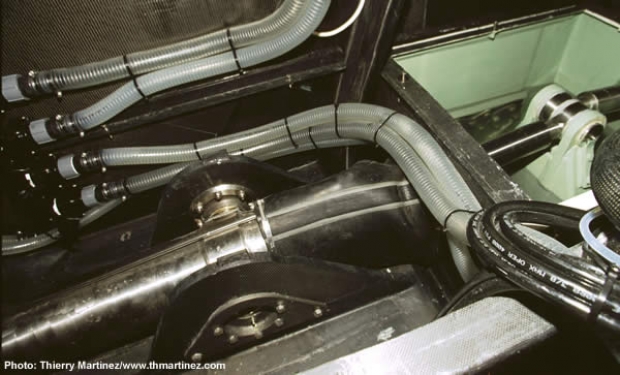
On bigger boats one or more often two hydraulic rams are attached to the top of the keel foil/lever arm. Robert Miller's 140ft Mari Cha IV for example has a single hydraulic ram on the starboard side of the keel. This mighty ram has a throw of 2m and is capable of delivering 200 tonnes of thrust to cant the keel and its 10 tonne bulb by +/-40°. However it is more common to have twin rams, usually with one mounted either side of the keel foil, each capable of independently operating the keel should one fail. The exception we have come across is Grant Wharington's Skandia Wild Thing maxi which has two rams, both mounted on the port side, the weight countered by the batteries, etc to starboard (below).

Due to the hinge/rotation point of the keel allowing water into the boat, the keel is housed in a watertight box between two partial bulkheads. With some particularly prudent designs such as Solidaires the canting keel is mounted between two full bulkheads. Some set-ups have a small box housing just the top of the foil and the ram's rod ends, while others have one big box including the top of the foil and the rams in their entirety. On Minis, where the loads are rather smaller, the top of the keel box is often simply covered by a waterproof rubber membrane similar to the gaiter surrounding the gear lever on a car.
All-important weight
From a weight perspective having large hydraulic rams, the top of the keel, the pin and its bearings, the substantial extra structure on which to mount all these items, as well as the extra water that is allowed into the boat - all of this represents extra weight over a fixed keel arrangement. Thus designers work hard not only to remove as much weight as possible from all this gear within the bounds of safety, but also to concentrate the weight as low as possible to lower its centre of gravity. This presents the conundrum between having a long length of keel foil coming into the boat, ie a longer lever arm that requires smaller lighter hydraulic rams to drive it (albeit with a longer throw) versus having a shorter length of foil inside the boat requiring the drive of bigger rams. On big boats, most, in our experience, resort to the latter set-up and some have even gone to the extreme of having the top part of keel foil angled off to port or starboard to further lower the centre of gravity.
Fortunately the cons of this substantial amount of added weight are more than outstripped by the added righting moment produced by forcing the keel bulb up to weather. Because of this more effective placing of the keel bulb there is also the possibility of saving weight by reducing the size of the bulb. This is particularly effective in the Open 60 class where there is no minimum weight restrictions for boats. With their all-up weight around two thirds of that of a Volvo 60 or 70, their bulbs are tiny in comparison.

However the temptation for designers of canting keel boats is simply to put more weight on to the bulb - every gram added ups the stability of the boat in a most magnificent way. As a result it is likely that canting keel arrangements on for example Volvo 70s may well end up the same weight or even heavier than their fixed equivalents. With the VO70 rule allowing a 1.5 tonnes displacement window for designers and teams to play with, the trade-off between having extra righting moment through extra weight on the bulb versus the downside of this resulting in a heavier boat is one of the most interesting science projects with the new rule. So far our initial enquiries indicate there are teams aiming for both extremes.
Below the waterline
Outside of the boat the role of the bulb and keel foil are also very different to a fixed keel arrangement. Whereas with a fixed keel the foil is crucial to providing lift and preventing leeway, with a canting keel it is purely a piece of structure with which to hoist the bulb up to weather - the smaller, lighter and less draggy the foil, the better.
Creation of lift or leeway prevention on canting keel boats is usually provided by an additional foil or foils. All the Volvo 70s for example we suspect will have twin asymmetric daggerboards as is the case with a majority of Open 60s - a notable exception being PRB. Vincent Riou's Vendee Globe winner has a single daggerboard which not only can be raised and lowered but is also capable of being twisted within its box by 2-3 degrees - a somewhat crude, but simple and evidently effective solution that saves the weight of one daggerboard and case.
Another simpler alternative has been tried with success on the new Cookson 50, where there are no additional boards, but the keel foil is fitted with a trim tab. Many canting keel specialists feel that a single daggerboard fitted with a trim tab - similar to those used on the ORMA 60 trimarans and already being used on the maxi Skandia Wild Thing - might be an interesting next step, although this arrangement is prohibited under Volvo Open 70 class rules (as would PRB's), where appendages are restricted to one degree of movement.
Foil construction
An important issue and a significant factor in the recent keel losses in the Open 60 class is the construction of the keel foil. These fall into four types - carbon fibre, fabricated steel, forged steel and cast steel. Each type has its own set of pros and cons.
Carbon fibre keels are the most expensive type but their attraction is light weight over steel alternatives, thereby helping in the on-going battle to lower the centre of gravity.
The principle downside of carbon fibre foils is that their cord usually has to be larger than that of a steel foil. Designer Merfyn Owen explains why: "If we are looking at equivalent safety factors steel is very strong, very stiff - the numbers are quite large. We are using steel with what we call a yield stress - the point at which the keel will bend - of 700 megaPascals. Carbon is significantly less than that.
"Steel also has that strength in all directions - it is an isotropic material. Carbon isn’t - it is uni-directional. So not only is the carbon not as stiff, but you can’t just lay a load of carbon in the keel with its axis in the 0° direction because it will be like a bamboo stick - you just have to twist it and all the fibres will shear and it will break. So you have to put some fibres in at 45 or 60° in order to give the thing some material properties in the y and z axis, and that is not a perfect process - even when you do that it is still not an isotropic material and so there are still vagaries about the design. So people tend to over engineer carbon fins, because you can’t engineer it quite so closely and somewhere in that problem is where they got the problem with the keel fluttering [on Sill et Veolia and Bernard Stamm's Cheminées Poujoulat/Armor Lux] , because they didn’t have enough material in the off-axis direction. It is the same with carbon fibre masts - you have to put material off-axis to get a material that is stable, but all that material which is off-axis is giving you thickness and weight you don’t want."
There are further downsides of making keel foils out of carbon fibre maintains Owen: if there is a weight saving in the keel foil, then to keep stability the same, the bulb must be bigger and therefore its drag increases. Then there is the technical challenge of how to incorporate the giant pin into the carbon foil - usually this is done by posting the pin through a steel sleeve within the foil - and the attachment for the rams. Designers Groupe Finot for example achieve the latter by putting a substantial steel cap including the appropriate fittings around the top of the foil. Having these large steel items high up the foil tends to negate part of the advantage of making the foil in carbon fibre in the first place.
Saying all this, with Sill and Bonduelle designer Marc Lombard claimed prior to their launch that he had come up with a way of making their carbon foils as slender as steel foils. And it should be remembered that despite their potential downsides, carbon foils have gone around the world successfully in the Vendee Globe on Bonduelle, Dominique Wavre's Temenos and twice on Team Group 4/ Hellomoto.
Fabricated steel foils
A more popular choice for keel foils are ones made from fabricated steel. These comprise some form of central beam, for example a box section, around which plates of rolled high tensile steel are welded. In the case of their Open 60s Merfyn Owen says the plates are constructed in two halves which are then welded to a box beam, with both the plates and the beam being load bearing. Pivot bosses and the ram attachment points are then welded on.
The advantage of fabricated keels is that they are still relatively lightweight, cheap and are relatively quick to manufacture. Their downside is that they have a finite life and the length of this is hard to determine as the two keel failures on Ecover and Skandia during the last Vendee Globe bear testament.

"It is true to say that if you believe the manufacturers’ data on the steel and the theoretical weld life values, keels shouldn’t have a fatigue life," says Owen. "We don’t design them to have a fatigue life. They are designed 50% under the fatigue life of the material, but the reality is different from the theory. What we have relied on in the past is to design these keels and to say to a customer, 'let’s call it a 60,000 mile life, it might do 75 or 80,000 (which is what Ellen’s first keel did), but let’s call it 60,000 and after that then technically it is over or keep an eye on it and just do short races not long ones.'"
Making the keel out of thicker steel might not necessary be the solution either. Increasing plate thickness requires bigger welds to join plate and requires more heat to be put into the keel, both of which can create a new set of problems.
On Kingfisher's first keel some tiny cracking was revealed by ultra-sound after 60,000 miles. As a result of this Owen says they made their keels 20% stronger by increasing the overall dimensions of the keel rather than upping plate thickness.
Forged and cast keel foils
The final two types of steel keel are both solid - 'cast' where liquid steel is poured into a mould and 'forged', where solid steel is beaten into the correct shape and then machined. As Owen points out swords are traditionally forged rather than cast for good reason, but this is to do with slight differences in the resulting steel at a molecular level that are beyond the scope of this journalist's chemistry O-level. Under the Volvo Open 70 rule it is only these two types of keel foils that are permissible.
Following the recent spate of keel problems, forged keels seem to be widely considered the prefered option as compared to fabricated for a given strength it produces a smaller albeit heavier foil with more reliable mechanical properties. A forged keel has been fitted to Mike Golding's Ecover since the Vendee Globe. "We believe that the forged keel is a faster keel and it is nearly 0.25 tonne heavier [for an Open 60], but it is smaller in dimensions for the same given strength. With a swing keel because you can move the weight that weight is working for you and if it is in a smaller package is going to be quicker," says Owen.
The new Ecover keel foil - acquired from Derek Hatfield's Spirit of Canada campaign - has a shorter cord and is stronger than the previous fabricated keels they used. "It is relatively smaller than the fabricated fin but it is heavier. And because it is heavier you can have a smaller bulb and the whole package gets less draggy," says Owen.

Other variables when it comes to steel foils is the quality and mechanical properties of the steel being used. This is in fact similar to carbon fibre where high strength steel can be brittle and hard to work with.
Engineering canting keels
Herein lies another complication compared to fixed keels. When specing keels of either type engineers work to a worst case scenario where the keel is at 90 degrees plus some vertical acceleration - ie when the boat suffers the most exteme knock down. But when engineering a canting keel this is not so much the issue as the regular working loads explains Farr Yacht Design's wizened engineer Russell Bowler: "The basic numbers are very similar but what happens with the canting keel boats is that they are working at 60-70% of that load 90% of the time whereas a normal keel is working at maybe 30% of that load."
Now in theory provided the keel is operating well within the elastic limit or even the fatigue limit (50% of the breaking load) of the material it is manufactured in then, one would think this would not present a problem. Wrong.
"They are working so much harder that if there is any notch details or any stress rises or any problems with the manufacturing of the keel they will eventually be found. So I think that is what you are seeing and it is a lesson for us that we have to be very tidy with the work that we do on the fins for canting keel boats," warns Bowler. "You just have to take a lot more care that the structure [of the canting keel] could live with a higher level of stress and you would lower that stress. You’d satisfy yourself that this keel is going to be working at a higher percentage of it’s maximum load and then you assign a stress accordingly. That might be 80% of what you might use of the stress of a fixed keel boat."
Upkeep
As important as good manufacturing is the constant upkeep and maintenance of the canting keel. Even mild corrosion for example can seriously impair the physical properties of the metal - this is of course another advantage of corrosion-free carbon fibre keels.
To give an example there is the apocryphal engineers tale of the Hercules that fell out out of the sky because it had had a portaloo installed on it. This leaked urine over a period of time that continually dripped on to a highly loaded frame, that corroded, buckled, ultimately causing the freak downing of the aircraft.
"When you write a rule such as the Volvo Open 70 rule or the Open 60 rule with regard to keels there is information in there that tells you how to do things, but it doesn’t tell you for instance to inspect the keel as it is being manufactured or after it has been manufactured or at 16 or 20,000 miles," says Merfyn Owen. "And it doesn’t tell you how to paint or prepare the keel or how your shore team should inspect the keel or how to repair the keel if say any areas are corroded. There is no operating manual for this and it is not written into the rules. And that side of things is as important as anything else."
The real horror show starts if the keel grounds or strikes a submerged object and superficially appears to be undamaged. This is where the price differential of various types of foil construction comes into the equation.
Of the four type fabricated keel foils are the cheapest option, coming in at around half the price of a forged foil and one third the price of a carbon one, the most expensive option, with a cast keel falling between the fabricated and forged options.
"Imagine you have got your boat and you have spent £100,000 on a carbon fin and the year before the Around Alone you smack that carbon fin at 14 knots on to a rocky bottom," says Owen. "You might think twice about changing that keel. You might inspect it and it looks okay, but if you have gone over a certain value then you could have done some damage to that keel which you might not see for another 20,000 miles.
"If you run aground at 14knots with your solid forged fin then it is more likely to give you some kind of notice that it has been damaged and you would be able to inspect it with ultrasound and be fairly confident with the results. If you did it with a fabricated fin, you might just say ‘I’ll have another keel’. That decision wouldn’t be taken so lightly with a £100,000 carbon fin."
What now?
If the reasons for the carbon keel issues were perhaps engineers and designers pushing available technology too far, the issue with Skandia and Ecover, where the keels simply snapped off, remain something of a mystery as we discussed in last week's article.
Andy Hindley, Race Director of the Volvo Ocean Race wonders if the problems with the Open 60s wasn't due to the boats both getting faster and being pushed hard. "The boats are getting turboed, the sails are getting faster the boats are lighter, but has the keel kept up with that?" he asks.
The Volvo Open 70 rule itself is not without potential problems with regards to the canting keel. While there is a minimum keel bulb weight there is no maximum and as a result, teams are back with a vengance in the weight hunting game, where any excess kilos above the waterline are slapped on to the keel. This potentially includes shaving weight off critical items such as the rams and other parts of the keel canting system which can affect the safety of the vessel.
"There is such a massive advantage for pushing the weight of a Volvo 70 because the weight that you can save goes into the bulb," says ABN AMRO skipper Mike Sanderson. "It did with the Volvo 60 as well, but on that you didn’t cant the keel and everyone had exactly the same amount of water ballast. If it was a big deal and everyone went on about Assa Abloy’s bulb last time, you wait until the conversations this time about bulb weight. Because now it is canted and now it is your sole source of righting moment."
Let us hope that the Volvo teams haven't been over zealous in their weight saving in key areas and the year of the keel disasters is finally behind us.
Most Read
Most Commented
Comments
Businesses
Pro businesses
-
-
United Kingdom
-
France
-
United Kingdom
Editor's choice
Member blogs
-
 Ned Collier Wakefield: MOD70 round BarbadosWell that was intense. 12 hard fought for seconds for the win. In idyllic conditions, Tony Lawsons MOD ...
 -
 Mini Transat leg 2 reportThe second leg of the Mini Transat started on 31st October, just over a month after ...
 -
Leg 1 reportI’ve been working towards the Mini Transat now for three years. In 2013 I was part ...
Business blogs
-
 The Island Sailing Club in Cowes, Isle of Wight, is delighted that Prince Michael of Kent ...
 -
Peta Stuart-Hunt chats with the 25 year-old British solo sailor Lizzy Foreman before she sets sail ...
-
The 2015 Student Yachting World Cup (SYWoC), an ISAF-recognised event hosted and run by students for ...
Editor's Choice
All time favourites...
-
 Three legs down into Ian Walker’s
 -
 Winning all but two races at
 -
 For the first time in its
Latest Comments
Add a comment - Members log in