
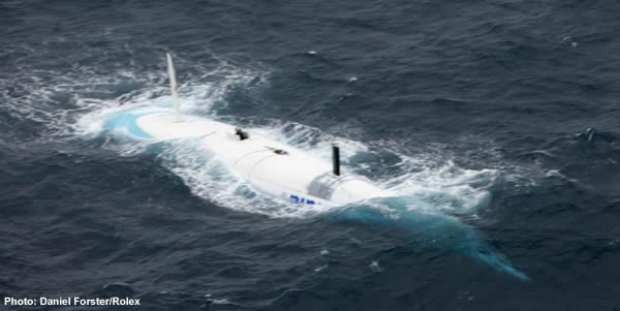
The trouble with canting keels...
Friday July 29th 2005, Author: James Boyd, Location: United Kingdom
It is now 14 years since French pioneer skipper Michel Desjoyeaux first used a canting keel on his Mini Transat boat. Following this Isabelle Autissier initiated the use of canting keels in the Open 60 class with her
Ecureuil Poitou Charentes. With this Autissier demolished the opposition on the first leg of the 1994 BOC Challenge only to have her boat destroyed and ultimately lost on the second leg - an incident that was not related to her ground breaking keel.
Since then canting keels have become more or less standard fit on Open 60s and proto Minis, but significantly the unprecidented stability benefits of being able to move several tonnes of lead up to weather have broken out of France. Canting keels were chosen by Hasso Plattner and Roy Disney for their respective maxZ86s Morning Glory and Pyewacket, and subsequently for Randall Pittman's Dubois design Genuine Risk while down under Grant Wharington went for a canting keel with his 100ft maxi Skandia, this week charging around the Solent. Going bigger still, canting keels are also being used with dramatic effect on Robert Miller's 140ft Mari-Cha IV and Frank Pong's Maiden Hong Kong.

They have also been fitted in conjunction with a forward steerable canard for some time on CBTF boats (above) that have culminated in Bob Oatley's 2003 Admiral's Cup winner and her subsequent replacement, and most recently with Neville Crichton's latest Alfa Romeo 100 footer.
But the biggest endorsement for the canting keel recently has been its adoption by the Volvo Ocean Race for their new 70 footer. Already Telefonica Movistar has established herself as the fastest monohull on the planet and part of the secret to her speed lies in the power generated by her canting appendage.
While canting keels represent a fantastic leap ahead in monohull technology, for some reason over the last year a number of boats have been experiencing problems with them. Back in their early days there was the memorable story of the canting keel on David Raison's Mini falling through the bottom of his boat shortly after the start of one Mini Transat in the 1990s. In impeccible style Raison simply undid the turnbuckles on his rig, lowered it to the deck and sailed home under jury rig, dinghy-style. This would be somewhat harder on a maxi.
In recent months we have seen the capsize of Grant Wharington's 100ft Skandia maxi during the Rolex Sydney Hobart race when sailing upwind in 35-40 knots she launched off the top of a wave breaking both the hydraulic rams used to cant the keel (read about this here). After the crew had been rescued, the keel fell out of the boat and she turned turtle (see top photo).
Meanwhile there has been the spate of canting keel trouble in the Open 60 class over the last year, for different reasons.
Following the launch of Roland Jourdain's Sill et Veolia last year, skipper Roland Jourdain expressed his concerns over excessive vibration in his yacht's keel. This proved so bad that Jourdain felt it prudent not to take the start line of The Transat. Sill et Veolia's Marc Lombard-designed sistership Bonduelle also pulled out prior to the start of that race as her keel was supposedly identical - canting and with a carbon fibre foil - and yet she had never experienced the same vibration.
The phenomenon Sill et Veolia experienced is known in the aeronautical world as 'flutter' whereby the speed of water/air passing over a foil causes a harmonic resonance to establish itself in the foil (much like the schoolboy dawdle of holding a ruler so that half of it is over the side of a desk and then pinging the free end so that it vibrates pleasingly.) However if left unchecked this resonance amplifies until it ultimately blows the foil apart. Flutter is related to the proportions and strength of a foil and is not limited ones constructed in carbon fibre.
While Sill et Veolia's carbon fibre foil was subsequently beefed up by adding extra carbon fibre unidirectionals at 45deg, the keel still only made it half way around the world in the Vendee Globe before Jourdain noticed further problems with it - "a black fluid easing out of cracks," as he described it. He was forced to retire and made it safely to Hobart. Meanwhiile Jean le Cam's Bonduelle made it around the world successfully finishing second with the exact same keel - a typically perplexing inconsistency with canting keels that has engineers, designers and boat builders still scratching their heads.

Swiss skipper Bernard Stamm was not so lucky as Jourdain. During Around Alone in 2002-3 his Open 60 had suffered a collision with an underwater object, although the impact was not bad enough to prevent him from finishing and ultimately winning the race. Over the following winter Stamm replaced his damaged steel keel foil with a new carbon one.
During The Transat last year as Stamm's Cheminées Poujoulat/Armor Lux was going full tilt in 45 knot winds, he reported that the keel was "shaking terribly". As Stamm later described it: "I tried to reduce the speed of the ship because the average was 20 knots of speed, but the movement of the keel was the same. Then the ship took a big surf at 26-27 knots and the keel started to move very quickly as if the bulb was a fish, and maybe 10 seconds after that the keel broke and the ship fell on its side." Stamm was rescued and later went out to recover his vessel which again appeared to have been the victim of flutter. Only now is Stamm's Open 60 sailing again.
More mysterious in the Vendee Globe were the keel foils simply snapping on Nick Moloney's Skandia and Mike Golding's Ecover. Fortunately in both cases the skippers were fine, both managing to keep their boats upright, Golding even managing to finish the race... The common factor to these two incidents were that both keels broke with similar hours on them and both boats were designed by Owen/Clarke Design Group (along with Rob Humphreys, Alain Gautier and SP System's Giovanni Belgrano in the case of Skandia).
"We’ve done lots of testing and analysis and we think that with 90% probability it was a fatigue failure, but why it should have occurred after that many hours we haven’t been able to come up with a satisfactory answer for," admits Neal Graham, Technical Manager of the Offshore Challenges Racing Team who is responsible for the Skandia Open 60.
The question vexing Graham is why Skandia's keel broke through fatigue with approximately 40,000 miles on the clock, when this was the replacement for the boat's first (and unbroken) keel, of similar construction and design, that had clocked up more than 70,000 miles. "That shows there were other contributing factors, but being able to pin point the contributing factors is nigh on possible," theorises Graham. "I think if you had the budget of NASA you’d still struggle." The contributing factors could range from anything between the skipper driving the boat harder or in a different way to the boat being more powerful, to a problem with the steel used in the foil's construction or the welds or a previous collision, etc.
"Everyone tends to lump all these together as canting keel failures, but apart from them all being swinging keels that’s about all they have in common and people forget that conventional keels used to fall off maxi-boats as well," says Graham citing the examples of the Whitbread maxis Drum and Martella. "So it is not confined to swing keels. A lot of people at the moment are saying 'swing keels are dangerous', but I think it is a bit early to pass sentence just yet."

So how does this legacy bode for the Volvo Open 70s, which in November will set off for the depths of the Southern Ocean their crews driving their boats harder than any canting keelers have ever been driven before?
Compared to Open 60s where the engineering of the keel, its structure and canting mechanism is left up to each team's designer and engineer, the Volvo Open 70 canting keel is on a paper a much more restricted, conservative piece of equipment.
Volvo Open 70 keel cant angle is limited to +/- 40 degrees, 10 degrees less than the maxZ86s and the construction of the foil must be solid (ie it cannot be fabricated) and carbon fibre is prohibited. Two hydraulic rams, each capable of canting the keel independently, must be fitted.
Under the VO70 rule, the keel package must also a minimum safety factor of three times "based on the yield or proof strength of permitted metals". However Volvo have gone one step further by specifying, for design purposes only, a maximum tensile yield strength of the steel being used for the foil as 390 megaPascals (MPa). It is fully expected though that the high tensile steel used in the keel foils specified by the teams will be closer to 800 MPa (although it still must be designed as if it were 390Mpa) so the foil immediately gains an additional safety factor of around two. This is the equivalent of saying that a mast can be built out of high modulus carbon fibre, but must be built as if it were specced to a lower modulus carbon. Overall it is estimated that the safety factor for a VO70 canting keel is roughly 50% higher than it is for an Open 60.
Other rules governing the VO70 keel is that the giant pin around which the keel swings can be located up to 150mm inside the hull. Maximum draft of the VO70 is limited to 4.5m so by moving the keel's rotation point 150mm up effectively places the bulb further up to weather when the keel is canted.
There are other benefits from moving the rotation point inside the hull as Race Director Andy Hindley explains: "It allows pin size to increase which gives a better bearing surface. We were concerned about that the underwater shape with the fairings you traditionally see on canting keel boats [where the pin is located on the hull}, were going to be made as small a possible because they would get the pin sizes down and down. If you allowed the pin to come inside the boat a little bit you could afford to have a bigger pin." It also gets rid of the drag-inducing fairing on the underside of the pin's bearing.
To date one Volvo Open 70 has suffered keel problems: ABN AMRO, during a delivery trip from Newport back to Europe around three months ago. On that occasion the titanium pieces attaching each hydraulic ram to the top of the keel broke as they were 250 miles into the passage. At the time they were reaching at 20 knots in 20 knots of wind.
"We were race delivering it, going full noise and we basically had a keel ram head snap on the port side," recounts skipper Mike Sanderson. "And then the attachment holding the ram on the opposite side collapsed. That was due to some misalignment due to another issue. They are each designed to take the whole load."
While the keel remained attached to the boat by its pin, with neither ram connected to the keel to restrain it, the keel was free to cant as it pleased. "The fun bit was that one of the rams was thrashing around inside the boat as well and that was pretty keen on punching its way out of the side of the boat," continues Sanderson. With full sail up the boat took on "a fair amount of heel". "As it turned out we luckily managed to bear the boat away in time so that we didn’t do any damage to the structure in terms of the keel pressing up against the keel box. We were incredibly fortunate."
The crew immediately dropped the sails, but quickly realised that the keel would stabilise more if they got some way on. They dropped a daggerboard and sailed home at times clocking 13-14 knots. Remarkably the boat remained quite stiff even with the keel hanging unrestrained. They were fortunate too with the weather in that they could run back to Newport and when later the wind came on the nose they were in flat water and able to motor sail.
Back in Newport, ABN AMRO was out of commission for seven weeks in total. This was not due to the rumoured massive amount of work that needed doing to the keel set-up than simply awaiting new parts, says designer Juan Kouyoumdjian. "We replaced the fittings on the keel that broke and at the same time we rethought and redesigned a bunch of features of the whole system which then had to be built and that took time. There were rumours that the problems were a lot bigger than what they were. I think that everything got over exaggerated because the boat didn’t sail for so long. But most of that time was already planned for refitting the boat, upgrading the boat, repainting the boat and so forth and on top of it, Moose [Mike Sanderson] and most of the crew went sailing on Mari Cha [in the Rolex Transatlantic Challenge]. So it appeared worse than it was."
ABN AMRO I's refit had been scheduled to take place in Europe once the sailing team took delivery of their second boat. Instead the refit was carried out at Newport Shipyard. Sanderson says they lost two weeks out of their schedule in total due to the breakage. They have obviously also addressed the alarming issue of why both ram end fittings broke, effectively disabling the idea of a safety back-up.
ABN AMRO was relaunched in late June and has since been delivered back to Sanxenxo, Spain without incident. As to the reasons why the fittings broke Kouyoumdjian puts his hand up. "I admit to you that it was under-speced under the normal loads that you can more or less calculate when you are designing these things, but it becomes obvious when you go out sailing and measure the dynamic loads that is it under-speced. It wasn’t that obvious when we designed it. The loads are huge and most of the peaks are dynamics peaks which makes it so difficult to predict when you are designing these things."
It should be remembered that the load case is dramatically different to an Open 60 where the boat has no minimum all-up weight and the bulb can thus afford to be substantially smaller, often weighing around 2.5 tonnes. In comparison Volvo Open 70 bulbs have a minimum weight prescribed by the rules of 4.5 tonnes and are expected to be closer to 6-7 tonnes.
"It is a grand prix event, these are grand prix boats and grand prix cars occasionally crash," philosophies Sanderson. "I didn’t see it as a massive set back for the team. I always expected to have issues and I know that we’ve all had issues among the boats that are sailing."
In the next part of this article, designer Merfyn Owen and Farr Yacht Design's Russell Bowler discuss the issues with designing canting keels
Most Read
Most Commented
Comments
Businesses

Pro businesses
-
-
Netherlands
-
United Kingdom
-
France
Editor's choice
Member blogs
-
 Ned Collier Wakefield: MOD70 round BarbadosWell that was intense. 12 hard fought for seconds for the win. In idyllic conditions, Tony Lawsons MOD ...
 -
 Mini Transat leg 2 reportThe second leg of the Mini Transat started on 31st October, just over a month after ...
 -
Leg 1 reportI’ve been working towards the Mini Transat now for three years. In 2013 I was part ...
Business blogs
-
 The Island Sailing Club in Cowes, Isle of Wight, is delighted that Prince Michael of Kent ...
 -
Peta Stuart-Hunt chats with the 25 year-old British solo sailor Lizzy Foreman before she sets sail ...
-
The 2015 Student Yachting World Cup (SYWoC), an ISAF-recognised event hosted and run by students for ...
Editor's Choice
All time favourites...
-
 Three legs down into Ian Walker’s
 -
 Winning all but two races at
 -
 For the first time in its
Latest Comments
Add a comment - Members log in