
Home grown effort
Thursday September 8th 2005, Author: James Boyd, Location: Australasia
While many might find running a Volvo Ocean Race campaign quite enough of a challenge, one cannot fail but be impressed by the stamina of Australian property developer/professional sailor Grant Wharington. Over the last months Wharington has not only been dealing with the creation of a brand new Volvo Open 70 as part of his Premier Challenge team, but has simultaneously carried out a huge repair - more of a complete rebuild - to his 98ft
Skandia maxi following her near destruction in the last Rolex Sydney-Hobart Race. As if running the two campaigns were not enough, Wharington also skippers both boats and this week for example, as the VO70 continues her sea trials down under, sees him competing at the Maxi Yacht Rolex Cup aboard
Skandia.
Of concern at present is - will the Australian VO70 make it to the start line of the Volvo Ocean Race as Wharington and his team still need to hook a title sponsor. "This will go down to the wire for sure as we are still the market for a naming rights sponsor," says Premier Challenge's Bindy Lockhart. "Time is ticking but we are still hopeful that one of our proposals will be successful. Please keep your fingers crossed for us..."
The boat itself is up and running in Australia and is unique among the VO70s for being a design by local architect and engineer Don Jones, who was also responsible for the 2003 Rolex Sydney Hobart winning Skandia maxi. As with Skandia Wharington has kept his Volvo campaign a largely home grown-affair the boat built near his base in Mornington on the outskirts of Melbourne.
Wharington enjoys the technical challenge of creating yachts and the Aussie 70 has several unique features. While the ABN AMRO 70s have twin rudders and daggerboards, the Farr boats a single rudder and twin daggerboards, the Premier Challenge 70 has twin rudders and a single board, of course with a canting keel. The single symmetric board may not work as efficiently as the twin asymmetric boards found on the other 70s - thus her windward performance is unlikely to be as good - but it is a light weight, lower drag option. It should be remembered that Vincent Riou's Vendee Globe winner PRB was a single board boat, although there was some play in her daggerboard case deliberately to allow the board to twist by a few degrees giving it some incidence to weather.

Wharington's 70 is what might be described as 'large', with a beam which he says is somewhere near the maximum allowed under the rule. The hull shape itself is also different, not as angular as the Juan K or Farr designs with a very narrow entry and more flair at the stern. This powerful hull shape should make the boat a weapon in the Southern Ocean. "If you have got unlimited sail area available to you, which basically you have, you want a big boat," maintains Wharington.
He adds that none of the new Volvo Open 70s are "narrow" - they are all in the upper half of the permissible beam limit. Having what may prove to be the beamiest 70 dictated their having twin rudders. "You only have to look at the Farr boats sailing upwind and the top of the rudder is out of the after," he says.
Building and campaigning the Skandia maxi was always part of Wharington's plan for his Volvo Ocean Race entry, gaining his team experience of sailing a canting yacht, although the 70 will not have the luxury of powered winches. "Well, I guess it'll keep us warm having to use pedestals," quips the skipper.
In the development of their 70, they of course ran VPPs but had the benefit of using their 98ft maxi as a performance benchmark. "We are very very impressed with the performance of the boat," Wharington says. "There is only one area where it is faster than Skandia - as you would expect it is around 130-150 TWA over 30 knots of true wind speed when it is just marginally faster. But that is all displacement driven. Generally the big boat kills it, but for a boat that is 70ft long it is very very impressive, no doubt about it."
The cockpit layout of the Aussie 70 appears to be fairly standard with twin wheels, twin coffee grinders and a separate island in the middle for the mainsheet winch. However the cabin top is distinctly different from the other boats. Cabin top parameters are well defined in the VO70 rule and on the other boats the result appears very similar to those we have seen on Volvo boats all the way back to Rothmans. While most of the 70s have a large sliding hatch over the companionway, the Aussie cabintop is effectively an enlarged version of what one finds on an Open 60, with a vertical door in the cockpit bulkhead. "It gives us much more protection around the hatch," says Wharington, although there will be a windage penalty for this.

Down below Wharington says that they are using the same hydraulic cylinders on the 70 as they have on the maxi, although this assumes he is talking about the larger variety (Wharington maintains that the keel rams broke on Skandia during the Rolex Sydney Hobart as they were supplied under spec). "It is nice to have the same engineering and the same components, because I think every boat so far has had keel problems of some sort," he warns. "There have been trunnions shearing off, hydraulic rams, universal joints on the end of cylinders and all sorts of things, but fortunately not us at this stage. Guys have been trying to build carbon fibre hydraulic cylinders and they are having failures with those. That is the biggest concern so far and I think they should be talking about it more.
"When we had our problem with our keel we spoke to Russell Bowler from the Farr Office and we were 100% open with him. This is our design philosophy, this is how it was made and I would have thought it would be more sportsmanlike for everyone to have that knowledge, because it is bloody dangerous and I think everybody should have a clear understanding of what can go wrong with these keels, because it is still new technology."
As with the other 70s the pivot point of the canting keel have been retracted inside the hull (as permitted under the VO70 rules) as with the maximum draft limit this effectively extends the arc of the canting keel, positioning the bulb further up to weather.
In terms of the VO70 rule Wharington says that he doesn't agree with the maximum weight limit. "There is this drive to take every gram out of the structure so that you can put it into the bulb - but if you didn’t have a maximum weight, well you’d probably just say 'we’re happy with that bit of structure, we’d leave that strong and we’ll just make the bulb a bit bigger'. The boats might end up a bit heavier but that might not be slower anyway."
This doesn't leave too much to the imagination as to where Premier Challenge is in 12.5-14 tonnes weight limit allowed under the VO70 rule. "I think people will be trying to hit maximum displacement," says Wharington. "Bulb weight equals righting moment, so it is all out there."

Whether it is better to have a very powerful heavy stiff boat or a lighter boat that will plane earlier is one of the intriguing design quandries of the VO70 rule. "It doesn’t make sense to be in the middle of the box," continues Wharington "Once you have designed your boat at minimum [displacement] you can’t turn it into a maximum because your hydraulics won’t be strong enough and neither will your structure or your fin. I think everyone is pretty locked in by now, unless the ABN guys have built one at each end and they sail it against each other and find out which is faster and give one to the A team and one to the kids."
Above decks the Premier Challenge 70 rig has four spreaders and jumpers as a majroity of boats are using. Wharington has his views about the VO70 sail inventory: "They have got huge sail capability, but I think the rule makers were trying to outlaw Code Zeros, which they haven’t. The rules don’t prevent you from having a masthead genoa, all they do is say you can’t furl it. So you can build a jib and call it a masthead spinnaker, because there are no girth restrictions and it can be 500sqm. That would of course be sheeted 20ft out of the back of the boat. So actually in reality you could build a sail that would go from the end of the bowsprit, to the back of the boat and to the top of the mast. Of course how you get it down I have got no idea, but if you could find a way of snuffing a sail like that you could make one."
While furlers are banned from big masthead sails like this, they can be used on the fractionals and if there is one boat on which we are most likely to see them it is the Premier Challenge boat (Wharington after all does have electric winches on his maxi). "I’m not sure we’ll be using a twin groove or anything like that. We might just be using hanks and furlers. I think a lot of the other teams will be realising now that that will be the way forward. You can’t do it with the guys and you cannot afford to lose a sail, because the sail restrictions are so tight - which I think is good. If you lose a sail it is one out of your inventory and so it makes people build stronger sails.
"You are allowed a maximum of three mainsails, but if we can do the whole race with two mainsails it gives us another VMG spinnaker that might be more important. We are very comfortable." The full Premier Challenge wardrobe is being made by Doyles in Sydney.
Aside from Wharington, the Premier Challenge crew is being spearheaded by ex-News Corp man Barney Walker and includes Will Oxley as navigator and the likes of Graham Taylor, Andrew Henderson, Ben Jones and Adam Hawkins. Australian Laser Olympic sailor Michael Blackburn was trialling for the VO70 during the Rolex Fastnet Race.
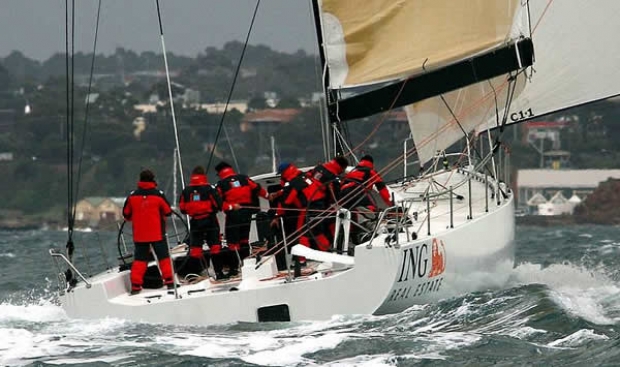
We hope that the Premier Challenge are able to get the necessary backing to supplement their present sponsors ING Real Estate and the Government of Victoria, but the clock is ticking. The crucial moment will be when they have to put their boat on a ship to get it to Europe. Any corporate readers interested should send an email here.
Most Read
Most Commented
Comments
Businesses

Pro businesses
-
France
-
Italy
-
United Kingdom
-
United Kingdom
Editor's choice
Member blogs
-
 Ned Collier Wakefield: MOD70 round BarbadosWell that was intense. 12 hard fought for seconds for the win. In idyllic conditions, Tony Lawsons MOD ...
-
 Mini Transat leg 2 reportThe second leg of the Mini Transat started on 31st October, just over a month after ...
-
Leg 1 reportI’ve been working towards the Mini Transat now for three years. In 2013 I was part ...
Business blogs
-
 The Island Sailing Club in Cowes, Isle of Wight, is delighted that Prince Michael of Kent ...
-
Peta Stuart-Hunt chats with the 25 year-old British solo sailor Lizzy Foreman before she sets sail ...
-
The 2015 Student Yachting World Cup (SYWoC), an ISAF-recognised event hosted and run by students for ...
Editor's Choice
All time favourites...
-
 Three legs down into Ian Walker’s
-
 Winning all but two races at
-
 For the first time in its
Latest Comments
Add a comment - Members log in