
The navigator's role
Thursday December 29th 2005, Author: James Boyd, Location: United Kingdom
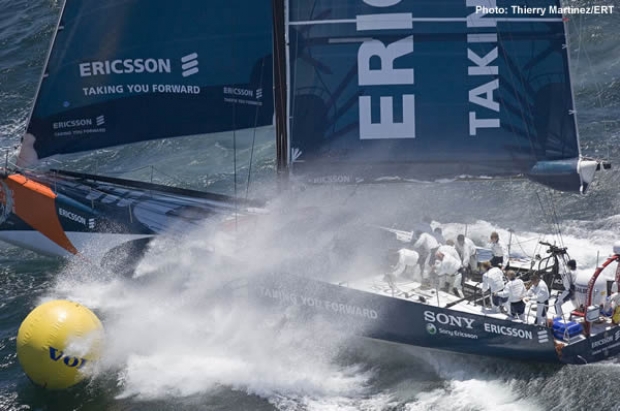
With two in-port races and one offshore leg of the Volvo Ocean Race done and dusted it might be tempting to think we are getting a picture of the form guide in the latest round the world race. But then we may been tentatively thinking this too back in Sanxenxo when in light conditions Neal McDonald's
Ericsson showed a clean pair of heels to the rest of fleet. Since then McDonald's team posted a useful second place at the scoring waypoint at Fernando de Noronha during leg one but had dropped to fourth place by the finish in Cape Town. On Monday more gear failure caused the team to post a disappointing sixth out of seven boats in the breezy conditions of the in-port race, in the process dropping them from second to fourth overall, although just one point separates them from second.
Among McDonald's posse of veterans on board Ericsson is navigator Steve Hayles, competing in his fourth round the world race.
"It was pretty frustrating," says Hayles of the first leg. "There are some fairly obvious reasons to us why that was. The keel was the last bit, but before that, it is easy to hide behind sails, but that really was the case." VO70s are allowed four spinnakers including a maximum of two mastheads. On Ericsson they carried two mastheads and two fractionals and it was one of the fractionals that they impressively wound round their appendages on the first night at sea following a broach in 40 knots during the first night.

"Neal has described it as a school boy error," says Hayles. "We popped it [the fractional kite] the first night and broached in a big gust and laid the boat down which in itself should be fine, but unfortunately the halyard or some part of the mechanism which holds the thing up broke and we ended up sailing over it and wrapping it around the keel and you’ve seen the rudder [above]. That happened in the same incident so the sheets were around that. So the boat has had a bit of beating all round. Obviously the rudder wasn’t a good thing. And almost the biggest problem was the loss. We were head to wind for an hour that night while everyone else was making 25 knots." Aside from having to play catch up in the short term one wonders how much time Ericsson lost through sailing with a piece of rope through their rudder for almost the entire leg.
Lacking this fractional chute would cost them once they were down into the South Atlantic, racing the front after they had made the turn to Cape Town. "When we were south of the Brazilians we got to the top end of our masthead sail and we were using the same sail we had up at the start, in approaching 30 knots of wind and basically it would have been another trashed sail had we kept going," says Hayles.
Their competition in the first leg ultimately came to an end when their canting keel chose to release itself. Despite Richard Mason lashing up a repair, they were forced to limp into port.
The long trawl south to get around the St Helena high highlighted some speed issues, no more so than when ABN AMRO Two zoomed past them. "They came from 15 miles directly behind us, sailed straight up to us, tried to roll us to weather and the wind went just light enough so that we held them off for two hours. Then they bore away and went straight through to leeward and disappeared over the horizon in front of us - which is hard. I know they are happy with their tactical prowess in that situation but if the tactics are going a lot quicker it’s good tactics!"

On the positive side of the equation the team made up good ground in the north Atlantic, tackled the Doldrums well and stole a march on ABN AMRO Two and Brasil 1 by crossing the equator furthest east putting them on a faster angle into Fernando de Noronha. They also feel that merely having competed the first leg puts them at an advantage over movistar and the Pirates who didn't. "We’ve doubled the number of miles that we sailed in the boat and it’s the first time we have competed against anyone," says Hayles. "So it was a massive learning curve. We approached it very much as a sort of opportunity to go two boat testing even though you don’t get to talk to the other guys. We ran 100s of tests and got loads of good data. It’s highlighted some areas that we need to not radically change, but to shuffle our sail program. Given where we were at relative to the other guys, it could have been a lot more painful. It teaches you how important [avoiding] breakdowns are."
With ABN AMRO One and ABN AMRO Two scoring a first and second on leg one, Mike Sanderson's team following this up with a win in Monday's in port racing in Cape Town, some clear form is now becoming evident in the Volvo Ocean Race but with five and a half months of racing left to go there is still much time left for this situation to change. "I think both their boats are quick if you sit back and look at the numbers," says Hayles of the two boat Dutch team. "If you look at their big runs 'the kids' [ ABN AMRO Two] were within 3 or 4 miles of them [ ABN AMRO One], but then we weren’t in the same piece of ocean sailing at 100%. I have no doubts that we are stronger in some areas and they are stronger in others.
"In some respects although they [ABN AMRO] will make progress, they cannot make as much progress as we are going to make. Very honestly I wouldn’t be surprised to see them continuing to be extremely competitive in the next two or three legs, but then I think a lot of things happen: the style of the racing will go against them, it will become a lot more compact and we’ll see a lot more VMG-type sailing and coastal racing and those things start to work against them a little bit. They are different enough in their performance envelope that when we do start to see some serious light air they could be last and second last just as easily they were first and second. It is going to be hard to know. But I am delighted about this - hats off and all credit to Moose [Mike Sanderson] and Juan K and the guys who put their sail program together. This is a very positive thing for the race and very interesting. Equally they have had more time, and more resources and more sails and more testing and two boats and they’ve broken more things and they should be very strong and they have done a good job. There is no doubt that is exactly where they should be."
Hayles makes the interesting point that if on leg one they'd encountered the same conditions they'd had in the race four years ago when they spent the best part of a week sailing through the South Atlantic downwind in six knots, the outcome might have been a very different one.
The VO70 navigator's role
Over the years the navigator's role in the fully crewed round the world race has changed immeasurably. Aside from the navigator's duties, on a Volvo Open 70 because of the shortage of crew, the navigator is an integral part of the sailing team and is obliged to spend a lot of time on deck particularly during manoeuvres.
Hayles says that since his first Whitbread on Dolphin & Youth in 1993 the playing field among navigators has levelled. "There’s probably 20 or 30 top class navigators who have done this race and studied it a lot and as the knowledge gets better so the knowledge gets shared."
Hayles cites the example of round the world race legend Mike Quilter who sailed on the maxi winners Steinlager II in 1989 and then on New Zealand Endeavour four years later, who he worked with at Team Tyco four years ago and who is now with Team ABN AMRO. "I don’t think there are great secrets anymore. When you did this race in the late 1980s I don’t think people knew within 60 degrees of where to go when they left Finisterre - literally. Weather routing packages and software and GRIB files have been around for a long time, but they do get more refined and shifts the job towards the fine detail."
The biggest change this time for navigators has been over the supply of weather information. In the race four years ago before each leg every team would provide the race organisers with a list of websites they wished to view during the leg. These lists would then be compiled into a master list supplied to all the boats, any website on this list being permissible for any team to access while racing. Researching these sites both before the start and subsequently accessing them from on board during the race wasted a huge amount of time, not to mention costing the earth in satcoms bills. To sidestep this the organisers have wisely employed Chris Bedford, who worked with illbruck Challenge four years ago to supply the same weather package to all the boats once every six hours during racing.
"In the last race, I would say about 30% of the time I put in was in simply finding where I was going to get the data from and how we were going to get in effectively from which websites at which times. It took a huge amount of time to get all that sorted and now that has gone. And the weather package they send us is very complete and very well thought out and Chris Bedford has done a great job and all credit to them it arrived on time every time without any issues."
On board Hayles says this has also changed the way he works, now spending roughly an hour trawling through the latest forecast data and then...waiting five hours for the next batch to arrive. "In all the races I’ve done to date there was always something you could do, somewhere you could go and look. In the last race you’d just go straight back on line and start looking for different bits and pieces."
So is the new system better? "It is different. It is more of a level playing field. You have to think harder about how to get more out of this data."
One comment has been that teams are only being supplied with five day forecasts which makes it hard to determine long term strategy. But Hayles thinks five day forecasts are perfectly adequate. "I personally wouldn’t want it changed, because I think the more you hand it to people the less opportunity there is to do a better job in your planning. I like to feel this is something the team does on its own. If you take it on and say it is a 10 or a 15 day forecast, then why not take it on a stage further and say we’ll do all your pre-race preparation and here is your chart pack and here is the software, etc? There comes a point where you literally do become a button presser which I don’t think we are at the moment."
For similar reasons he is also not in favour of shoreside routing as practised in some of the French offshore races and record attempts - not until he is at least 40 that is! "I reckon one more race for me and it would be perfect... I have pretty strong views on routing and it is not the team’s view: I wouldn’t want someone routing me. If this race had weather routing I wouldn’t be navigating in it. But it depends who you work with. There is meteorological support for the navigator on the boat who is actually still making decision about what is going on and then there are people telling you to go to this waypoint - very strong routing. The data we get delivered to the boats - I think it is part of the job to make sure you can go through that simply and efficiently and store it away and go back through it. For me it is not just about navigating, it is the fact that when you leave the dock, you leave the dock and that’s it, you’re out there and if you computers fail - tough, if you can’t get the weather - tough."
He also sees it as the thin end of the wedge. "And I know often it does stop at the weather routing. But for me I don’t know where the line is. Why not get some trimmers phoning us up and looking at the [on board] video cameras and telling us what to do and let’s get all sorts of people sat in the shore crew?"
Navigating the new VO70 is also providing a new set of challenges. Firstly the boat is not a Volvo Ocean 60. "After three races I felt very comfortable in the 60 - you’d have a good feel for things, you’d know how long you’d stay on the front of weather systems and you’d know how quickly fronts came through you and about the potential losses: Say you do the classic dig south, how far you were going, what you could afford to lose and when you were going to get it back. Although the computers do a good job with that your own feeling is very strong. And in these boats we don’t know that yet."

Having a substantially smaller sail inventory for this race has also made life much harder and one wonders if Volvo haven't cranked down too much on this. "This time we almost don’t have enough sails to completely cover all the angles we want to sail and how do you deal with that in your weather routing either pre-race or on the boat? The software isn’t quite smart enough to work that out. The last race you might not have the perfect sail, but you’d get within a few degrees of it. This time sometimes there can be a 10 or 15 degree area where you simply can’t go. And maybe the other people are the same, but there will be times when some are weak and some are strong."
Relative wind strength is also paramount. "It is no secret that when you get to the right place in the ocean for a period of time and you get more wind than someone the differences are enormous. There are parts of the VPPs of these boats where if you are sailing along in a certain condition and you get one knot more wind -and that is all that happens -you can go two knots faster. That can be brutal."
Then there is the aspect that the new 70s are a quantum leap faster so, as Hayles puts it, you have to change the scale of how you race. 500 miles away might only be a day on the water whereas in the last race 400 miles was fairly exceptional. With many insiders saying that a Volvo Open 70 covering 600 miles in a day is a case of 'when, not if', the boats are now achieving close to maxi-multihull speeds. In the Southern Ocean this is significant as it means the boats are approaching the speeds weather systems move at. Thus there is greater possibility of playing the weather rather than it playing you, navigators almost able to choose their isobar of choice.
"The danger with that is, and it almost happened on the first leg, it becomes all about one weather system or a front or a low pressure system," says Hayles. "When we left Fernando de Noronha we could already see over Brazil a cold front which actually didn’t come through us until two days before we got in. So you are watching it the whole time and your speed in relation to it becomes incredibly important and your angle. If someone hangs on to the front of one of those systems and someone else gets dropped off the back you will see hundreds or thousands of miles between boats. And the problem is that when you look at them numerically or look at them in the routing, they are bordering on chaotic. A fraction of a percentage difference in wind speed or boat speed will determine whether you stay on the front or don’t stay on the front of these things. So there will be some relatively high risk strategies I think at times."
Added to this in the Southern Ocean is that boats will mostly be gybing between northwesterly and southwesterlies according to where they are on a weather system. "Everyone will know that there is a shift coming and we will gybe, but you only have to disagree by a few hours... On this first leg we gybed around a relatively static system so it doesn’t make that much difference and we all disagreed slightly about where that gybe point was, but the system wasn’t moving so it didn’t make too much difference. When you get these systems coming through the fleet at pace, if we split when we are running downwind in 30 knots of wind we are separating north and south by 18-19 knots, so it doesn’t take too many hours at that speed to have hundreds of miles of north and south separation on this next leg and then you are rolling the dice a little bit."
Tomorrow in the second part of this article Steve Hayles tells us about how the tools of his trade have changed

Most Read
Most Commented
Comments
Businesses
Pro businesses
-
United Kingdom
-
-
United Kingdom
-
United Kingdom
Editor's choice
Member blogs
-
 Ned Collier Wakefield: MOD70 round BarbadosWell that was intense. 12 hard fought for seconds for the win. In idyllic conditions, Tony Lawsons MOD ...
 -
 Mini Transat leg 2 reportThe second leg of the Mini Transat started on 31st October, just over a month after ...
 -
Leg 1 reportI’ve been working towards the Mini Transat now for three years. In 2013 I was part ...
Business blogs
-
 The Island Sailing Club in Cowes, Isle of Wight, is delighted that Prince Michael of Kent ...
 -
Peta Stuart-Hunt chats with the 25 year-old British solo sailor Lizzy Foreman before she sets sail ...
-
The 2015 Student Yachting World Cup (SYWoC), an ISAF-recognised event hosted and run by students for ...
Editor's Choice
All time favourites...
-
 Three legs down into Ian Walker’s
 -
 Winning all but two races at
 -
 For the first time in its
Latest Comments
Add a comment - Members log in