
It's a Pirates life for Jules
Wednesday November 2nd 2005, Author: James Boyd, Location: United Kingdom
With Steve Hayles on
Ericsson, Simon Fisher on
ABN AMRO II, the half Brit/half Aussie Andrew Cape on
Movistar and Jules Salter on the
Black Pearl, British navigators seem to be in the majority for this year's Volvo Ocean Race.
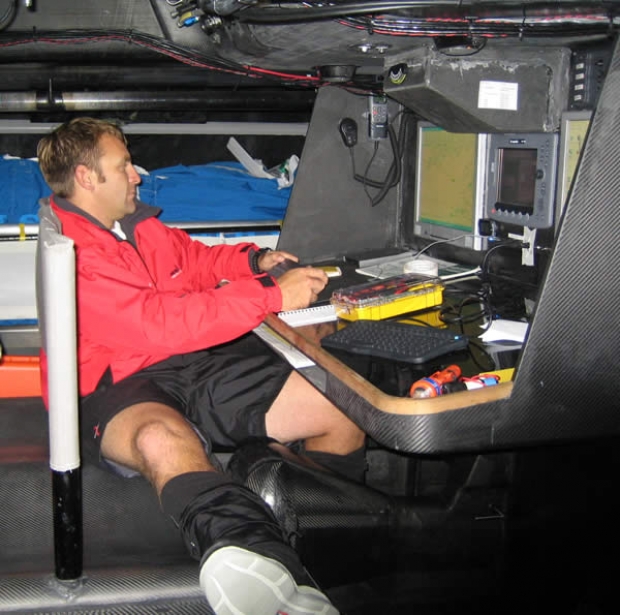
Among these names perhaps the most unexpected appointment was Paul Cayard's choice of former GBR Challenge navigator Jules Salter to his team over one of his regular Californian cronies. Although following his time with Peter Harrison's now defunct America's Cup campaign, Salter is best known as an inshore navigator, he has sailed extensively offshore in this capacity in most of the 'classic' offshore races such as the Sydney-Hobart and Fastnet and he crossed the Atlantic this year in the Rolex Transatlantic Race on board Mike Slade's maxi Leopard. Despite nearly going round the world on the Oryx Quest - something in retrospect he doesn't regret missing out on - the Volvo will be his first round the world race.
Salter says that he nearly sailed on board Team News Corp in the last race, but this coincided with him getting the call-up from GBR Challenge. "It’s always something I’ve wanted to do since I was a kid and this opportunity came along and it was too good to turn down," he says of the Volvo Ocean Race and his appointment to Pirates of the Caribbean team. "I was thinking about doing the Cup again, but with this the boats are awesome and it is pretty exciting. I have done most of the other offshore races in the World now, so this is the last one to have a go at. This side of the sport [offshore racing] has always interested me - I love sailing offshore."
With this Volvo Ocean Race he would have liked to have had more notice before taking on this role, but due to the lateness of almost all the teams, this was never going to come to pass. "In my ideal dream world of being a navigator in the Volvo Ocean Race, I’d have a year to prepare and do a couple of little research things and ease myself into it. But equally it is good to just jump in and see what happens. So far so good. I started on 1 June and it has been full on every day I have been something related to the race."
Two ingredients which helped swing his signing with the Pirates was the prospect of racing the sailing community's hot new weapon - the Volvo Open 70 - and the opportunity to sail this beast around the world from one of our sport's most eminent yachtsmen - Paul Cayard. "It has been really good to have a chance to sail with an experienced, great team. There is no better place I could have joined in with it."
In terms of moving the navigator's role from America's Cup to Volvo Ocean Race, from inshore to offfshore, Salter says that most of the tools remain the same and ultimately it is still a yacht race with just the same high level intensity as a top round the cans or coastal race, just the duration is considerably longer.
One of the significant differencies between inshore and offshore racing is the strategic use of the weather. With inshore racing it is about spotting shifts and short term trends. While this is also true of the Volvo Ocean Race, navigators must also attempt to analyse and make best use of the available weather on a bigger scale. This is particularly true the faster your boat and with the Volvo Ocean 70 attaining near multihull speeds there is much more opportunity this time around for navigator's to play the weather rather than the weather play them. For example if a Southern Ocean depression moves at 20-25 knots - the same speed as your boat - then it is possible to position your boat in the optimum part of this system to get the most favourable wind and sea conditions to suit your boat's polars. While in the Volvo Ocean Race this is complicated by stopovers, in maxi-multihull non-stop around the world record attempts boats have been known to ride just two systems through the length of the Southern Ocean between the Cape of Good Hope and the Horn.

"You have got to look a long way ahead, because these boats do cover massive distances very quickly," says Salter. "You can be a lot more aggressive with your angles. You can get a lot of leverage very quickly which is scary sometimes if people spear off in different directions or if everyone has got different sails that take them to different places. So the right way might be three different ways depending upon what sails people have taken and what their boats perform like."
It is thought that in this first Volvo Ocean Race with the new 70 footers and their new sail inventories, teams will have widely varying sail inventories, in contrast to those used on the 60s used last time, when sails used were much more refined, the boats much closer to being one design. This will be one reason why boats will end up on different parts of the race course and the leaders will find covering those behind exceedingly difficult.
A significant change this time around with the Volvo Ocean Race is that the organisers have reverted to the old system of providing the same forecast to all crews. Four years ago navigators would spend umpteen hours and tens and often hundreds of thousands of dollars in satcom call time downloading forecasts directly to their boats via the internet.
This time round Volvo have employed expert marine meteorologist Chris Bedford (who worked with illbruck exclusively four years ago) to conjure up the forecasts. These will be sent out to the boats every six hours. The standard package of met data is likely to include GRIB files of the standard weather models (that can be directly pulled into nav programs like MaxSea, Deckman and Expedition), satellite images and local high resolution forecasts the closer the boats get to port.
In addition to the standard package, navigators are allowed to access 'publicly available' weather services such as radio broadcasts, weatherfax and the downloading of weather images direct from satellites. However Salter views these tools as primarily being used as a back-up. "You are going to hope that your satcoms are working so you are always going to get the Volvo package on time every time. But if you were to miss out on that you might find you can get some back-up through weather fax. The satellite stuff - the pictures from whatever satellite is over your head is obviously really important and you can and are allowed to grab those."
With little time to prepare for the Volvo Ocean Race Salter has been having to call in additional support. The team have employed French routing guru Jean-Yves Bernot to assist them and Salter has spent around two weeks with Bernot analysing the first leg to Cape Town and developing his offshore navigation and meteorological skills. Former Whitbread and Vendee Globe sailor Nick Moloney has also been employed by the team as a back-up navigator.

Since the Black Pearl was launched on 12 September Salter has not simply been mulling over which is the best way to get to South Africa. The Volvo Open 70 is a new beast and while designers produce VPPs for the boats, these need refining once boats are launched. And then there is the lengthy process of establishing polars for different sails and sail combinations and working out crossovers, the wind strengths and angles when sail changes need to take place. "The sail guys on this boat are a strong group so I am there to collect the database at the end and helping to manage some of that. I did a bit of that at GBR. It’s nothing technical, more secretarial."
As has been mentioned at length before, the VO70s are larger more powerful boats than their predecessors and have only 10 crew rather than the 13 that manned the VO60s. With little gear on board to make sail handling easier, the boats are effectively being sailed shorthanded. As a result Salter expects that he will be spending less time than he might normally down below at the chart table number crunching and analysing at options and will be having to contribute more on deck.
In this age of waterproof tablet PCs and wireless networks on board boats there is in theory little reason why Salter shouldn't carry out part of his job on deck. However this will depend greatly upon the conditions. "With these boats there is about two foot of water across the deck most of the time, so that might be a bit tricky..."
While all the crew 'have a job to do' there is no hiding the fact that physically surviving on a Volvo Open 70 particularly when conditions are anything more than moderate will be challenging itself. "The boat is pretty grunty and physical - it is the loudest and most violent boat I have sailed on," says Salter. "But it is interesting. It is kind of like trying to do my law finals again and train for a marathon at the same - just the physical and mental challenge of keeping it together at sea while you are bouncing around."
Compared to the Kevlar 60s, the Volvo Open 70s are all carbon fibre with PBO rigging and 3DL sails and in any sort of seaway being down below is like being inside a large drum. On the Pearl they have been finding it has been getting exceedingly wet down below and on the job list, as the boat has been out of the water recently, has been hunting down and fixing the leaks.
The stress Volvo crews will experience this time will be similar to that which multihull sailors experience sailing offshore shorthanded. "I’m sure it will be pretty scary," says Salter. "I think the most intimidating thing maybe is the stress you might put yourself under day after day in heavy conditions. It is not as bad for me because I am not on deck as much as the other guys, but even down below it is so loud."
Most Read
Most Commented
Comments
Businesses
Pro businesses
-
Italy
-
France
-
United Kingdom
-
Italy
Editor's choice
Member blogs
-
 Ned Collier Wakefield: MOD70 round BarbadosWell that was intense. 12 hard fought for seconds for the win. In idyllic conditions, Tony Lawsons MOD ...
 -
 Mini Transat leg 2 reportThe second leg of the Mini Transat started on 31st October, just over a month after ...
 -
Leg 1 reportI’ve been working towards the Mini Transat now for three years. In 2013 I was part ...
Business blogs
-
 The Island Sailing Club in Cowes, Isle of Wight, is delighted that Prince Michael of Kent ...
 -
Peta Stuart-Hunt chats with the 25 year-old British solo sailor Lizzy Foreman before she sets sail ...
-
The 2015 Student Yachting World Cup (SYWoC), an ISAF-recognised event hosted and run by students for ...
Editor's Choice
All time favourites...
-
 Three legs down into Ian Walker’s
 -
 Winning all but two races at
 -
 For the first time in its
Latest Comments
Add a comment - Members log in