
Third time not so lucky
Tuesday August 23rd 2005, Author: James Boyd, Location: France
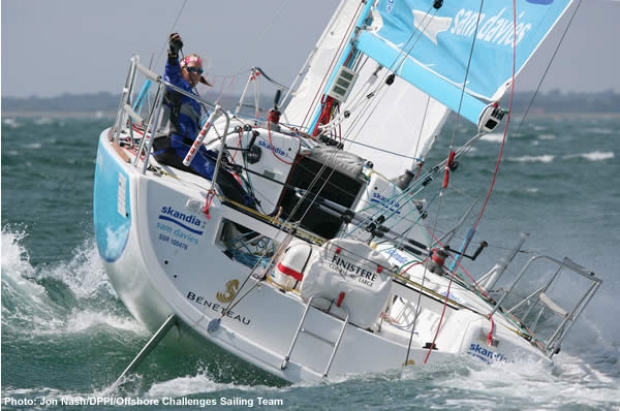
Sam Davies' third attempt on the Solitaire Affelou Le Figaro got off to a bad start. Having put in promising results throughout the year, soon after the start of the first leg of this year's race she was run on to the rocks by German competitor Jorg Riechers severely damaging
Skandia, her 33ft one design Figaro Beneteau 2. Fortunately she was able to continue, but not fully cocked.
"It was really bad and I didn’t deal with it very well either," Sam admits. "It stressed me out, so I sailed the [first] leg really badly. I was worried about the boat, so I changed down early, I didn’t put the spinnaker up as early as I normally would, because I could see it all moving around the keel."
The damage to Skandia was severe and structural: the collision had popped all the ring frames as well as the main and cockpit bulkheads. In short every structural bulkhead around the keel had come away from the hull... In a fleet of 45, Sam finished a disappointing 26th.
When Sam reached Bilbao Getxo at the end of the first leg, Skandia was whisked out of the water so that her shore crew Erwan Le Meilleur and Rob Dutton, who'd been sent down to Spain by Offshore Challenges, could set about the repairwork as well as fixing the dent in the bulb.
"Rob sacrificed doing a delivery on the Open 60 coming back from the Fastnet Race and a couple of days holiday. It was really kind of him to do that," says Sam, adding equal praise to her young French shorecrew. "It was only a temporary repair. They just laminated over the top of everything to stick it all down to hold it stiff. It will all have to be ground out and relaminated this winter. At the moment it is a bit ugly, but it's efficient and I’m sure it was stronger than it was before."

Sam with her shore crew Erwan Le Meilleur
Repairwork to a one design Figaro usually has to be carried out to class rules, but in order to finish the repair in time for the start of the second leg, Sam was able to get a special dispensation from the Race Committee. Even so, Dutton and Le Meilleur had to work round the clock to get the boat fixed in time.
Bilbao Getxo proved a highly stressful time for Sam. "There were loads of little things I wanted to tinker with during the stopover and basically I was forbidden from stepping on board because of the repairs that went on until 6pm the night before the restart. So I didn’t handle that very well either. I always think of situations that happen on the race course that are under your control. I’ve not really had anything happen to me that’s beyond my control like that - and it’s not very nice. On the sea I am cool and calm and never get stressed at all. But it was horrible. I never want that to happen again. It was stupid. I was something I completely omitted to think about during all the preparation, learning and training and everything."
And even during leg two with her boat fixed the cloud was still hanging over Sam, for the jury were not going to hear her case until the end of the second leg in La Rochelle. "I had the worry of that for the whole of the second leg. Even though you try and shut it out of your mind it is still there in the back. But once it was over in La Rochelle when the protest finished, I was completely different and I couldn’t wait to go sailing. And I knew it was going to be upwind [on leg three] and I liked the sound of that." Strange girl.
In La Rochelle the jury found in Sam's favour, Reichers was disqualified from the leg, but Sam was only compensated five minutes. "Everyone is really careful of me at the leeward marks now because it is the second time this year that I’ve disqualified someone in a race for shutting me out at the leeward mark. I got Fred Duthil disqualified in the Generali [Solo - singlehanded raced in the Med]. He got third in the race but he chucked me out at the leeward mark and I hit the mark and had to do a turn and I was really cross and he didn’t say sorry afterwards, so he got disqualified. Now they are more careful at the mark with me!"
Fortunately in the leg three, the tide turned in Sam's favour when she posted a 10th place into Crosshaven. The leg was mainly choppy and upwind, weather that Skandia and her skipper seemed to enjoy. "I was fine. I was happy on my boat. I think because I have spent so much time sailing, doing all the races, it was just another leg and when you hear people moaning it makes it all the better - that’s good because you know they won’t be sailing so well any more."
Big breeze is also forecast for the final leg back to France. Yesterday the course was shortened due to 45-50 knot winds expected had they gone out to the Fastnet Rock. Instead Sam says they can still expect 35 on the new direct route south. "I’ve been out in 60 knot gusts and a continuous 45, on a delivery trip in the English Channel in February. You have the Solent and two reefs in the main and it’s fine. Tacking is a bit difficult, but it’s not dangerous and there’s still the storm jib to go. It would be a bit different if you were racing though," she says.
With the light start to leg three Sam says she was able to get away well and stay up with the leaders. Figaro sailing is in many ways is the ultimate one design racing and there is a definite hunting in packs mentality. Traditionally newbie Figaro sailors follow Figaro legend Michel Desjoyeaux and tack when he tacked. However this year Desjoyeaux, who aside from having won the Vendee Globe, Transat and Route du Rhum is a two time Solitaire winner (Jean le Cam and Philippe Poupon have won it three times), is lying eighth overall and the form has shifted to some of the younger talent.
"It is all about being in the lead pack, but that was a mistake I made on the second leg - I was in the lead pack and we blocked ourselves into the max left option, by sailing ourselves against each other, rather than the whole fleet," admits Sam. "You see the boat on the left is winning all the time so you go left and in the fact the fleet on the right is gaining height and they end up sailing past you. So it is dangerous [to sail with the pack] as well. But if you are in the pack then everyone works harder to stay together. You sail faster because you are trying to get in front of the boat next to you or just in front and generally if everyone is there you know you haven’t made a stupid decision. If you really want to go right, when everyone is going left you reflect more on why you want to go right. At the same time it is dangerous because someone who doesn't do this can take off and get a big lead."
Sam is fast in the light, but also enjoys it when the breeze is up. "Once the wind increases it is a bit more everyone the same speed, so then it is just choosing the shifts, but I had a good start, had some good boat speed and made some good decisions." While you would have thought that big guys, like Gildas Morvan who are more grunty than Sam, would have the advantage, she says this is not necessarily the case. "He can stack himself! He has 50kg more on the rail than me. But once it gets to a certain stage it is not muscles any more, it is just sticking at it and it is more psychological. And I’ve found a really good tuning for my pilot and my sails. I spent the whole of the day when it was rough [on leg three], trying to work out a good pilot setting for the night so that I didn’t have to steer all night."

During the night when conditions allowed Sam would sleep for 20 minutes and then be up on deck for 20 minutes checking that the boat was still keeping pace with the competition and that there had been no shifts. "I have managed to sleep more because I have more confidence in the pilot and the boat is still going fast when I’m not looking. I think that all comes from the Transat [AG2R]. In Port la Foret [at the Figaro training school] we did quite a lot of training for the Transat using the pilot so I have got more confidence in that, so I can get more decent sleep rather than dozing off in the chair. I don’t think that necessary makes a difference for each leg - it is cumulative. On the next leg I think I will be a lot less dead than the last leg in 2003. And I’ve learned a lot. Other people say they didn’t sleep at all, but I think the good people do sleep. You just have to know the right moments to sleep in because if you sleep at the wrong moment it can be fatal."
The right moments are obviously when conditions are steady, but also depends greatly on the sea state: "This next leg there will be a lot of time when it will be faster if you hand steer the boat, but for the last few legs there has been a lot of time when it has been fine on pilots," Sam continues. "Upwind is not bad but occasiionaly it is difficult to keep the boats going well in the waves. Reaching requires more hand steering. Upwind in flat seas it is perfect in wind more than 6 knots. Then some spinnaker-type sailing is fine for the pilot but it depends upon the waves. They make a big difference. If you can surf on the waves then hand steering is a lot faster."
In early Figaros Sam used to say that she had trouble finding time to eat. Now, for the Solitaire at least, she has found a solution. "I managed to eat and I was making my tea in the afternoon, although that and the Pot Noodles seem to end up mostly in the cockpit. But at least I was eating half a hot meal every few hours. And all that means you are a bit more with it at the end." Nice and Spicey flavour is favourite we are told.
Sam has even successfully initiated some French sailors in Britain's favourite fast 'just add hot water and eat' food. For Figaro sailors the Pot Noodle is effectively freeze-dried - light, easy to make, easy to eat and tasty. "I do have some real freeze dried as well, but Pot Noodles are like the McDonalds of freeze dried food - it’s fast, it tastes really nice and it’s really bad for you! Some of the other ones are a bit more balanced with nutrients, but I think it is more about if you enjoy eating it, you will eat it and then you’ll have more energy inside you than people who take all healthy stuff and then don’t eat anything because they don’t fancy it."

This Solitaire Affelou Le Figaro is Sam's third attempt at what is effectively the world championship of singlehanded offshore racing and she is obviously much better at the unique disciplines required for this type of sailing than she used to be.
"I am less nervous although at the start I think I was more nervous than I registered," she admits. "Less nervous, but more confident in my boat speed. It is frustrating because even though I feel I am sailing so much better you still end up with the same result. That's because the level is so much higher, you have to do something so good to be able to do really well."
She says that although there are new people coming into the class, there are less people leaving it to move up into the trimarans and Open 60s. "Previously people would spend a couple of years in the class and then they’d go off and do something else. Whereas now because everything else is so expensive and the Figaro is such fun and such good value, I think people are staying, so it keeps the level up. So the only way to climb up the ladder is to get better than other people rather than jumping up places where people have left gaps."
Sam joined the Figaro class in the same year as the new Marc Lombard-designed Figaro Beneteau 2 was introduced. Much progress has been made in terms of boat speed, but there are still some grey areas. "Every year a different designer seems to have good sails. This year it is Delta Voile who seem to be really fast. North are quite fast. Last year it was All Purpose and Star Voile and in the first year it was North Sails. And there is still so much we don’t know about. The [twin] rudders are a bit of mystery. Should we change the trim or what we should do with them? Even now I am not entirely sure about rig tension and how to change it with the breeze. I think that probably is why I am fast in the light - I probably have naturally a good light wind setting and not necessary a good one for breeze. There are so many things still to learn."
Sounds like a few days over the winter with one design guru David Howlett might be in order... "Before I would have learned nothing from it, but now I feel I understand why you make the changes and a bit more about how to feel what the difference is. Before I was so out of my depth. Now I would benefit from someone like Sid or Iain Percy to put their one design knowledge into this."
2005 is also a year of research for Sam. "Groupe Bel [sponsors of former winner Kito de Pavant] are doing a study of what we eat and I am one of their specimens. They record everything we take on board and then we record everything we have left at the finish. Then we tell them vaguely when we ate and how much sleep we had and they do a study on each of us."
Sam is also taking part in some other research into fatigue. "We've been provided with heart rate monitors which we wear for three different periods during the race. It is quite a complex one which measures the reaction of your heart rather than just the beat, showing how physically tired compared to how mentally stressed tired you are. And we do electrocardiogram at the stops to see how fatigued we are. So It should be quite interesting to find out about this."
The start of the final leg of the Solitaire Affelou Le Figaro is today, Sam's 31rd birthday.
More photos on the following pages...


Most Read
Most Commented
Comments
Businesses
Pro businesses
-
United Kingdom
-
-
Italy
-
Editor's choice
Member blogs
-
 Ned Collier Wakefield: MOD70 round BarbadosWell that was intense. 12 hard fought for seconds for the win. In idyllic conditions, Tony Lawsons MOD ...
 -
 Mini Transat leg 2 reportThe second leg of the Mini Transat started on 31st October, just over a month after ...
 -
Leg 1 reportI’ve been working towards the Mini Transat now for three years. In 2013 I was part ...
Business blogs
-
 The Island Sailing Club in Cowes, Isle of Wight, is delighted that Prince Michael of Kent ...
 -
Peta Stuart-Hunt chats with the 25 year-old British solo sailor Lizzy Foreman before she sets sail ...
-
The 2015 Student Yachting World Cup (SYWoC), an ISAF-recognised event hosted and run by students for ...
Editor's Choice
All time favourites...
-
 Three legs down into Ian Walker’s
 -
 Winning all but two races at
 -
 For the first time in its
Latest Comments
Add a comment - Members log in