
Joyon recounts the loss of his trimaran
Thursday July 7th 2005, Author: James Boyd, Location: France
An exhausted skipper, an unreliable pilot and merciless seas… Without even having the time to celebrate correctly her recent two historic records, the brave old trimaran,
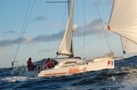
IDEC, passed away during the night on the rocks off Penmarc’h at the south western tip of Brittany. Francis Joyon travelled back to La Trinité sur Mer on the south coast of Brittany this morning with his sponsor, Patrice Lafargue. He shared his sadness with us, although he was still elated by the performance of his faithful trimaran during her final days at sea, when she was to show us such a remarkable performance.
What should have been a routine trip back home downwind turned into a nightmare last night. At the end of an exceptional career, and less than 24 hours after putting a new historic record into the history books of sailing, the IDEC trimaran was destroyed in most brutal fashion, "broken up in just a few minutes after going aground", to quote her skipper, Francis Joyon, who was clearly still under the shock.
During a short press conference in La Trinité-sur-Mer, the new holder of the Atlantic record and the 24-hour single-handed sailing record talked about this fatal accident. In spite of a clear lack of sleep, and with very mixed emotions, Joyo talk of the days of sheer joy during his crossing, but admitted he had never felt so frightened in a boat as last night.
And then he discussed how the boat in which he set solo records non-stop around the world and across the Atlantic, was wrecked. "I must have been out of it for an hour," he recounted. "After crossing the finish off The Lizard, I headed for the Chenel du Four, then went through the Raz de Sein during the evenin. As I had planned to reach La Trinité during the morning, I decided to slow the boat down a bit, by reducing the canvas, and with the wind aft, I was on a bearing well off Penmarc’h Point - about 30° to the right. As I hadn’t managed to get any sleep for a long time, when I did fall asleep, it was very deep… I was using the autopilot, and I think it must have taken her off course, as happened once or twice during the record - but I wasn’t going fast enough this time to be warned of the change.
"I suddenly woke up, when I heard a huge crash, when the boat came down in the breakers between a 6m high rock to my left and another one to my right. I was stuck there in the middle. I had managed to go aground on the sharpest rocks you can find off Penmarc’h Point. I think it must have been around one in the morning, and I immediately sent out a 'Mayday', as I thought I was on some rocks a little further out to sea. I didn’t think for one moment that the boat had turned in towards the coast. In the pitch black conditions, I gave my position and the coastguard service in Corsen told me that the rescue service was on their way, and that the boat could be reached on foot!
"They helped me ashore in among the rocks… I didn’t know what was going on for an hour or so, and I let them take care of me, which isn’t at all like me. As the rescue team
saw I was in shock, and not very coherent, they suggested I go to hospital - I was examined for three hours in Pont L’Abbé.
"My brother came to see me at four in the morning, and we went back to the boat to try to get her off with the help of the sea rescue service: a diver from the rescue team went into the water, I got on deck to help him moor up the trimaran, but just at that moment, she swung around and in just a few moments, the breakers smashed her up and her mast came down… In spite of the extraordinary bravery and the determination of the sea
rescue team, as we speak, all that remains of her is a few tiny pieces. It’s incredible that in such a short space of time, a boat can be smashed up like that.
"Those six days at sea on board IDEC were a sheer joy, and when you find this sort of success with a boat, you get attached to her. I’m almost ready to believe that those little bits of fibre have some sort of spirit. I really believe the boat worked harder than I did in getting these two records. I was beginning to think about other challenges. I was determined to tackle the solo 600 miles in 24 hours barrier in her. But in the end, at sea, you are the only one in charge and you have to accept your mistakes, just as you accept the laurels of victory at other moments."
Patrice Lafargue, CEO of IDEC added his view: "Seeing this boat destroyed is of course very emotional, as we were very attached to her. But it was Francis, who got us to love her, and what we love above all is Francis - today, he is here with us, and that is the main thing, and if he wants us to stay with him, we’ll continue to follow him and experience some more great moments."
IDEC, an historic career spanning 20 years
When Olivier de Kersauson had Poulain built in the CDK yard at Port la Forêt based on plans from the Van Péteghem-Lauriot Prévost design team back in 1985, he could not have imagined that this fabulous platform would enjoy such a long career.
At her launch Poulain measured 23m long and had a beam of 16.20m, with 295sqm of sail on a 32m high mast, and weighed around 12 tonnes. On board her de Kersauson was to take part in the Route du Rhum in 86 (that he was forced to abandon), then finished second in the UAP Open(Round Europe) in 1987, before he won fourth place in the La Baule-Dakar race in 1988. In that same year, Poulain stopped their sponsorship of the trimaran, which took the name Un Autre Regard when de Kersauson set off around the world alone in her. The French skipper would return from his journey after 125 days 19 hours and 32 minutes of sailing.
Racing around the world in record time became the challenge for all the great skippers in the early 1990s, and it was with this in mind that the trimaran became Charal in 1992: from the original platform only the central hull, the crossbeams and the special doghouse remained. However, de Kersauson and his crew were to hit a growler and had to give up on their first attempt at the Jules Verne trophy.
That was not to hold her back though, because following the accident, the floats were modified and the boat was fitted with a lighter mast in 1994. This operation required the standing rigging to be replaced too. The fittings were also updated and Lyonnaise des Eaux Dumez was now 27m long, 16.35m wide, with 340sqm of sail, hung off a 33m tall mast with all all-up weight of 14.5 tonnes. De Dersauson and his crew set off again to tackle the Jules Verne and set a new world 24 hour record of 520.9 miles in 24 hours, but it was Peter Blake and Robin Knox-Johnson’s ENZA New Zealand that walked away
with the Jules Verne Trophy.
In 1996, some final modifications were carried out, and the trimaran was once again rechristened, this time as Sport Elec and adopted the shape she still has today (Francis Joyon has in fact only changed the rudder). Above all, it was with this identity that the giant trimaran, entered into the history books, when on 19 May 1997 Olivier de Kersauson and his crew crossed the finishing line of the Jules Verne having smashed Peter Blake’s record by three days. Sport Elec took 71 days, 8 hours, 22 minutes and 8 seconds to sail around the world, a performance, which was only improved upon five years later with the advent of the new G-Class maxi-multihulls.
In 2004 in the hands of Francis Joyon, this trimaran, which already had a special place in the world of ocean racing, became the first boat to be sailed around the world singlehanded in less than 80 days - in fact more than a week less than 80 days - (with a new solo record time 72days, 22 hours, 54 minutes, 22 seconds. A year later, she set a new solo 24 hour record of 543 miles and demolished the solo west to east North Atlantic record setting a new benchmark time of 6 days, 4 hours, 1 minute and 37 seconds, breaking the old record which had stood for 11 years - all this in spite of her age. There are no two ways about it. Before leaving us, the red giant certainly left a lasting mark on the oceans…
Most Read
Most Commented
Comments
Businesses
Pro businesses
-
Italy
-
Italy
-
Netherlands
-
Editor's choice
Member blogs
-
 Ned Collier Wakefield: MOD70 round BarbadosWell that was intense. 12 hard fought for seconds for the win. In idyllic conditions, Tony Lawsons MOD ...
 -
 Mini Transat leg 2 reportThe second leg of the Mini Transat started on 31st October, just over a month after ...
 -
Leg 1 reportI’ve been working towards the Mini Transat now for three years. In 2013 I was part ...
Business blogs
-
 The Island Sailing Club in Cowes, Isle of Wight, is delighted that Prince Michael of Kent ...
 -
Peta Stuart-Hunt chats with the 25 year-old British solo sailor Lizzy Foreman before she sets sail ...
-
The 2015 Student Yachting World Cup (SYWoC), an ISAF-recognised event hosted and run by students for ...
Editor's Choice
All time favourites...
-
 Three legs down into Ian Walker’s
 -
 Winning all but two races at
 -
 For the first time in its
Latest Comments
Add a comment - Members log in