
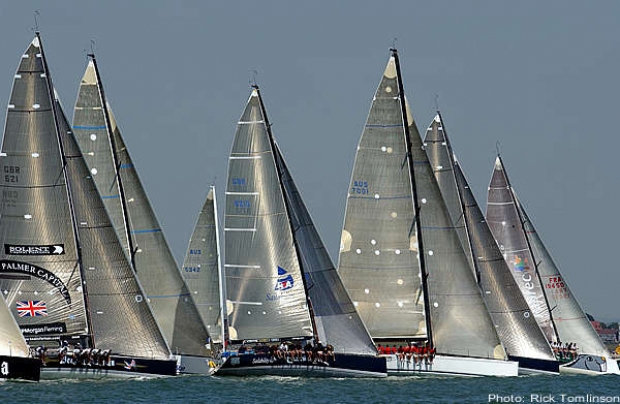
Does the Admiral's Cup have a future?
Thursday July 14th 2005, Author: James Boyd, Location: United Kingdom
 Back in the mid-to-late 1970s when the Admiral's Cup and IOR were at their peak, the self-proclaimed World Championship of offshore yacht racing would regularly see 19 three boat teams competing with national teams from every continent around the globe represented. At one point designer Ron Holland had 32 new boats in build while Doug Peterson had 33 and Frers 35 - all to compete in various national Admiral's Cup trials.
This year for the second time since 2001, the Admiral's Cup, an event which once rubbed shoulders in stature with the America's Cup, was cancelled.
What went wrong on this occasion?
"When we looked at the team format of Mumm 30, Swan 45 and the big IRC boat that was done on the basis of polling interest and there were 13 seriously interested teams," says Stuart Quarrie, who sits on the RORC's Admiral's Cup Steering Committee. "When it got down to it there were two teams - Australia and the UK. And for all sorts of reasons all the other potentially interested teams disappeared for different reasons. The Irish had three boats and while the big boat was prepared to fund itself without sponsorship the two smaller boats couldn’t afford it. The Americans were going to use Peter Vroon’s new Tonnerre which is late in build, so she wasn’t going to be ready. It is felt that the Farr 52s aren’t competitive under IRC compared to swing keel boats so a second British team was really difficult because one Farr 52 was prepared to do it, but the other two said ‘we’re not going to be competitive’. The Swan 45 class association was really really keen, but the owners ended up saying ‘no, we don’t want to do that’."
Even the French were unable to muster to a team, despite the enthusiasm of Commodore's Cup winner Gery Trenteseaux, as they too experienced problems finding a competitive IRC boat within the stipulated rating of 1.300-1.550. (To give some idea of what the RORC had in mind for the large IRC boat - the Farr 52s have a rating of around 1.31, while the Ker 55 Aera is 1.3266, a TP52 is around 1.336, the Nokia maxi, which Charles Dunstone has recently sold, was 1.49. A maxZ86 would be too big at 1.649).
Peter Morton says he faced a similar problem: "I did the numbers for Charles Dunstone and they didn’t make sense. We weren’t going to be competitive against the swing-keelers. It was a mathematical impossibility to do well."

So which boats?
We polled some past competitors:
"One Mumm 30 with at least three crewmembers under 23 years old, and then two boats with minimum length of 40ft which sail under a handicap system, so even a 120 footer can participate," is the recommendation of Volvo Ocean Race skipper Bouwe Bekking, a regular Admiral's Cup competitor in the early 1990s.
Peter Morton takes the opposite view about a handicap class: "I think they had too wide a rating band so therefore people we were quickly on to the fact that there were only half a dozen competitive boats of that size in the world. I would have restricted it down so that there were a lot more boats that people would have felt that they were competitive with."
Ian Walker believes: "There are no appropriate boats currently as there is no appropriate rating rule. If you had to do it now you would have to pick two IRC bands that would attract 32-44ft boats and 45-60 foot boats, plus the Mumm 30. You cannot have swing keel and fixed keel boats racing each other." So at least there is consensus on the small boat.
Australian stalwart competitor and sailmaker Michael Coxon was surprised RORC's proposed format this year didn't fly. He suggests Farr 40s. "You need one design classes that are available to charter at reasonable price."
While the Swan 45 might be one of the most recent one designs they are racer cruisers and thus, some observers maintained from the outset, not suitable for what is supposed to be a Grand Prix event. "One of the things we found with the Swan 45 class, is that a lot of owners were happy to go off and do a Swan regatta or a club-level regatta, but weren’t prepared to put themselves on the world media-stage as a full-on grand prix professional level, because they didn’t want that amount of pressure," says Stuart Quarrie.
One of the reasons the Swan 45 was chosen over the Farr 40 is that it was a felt a mandatory owner-driver class wouldn't be suitable for a Grand Prix-level event. While the Swan 45 is obviously also owner-driver it was felt the class might be more flexible over this than the Farr 40s. "It’s hard to explain to a sponsor that the owner has to drive but it is still a ‘World Offshore Championship’," says Ian Walker. "The Tour Voile works well. I would however limit pros to keep the costs down."
Michael Coxon takes the opposing view: "Owner drivers in the OD class is a must as this is why the OD classes are so successful." The owner-driver issue is obviously a sensitive one, but in our view it should be left open and be down to the merit of each team.
A class that clearly should feature in a future Admiral's Cup is the TP52. However even here there is a problem as at present there are examples from the US, Spain, Italy, UK, Greece, Ireland and oddly Chile, and ones in the pipeline from Holland and Germany but at present there is a decided lack from other countries such as Australia, New Zealand or even France. Such is the momentum of the TP52 class that we suspect this particular problem may be short-lived.
While at present there are some strong one design classes and the TP52 box rule, plus a spate of other box rules in the pipeline (more on this in due course) many feel, as Ian Walker does, that the demise of the Admiral's Cup has gone hand-in-hand with the state of a globally-endorsed handicap rule for full-on race boats: The decline of the Admiral's Cup seemed to more or less mirror that of IOR. There are many who believe that until a new Grand Prix Rule is created and adopted with equal enthusiasm world-wide, the Admiral's Cup is unlike to ever regain its former glory.

Where?
Then there is the question of the venue. Traditionally it has always been held in Cowes despite an aborted attempt to move the regatta to Ireland. But there is a strong lobby which feel the event should be moved around the world - either being hosted by the winning team, as the America's Cup is, or on a more arbitrary basis, in the same way Class Associations organise their World Championships.
Bouwe Bekking prefers the former option: "I personally like the Solent, but the problem is that the owners/sponsors who are paying the bills know that there are (warmer) places with better facilities than what Cowes has to offer, not to mention the savings they would make, as Cowes is very, very expensive. To get the Admiral's Cup going again, I would ask several countries if they would be interested in organising the event and what they can offer, guarantees for the participants, etc. Or maybe incorporate it into an existing event, like the Copa del Rey, Punta Ala, etc. Spain, France or Italy would be an obvious choice to start it off again since there are already so many different nationalities racing over there in other events. After the first series, then give the winning country the opportunity to organise the next event."
Peter Morton suggests the latter: "People like a change. I think they should sit down now and say ‘right in 2007 we’ll take it to Palma, in 2009 it’ll be Newport, 2011 Sydney and 2013 we’ll be back in Cowes.’ And be very clear for the next two what the boats are, so people can actually plan. The problem is all this short term sorting of problems - it is all left too late. There is no long term planning."
There are other issues with running events from Cowes says Morton: "I think people like coming to Cowes because of the history and it is an interesting sailing place, but I think the way the regattas are being run - everything from the paperwork to the quality of the race management is poor compared to regattas you go to aboard. You go to Key West where Premiere Racing run it and they make it easy and competitor friendly to do. That is the not the case here any more."
Bekking agrees: "The biggest problem organisers have to overcome is to get rid of the all paperwork. There is not an event in the world where so much paper work has to get done. Keep it simple! This has been putting teams off more than people they realise."
Michael Coxon has a blunter view. "The Solent has no appeal to me or most people I know. This is an owner driven sport and the owners would not chose Cowes as a holiday destination!" Saying this during the racing at the Vice-Admiral's Cup last weekend, the temperature was every bit as good as the Mediterranean and the tidal nuances and underwater topography of the Solent make it one of the most challenging stretches of water in the world to race in.

How 'offshore'?
Then there is the issue of whether or not the race, if were to remain in the UK, should include the Rolex Fastnet Race. "I think the Fastnet added a lot of prestige and drama," says Ian Walker. "It may also be the key to attracting the foreign teams back. The problem with using the Fastnet was that you then have to run the Admiral's Cup during Cowes Week when there are not enough facilities and the sponsors get drowned. I like the balance [of inshore/offshore races] but I would have one less inshore race to shorten the event more."
Stuart Quarrie agrees: "I think the Admiral’s Cup lost its way when the Fastnet Race was dropped from it. Although professional sailors whinged about the Fastnet, it was one of the draws from owners from around the world. You still get owners coming to do the Fastnet - they just don’t do the Admiral’s Cup. But it is quite difficult to put the Fastnet back in because everything has moved on. Cowes Week has moved on from when the Admiral’s Cup was part of it, the Fastnet has got Rolex as a sponsor which then makes separate sponsorship of the Admiral’s Cup difficult." The Admiral's Cup has a long association with rival watch brand Corum.
Our view is that if the event is to have any credibility as the premier 'international offshore team competition', then it must include at least one race of some reasonably serious mileage, like the Fastnet. Perhaps the event could be tacked on to culminate in the 'classic' 500 mile offshore events like the Sydney-Hobart, the Newport-Bermuda, the Round Gotland, the Rolex Middle Sea Race as well as the Fastnet.
Part of the problem with the offshore component of the Admiral's Cup has been the type of boats being sailed in the event since the 1980s have become increasingly unsuitable to racing offshore. Ian Walker feels this might change with the advent of some new faster box rule boats, with greater stability along the lines of the TP52.
Michael Coxon gives his view: "I would leave the Fastnet in for the big boat only and not load the points, ie: equal points to any other race in the big boat regatta. Maybe the smaller OD boats could sail say three short races a day while the Fastnet is on and the three daily races (or whatever number the conditions allow you to get in on that day) would equal just one point. This keeps all competitors sailing, owners happy and ends the regatta on about the same day for all."

Cost:
Relating to our article yesterday about IRM, another problem facing the Admiral's Cup is that at a time when there is little culture outside of the Mediterranean for spending big bucks on 'Grand Prix' yacht racing, competing in the Admiral's Cup represents an expensive week and a half of racing.
Peter Morton puts it in perspective: "The budgets for a big IRC boat to do the Admiral’s Cup to the standard the Dutch did when they won or the Italians or when we won it in 1989 or even when we came second in 1999 - the big boat budget is close to £200,000 - and that’s just running costs. The Swan 45 I’m sure would be over £100,000 and the Mumm 30 £50-60,000. That’s two suits of sails, maybe two and a half sets. To think you can get away with less is nonsense. In 1999 on Venture our sail budget was $330,000 and that was a nine week program and we came second. There aren’t the people around anyone who want to spend that kind of money to make the numbers up."
However Morton also feels that the issue for owners these days is less one of money than of time: "There are sixteen TP52s being built at the moment at $1.5 million each, so there are people out there prepared to spend the money. But things have changed. In the old days boats could be run off companies perfectly legally and there was no Schedule E and it was slightly easier for owners to run boats through their businesses. Now it is just impossible. That has changed things, when people were paying 19 and 6 in the pound and their sailing was costing them 5p in the pound effectively, it was a little easier. Nowadays people are money rich but time poor. The guys who used to do it properly like Graham Walker - we built seven new Indulgences in nine years - he had time as well because his business was properly structured. Owners now are generally a lot busier and they don’t have the time to put into it that they had."

Has the Admiral's Cup had it's day?
The face of yacht racing has changed immeasurably since the halcyon period of the 1970s. Aside from developments in yacht design, the calendar has expanded wholescale. "In those days there were only half a dozen high class regattas in the world," says Stuart Quarrie. "Now you look at the calendar worldwide and there are hundreds, so the choice for owners and crews is much bigger and there is less need for an event like the Admiral’s Cup."
So has the event had it's day? Michael Coxon thinks not necessarily: "The venue has but as we can see if you get the right mix of boats and venue racing is still popular. To get numbers up it should be a Club/ team event, not a national event or you limit more than one team from each country."
Stuart Quarrie offers this suggestion: "Another option is to put the Trophy in the trophy cabinet and lock the door and wait for something else to come along which needs it - like the One Ton Cup - or to hope that there is a new international rule that in two or three years time one could use sensibly and seriously with a full worldwide fleet using the rule. At the moment I don’t know which way it is going to go."
Our view is that the Admiral's Cup does still have enough unique qualities to give it a place in the modern day yachting calendar: Principally that it is a team event for national teams racing large keelboats. It also has a great history and for many it still holds considerable prestige - winning the Admiral's Cup means your country is the greatest keelboat racing nation in the world.
The problem RORC now face is one of credibility. Two of the last three events have been cancelled and next time round they will have an increasingly tough job convincing owners that 'this time it really is going to happen'.
The choice of boats for this year's event in retrospect was unfortunate and it is easy to stand back now and say that there are fleets of boats out there which perhaps would have been more suitable - the Farr 40 instead of the Swan 45 for example and perhaps tweaking IRC so that canting keel boats have a more equitable rating. Had this come to pass then perhaps the RORC may have got their 13 teams.
The problem is that one designs come and go and for example today with handicap rules and one design classes in such a state of flux it is hard to predict what would be the right classes to pick for an event in 2007. A Farr 40 for example might work in 2005, but will it still be as competitive a class two years from now with the advent of newer one designs and box rules? At present it is going to be extremely hard for RORC to make such predictions with any degree of certainty until such time as the present rule debacle settles down and some stability is regained.
In our view the next event should definitely take place in Spain, the present home of grand prix keel boat racing and where RORC stand a much better chance of hooking a much needed-title sponsor for their other premier event outside of the Rolex Fastnet Race. A title sponsor would help raise the profile of the event once again and with some media budget it would attract boat sponsors and the whole show could get back on the road again.

Most Read
Most Commented
Comments
Businesses

Pro businesses
Editor's choice
Member blogs
-
 Ned Collier Wakefield: MOD70 round BarbadosWell that was intense. 12 hard fought for seconds for the win. In idyllic conditions, Tony Lawsons MOD ...
 -
 Mini Transat leg 2 reportThe second leg of the Mini Transat started on 31st October, just over a month after ...
 -
Leg 1 reportI’ve been working towards the Mini Transat now for three years. In 2013 I was part ...
Business blogs
-
 The Island Sailing Club in Cowes, Isle of Wight, is delighted that Prince Michael of Kent ...
 -
Peta Stuart-Hunt chats with the 25 year-old British solo sailor Lizzy Foreman before she sets sail ...
-
The 2015 Student Yachting World Cup (SYWoC), an ISAF-recognised event hosted and run by students for ...
Editor's Choice
All time favourites...
-
 Three legs down into Ian Walker’s
 -
 Winning all but two races at
 -
 For the first time in its
Latest Comments
Add a comment - Members log in