
Inside Ericsson
Friday November 25th 2005, Author: James Boyd, Location: United Kingdom
Jason Carrington broke new ground in the last Volvo Ocean Race when as Project Manager of the two Assa Abloy boats, he opted to build them using female tooling - the first time this had been done for a Volvo boat. Although more costly and taking more time this, Carrington and the team felt, was worth it to save the weight of the fairing, and particularly because they were building two boats.
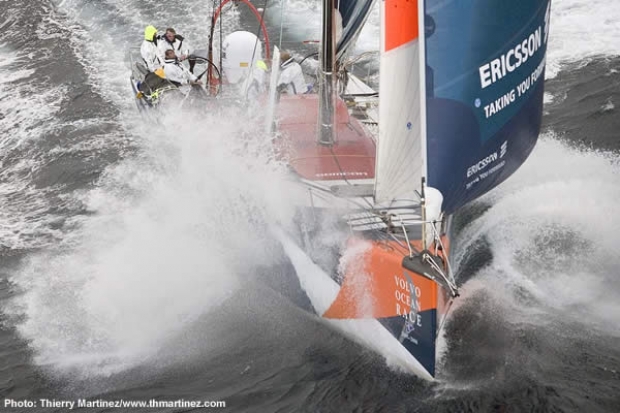
For this campaign Carrington has again teamed up with Atlant and skipper Neal McDonald to run the build of Ericsson at Green Marine (he is also part of the sailing team). This time around he once again opted for building Ericsson in a female mould, the only team to do so apart from ABN AMRO who built their second boat this way, but Carrington says on this occasion the choice was not so obvious.
"It was a bit trickier because we felt we were late and although female moulding is definitely the way to go it is a) more expensive and b) (more importantly for us this time) it takes longer. We felt that time on the water was going to be key, so it wasn’t as obvious. We still did it, but we didn’t do it to quite the degree as say ABN."
Building from a female moulds is standard practice in production manufacturing, where it saves time and expense fairing the outside of the hull. However traditionally to create a female mould it is necessary first to construction a male plug from which the female tooling is created. However because time was short with their construction instead of building a plug they built the female moulds from scratch.

"We built female frames and then built the mould - battened and faired carbon on top and then faired again," says Carrington. "While it worked very well and it saved a lot of time and was a lot cheaper, it is hard to say that is as good as what ABN did. [With ABN AMRO Two Killian Bushe created the moulds from a plug.] But it is still a good system and we didn’t have to put any filler on the boat and we made the gains we wanted to make and saved the time." Still Carrington has calculated the build of Ericsson took 37,000 manhours.
A significant difference between the Volvo Open 70s and the previous 60s is that carbon fibre is finally a permitted material for hull construction. Ericsson was built, like most of the VO70s, in pre-preg carbon with an aramid Nomex core. For Carrington and the build team, carbon proved a very much easier material to work with than Kevlar (simply cutting Kevlar is far from easy), and it also made for a better moulding process. "If you build a Kevlar boat in a carbon mould the materials react differently when it is heated so you don’t have those issues," he explains.
On the materials front Carrington worked with SP and got his own run of pre-preg tailored to his specification. "We got our own resin/cloth ratios," he says. "It was prepreg and we were good at getting a pretty low resin:cloth ratio and we would change it depending upon the layer. If we were near a core we would have slightly more resin, but only 33%, so pretty low. And we’d do warm de-bulks to suck out any excess resin with peel ply so we were pretty anal about all that. Every sheet of Nomex was weighed - I weigh all the sheets myself so I know how much they are. We’d create a puzzle of where we put each sheet in the boat to make sure we got heavier sheets in the heavier load areas - mind you we are not talking about much weight…"
The hardest area of the boat to build, and a first for Carrington, was the structural area and box for the canting keel. "It is quite complex on the Farr boats," he says. "The more you get to know it you realise that it is very clever, but it takes you a long time to get your head round it. It took us well into the build program to start to figure out how all the bits went together. If we were starting again now we might do some things differently with how we built the keel tower - it might be part of the boat. Some of that area was built in the female mould which was nice and saved weight but we would build more of it in the female mould."
With the Farr boats the carbon fibre box/tower in which the top of the canting keel resides also forms the structure for the keel bearings - the giant pin through the middle of the keel around which it rotates, as well as the mountings [known as the ram shelves] for the hydraulic rams used to cant the keel.
"We spent a lot of time looking at the whole structure around there and we had our own people looking at that as well, so we don’t have big differences but some subtle differences in those areas," says Carrington.
While Carrington developed a reputation for his weight stinginess with the Assa Abloy boats four years ago and they have gone to similar lengths this time, he admits that because the VO70 is so new they have in some area been careful to put weight back in. The structure around the keel rams is one such area.
Among the boffins employed by the team was structural engineer John Levell, who was integral to the design team of Ellen MacArthur's B&Q Castorama trimaran. While Levell worked his number crunching magic on many areas of the boat - teaming up with Formula Spars Tim Dean on the rig, he also worked with Roger Scammell on the keel area. Scammell is no stranger to canting keels have created many for the Open 60 fleet.
Lovell was also responsible for redesigning Ericsson's daggerboard system from the original Farr design and their keel fin, which - for those who have been reading up on it following the Open 60 keel fin breakages in the Vendee Globe - is a forged rather than fabricated fin, as it is believed is fitted to most of the VO70s.
In terms of Ericsson's hull shape it is the 'standard' Farr shape, identical to Cayard's The Black Pearl which was also taken off her female moulds - and to Brasil 1 and doesn't have the chines in her run aft like movistar and the ABN AMRO boats have.
However there are many differences between the three Farr sisterships when it comes to details and often not minor detail. The most obvious difference between Ericsson and the other VO70s is that her mast is conventionally rigged and doesn't have jumpers to support the top mast. On the positive side this saved the weight aloft of a pair of spreaders, but equally has meant they don't have as tight a sheeting angle for their overlapping headsails. They have cunningly got around this by simply cutting out the offending area of leech on these sails.
"Magnus [Olsson - Atlant's in house round the world racing guru] is a big believer in this configuration and so is Neal," continues Carrington. "I know it seems like we are going out on a limb but if you look back to the 60s - there were Silk Cut and EF that had jumpers and everyone else had these. And in the following race everyone had the same as us, so I feel that they are all out on a wing!"
Losing a set of spreaders also allowed them to put more weight into the tube and Carrington believes that their set-up makes for a stiffer, safer rig. "I am not saying we have a stiffer mast, but those opportunites are there. And it is hard to set the rig up for all conditions with jumpers. I’m sure there are advantages to the other system, but we like what we have got."

In terms of halyard locks (above) Carrington believes most teams are using locks from Southern Spars or ones similar. Theirs was conjured up by Tim Dean. "They work really well. We have them on all the spinnaker halyards but not jib locks. We have the option of using them - they are in the mast but for the inshore we don’t use them so that it is easier to get the jib down."
The deck layout has some differences from the Farr standard design. Halyards and other lines coming back from the mast are fed back through pipes in the cabintop rather than around the side. "We’re the only ones doing that," says Carrington. "Everyone else’s goes out and then comes back because we got a rule interpretation - it was a case of how you read the rule. I think everyone read it differently to us. If you go straight back you save the weight of extra turning blocks and structure and you have less friction."
In the cockpit they have two grinders, although Carrington says they considered three for a long time. Their runners and spinnaker sheets also run through tubes beneath the deck. This prevents guests from sitting on them but is most useful in enabling them to stack the sails aft. "If you have a Southern Ocean gybe it is a nightmare if the runner tail jams up," says Carrington.
Ericsson is one of a deecreasing number of boats to accept the added weight penalty of a spinnaker pole. Carrington admits the call on this was marginal. "We tested it and it is not as conclusive as we thought it would be but our feeling is you should have a pole and we are very happy we have one. Equally you pay for it because if you want a pole, it comes with a jockey pole and the guys and associated fittings. So you are paying 75kg which you might put in the bulb." But the pole also has other uses. As on the VO60s when this is not up it snaps firmly into fittings on the pushpit and deck to provide a wall to stack above.
The teams are stacking every bit as aggressively as they did with the 60s but in addition this time they are allowed to alter their fore and aft trim through the use of a tank containing a maximum of 1200lt of water mounted inside the transom. "It does make a difference," says Carrington. "It lifts the bow up a bit and makes the boat a bit easier to steer. That is a good part of the rule, but equally you still stack aft as we did last time."
On the foredeck Ericsson is the only boat to have a big foredeck hatch allowing them to make forward drops, to speed up manoeuvres in the in-port races. Carrington says they also use this offshore when conditions allow. While some boats use hydraulics to tension their forestays on board Ericsson they have a fore and aft track system on deck to do this, an idea provided by Carrington's old Assa Abloy partner Neal Graham (how could he not be involved?) and taken in turn from some of the French open class boats. "We use our foreguys to link in to pull it," says Carrington. The only hydraulics they use on board are to do with the mainsail - outhaul, vang, checkstay.
Ericsson is also the only boat with a full-width mainsheet track. Conventional wisdom has it that - and this dates back to the 60s - if you drop the track down on to the deck then you save the weight of the beam necessary to elevate the track off the cockpit sole. Carrington disagrees: "With these boats, the wind is a long way forward all the time so you use the traveller a lot and we are often at the end of the traveller and it makes the boat stiffer because you get a nice beam right across the cockpit. If you put it on the cockpit your bulkhead there has to be fairly heavy to take the traveller whereas our bulkhead there can be very light. So it is not a penalty in terms of weight."
With the exception of the Sunergy VO70 which has a single daggerboard, all the other boats have twin asymmetric daggerboards to prevent leeway and provide lift when the keel is canted. There is a significant difference here between the Farr and Juan K-designed ABN AMRO boats in that the boards on the latter are extremely long. "Their boards have got to be at least 100kg which is a quite a significant weight, but then I suppose they believe in that," says Carrington. "Our boards are slightly different from the standard Farr board. The section is the same but the plan form is different because we are using a different type of bearing. Most of the Farr boats are using a thrust roller bearing. We are using just a plain bearing like all the French boats use which is quite a bit lighter. It is just a solid Ersalite bearing. We did that because we didn’t particularly believe in the roller bearing - ours is simple and light and we also wanted to be able to swap the boards over if we broke one, so that we could turn it upside down and put it down the hole. So we can do that and have invested a little bit of weight back into the boards so that we have that option. They are not as strong upside down as they are the right way up but we can still do it"
Unlike the other boats, the daggerboard cases on Ericsson are the same shape as the boards themselves and the team have been experimenting with board angles, but an interesting innovation the team have made has been the way the aperture at the bottom of each daggerboard case exit is closed up when the board is raised. Both Ericsson and movistar have such systems and for the Swedish team, Roger Scammell and John Levell came up with what is known as a 'guillotine' system. "It is very cool," says Carrington. "When we have got them up we just shut them up. If you don’t have that you either have a rubber gasket which is very messy and doesn’t really work or you do what ABN and I think the Pirates have done as well which is to have a square tipped board so you just leave a little bit of the board poking through to effectively shut the slot. We looked at that, but for us we found it quite alarming the losses particularly upwind by having a square tipped foil."
The guillotines, which we were not allowed photograph, are a magnificent example of carbon fibre build work. The guillotine itself is a 150mm wide flexible plate which is plunged vertically into a case on the front side of the board case. As it descends the guillotine case goes through a 90degree turn forcing the flexible plate around this corner and then across the aperture in the bottom of the daggerboard case, thereby closing it. Obviously the loads generated by the boards when they are being used in anger, are enormous, so arranging for a plate to be slipped through this structure presented some interesting challenges.
Unfortunately a downside of the guillotine system is that it is not automatic and the team have already demolished one when the board was lowered without lifting the guillotine. "You obviously have to remember them, but you can take them out and swap them and they are very light," says Carrington.
Down below the layout on Ericsson is fairly standard Farr with a full bulkhead forward of the mast/daggerboard area and there are full bulkheads albeit with three large cutouts on the fore and aft sides of the keelbox. The keel box, the wedge-shaped box and 'wet' area where water comes into the boat around the keel pin, is tiny compared to Open 60s. The rams protruding out either side of this box also have their own enclosures with windows in the top to view the action. Teams tend to be quite unwilling to discuss the details of their canting keel systems but Carrington says that their rams are seated on a roller-type bearing rather than a plain bearing so that it can still operate should the keel somehow become misaligned.
While Italian hydraulic ram specialist Cariboni has come up with the ram packages on several of the VO70s, the Ericsson rams were made in titanium with a ceramic lining, constructed in the US by Bosch Rexroth and are capable of shoving 70 tonnes. "They are pretty Gucci things. Roger Scammell worked with them on that," says Carrington.
Movistar are believed to be the only team to have tried out the Farr suggestion of using carbon fibre rams, although it is believed this was not successful. "It was quite a tough call because the Farr weight study which is a very accurate, they were assuming you would be using carbon rams which they were saying would weigh 15kg," says Carrington. "We didn’t believe that and we didn’t have the time to go with it, so we decided pretty early to go with titanium."
Aside from the ram, the second biggest issue for Carrington was that the Volvo Open 70 rule allowed keel pins to be fitted 150mm inside the boat. While one would have thought this would make the construction simpler as it allows the structure for the keel pin to be inside rather than half outside the boat, Carrington says that it has caused many more headaches in finding a good way to close up the rectangular aperture caused by moving the pin inside. "That has been quite a drama to get that right and working well. I think all the boats have had issues with that," says Carrington. Unfortunately the Pirates experienced issues with theirs and have had to pull out of this first leg as a result.

Carrington describes the system: "The Farr boats have a sliding door and to fair that into the keel fin itself you have to have this sliding barrel, because the pin itself is 150mm up from the hull surface. I would like to have thought of that because it is quite neat, but it causes a lot of problems." The keel pin itself is made in stainless steel and is around 120mm in diameter.
While many teams have been experiencing problems with their keel canting systems, on board Ericsson Carrington says they have encountered nothing major. "We haven’t broken anything. We’ve had initially leaking problems with the keel pin. The pin is below the waterline and 150mm above the hull, so there is quite a pressure head of water there so that is quite difficult to deal with especially when the thing is swinging around. The first time we put the keel on we didn’t really know what we were doing in terms of how it should go together or what glues to use and so on. So we had quite a leaky boat for a while."
Down below on Ericsson the fit out is immaculate. Weight where possible has been put on the centreline and weight saving has extended to having no floorboards. All bulkheads are Nomex cored and Carrington says all the hatches were made as part of the bulkhead rather than having flanges glued in afterwards. In the build the sheer (the turn between hull and deck) was built into the hull. "We just sat the deck on top. That was a big gain in terms of weight."
Between the main bulkhead and mast and in between the two daggerboard cases is the head compartment where the 'throned' have the opportunity to rewire the electrics panel on the aft side of this compartment. As ever, everything down to the washbasin is built in carbon. Running along either side of the boat forward of the pipecots aft are stacking bins, where everything from food to spares are kept and transferred from side to side between manoeuvres. A significant difference down below between the 70s and their 60ft predecessors is that there are no water ballast tanks and this has created more space aft, allowing pipecots to be mounted further outboard.
Looking aft from the centre of the boat, there is no join between the companionway steps and the cockpit. This allows for sails stacked inside the boat to be moved across without having to move them fore and aft. "That was driven by Farr," says Carrington. "They are relying on the hull and the deck structure independently."
Aft of the companionway down the centreline are the engine, generator and Carrington is pleased that he even managed to get the fuel tanks into this central area. Also hidden within this area is the mechanism for the lifting folding prop. This system is now allowed on the VO70s enabling the engine propeller to be kept inside the boat to minimise drag, and dropped out when needed. "That was all done by ourselves. We spent a lot of time and energy in doing that."
At the back of the boat just forward of the aft bulkhead are the chart table and media station. These are very similar areas, Steve Hayles' chart table pointing forwards, Magnus Woxen and Richard Mason's media centre facing aft. The seats for these hide the main fresh water tanks.
Between the aft bulkhead and the transom is the steering quadrant for Ericsson's single rudder. Obviously with twin daggerboards and a canting keel off centreline, the vulnerability of the rudder is greatly increased. However each boat is obliged to be fitted with an emergency system and Carrington says the transom-hung spare Farr have come up with for this purpose is not 100% efficient, but still good enough to allow them to race.
While Ericsson seems highly effective around the cans, her performance in the offshore leg has been on the pace but not faster and it will be interesting to see the kind of surgery she undergoes in Cape Town.
More photos on the following pages...

Most Read
Most Commented
Comments
Businesses

Pro businesses
-
United Kingdom
-
-
-
France
Editor's choice
Member blogs
-
 Ned Collier Wakefield: MOD70 round BarbadosWell that was intense. 12 hard fought for seconds for the win. In idyllic conditions, Tony Lawsons MOD ...
 -
 Mini Transat leg 2 reportThe second leg of the Mini Transat started on 31st October, just over a month after ...
 -
Leg 1 reportI’ve been working towards the Mini Transat now for three years. In 2013 I was part ...
Business blogs
-
 The Island Sailing Club in Cowes, Isle of Wight, is delighted that Prince Michael of Kent ...
 -
Peta Stuart-Hunt chats with the 25 year-old British solo sailor Lizzy Foreman before she sets sail ...
-
The 2015 Student Yachting World Cup (SYWoC), an ISAF-recognised event hosted and run by students for ...
Editor's Choice
All time favourites...
-
 Three legs down into Ian Walker’s
 -
 Winning all but two races at
 -
 For the first time in its
Latest Comments
Add a comment - Members log in