
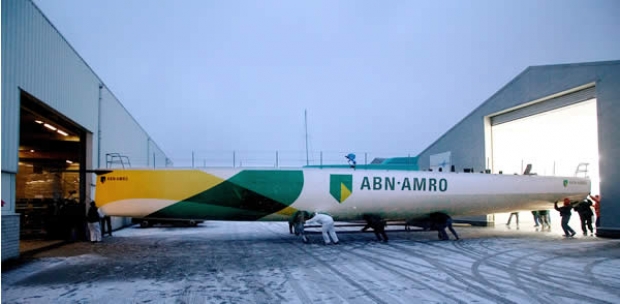
First new Volvo Ocean 70 unveiled
Wednesday January 5th 2005, Author: James Boyd, Location: none selected
Under cover of the less than focussed days straddling Christmas and New Year the world's first Volvo Open 70 was surruptiously unveiled in the snowy Dutch port of Lelystad.
ABN AMRO 1 is a design by Argentinian Juan Kouyoumdjian and has been built in Holland by a team led by the immaculate Killian Bushe who was responsible for the construction of John Kostecki's 2001-2 Volvo Ocean Race winner illbruck.
Before getting into the nuts and bolts of the new boat, let's remind ourselves of what a Volvo Open 70 is:
| Length overall: | 21.5m | (70.5ft) |
| Beam: | 4.7-5.7m | (15.4–18.7ft) |
| Draft: | 4.5m | (14.8ft) |
| Mainsail Area: | 172sqm | (1883.7sqft) |
| Headsail Area: | 140sqm | (1506 sqft) |
| Spinnaker Area: | 500sqm (max) | (5382 sqft max) |
| Mast Height: | 31.5m above water | (103.3ft above water) |
| Weight: | 12,500-14,000kg | (12.3-13.8T) |
| Keel Bulb: | 4,500kg min | (4.4T min) |
While the rule has the word 'open' in it - it is anything but this. Rigs will be relatively standard and the Volvo Open 70 rule is a very tight box when it comes to the hull with specific limitations on: hull shape, sheer line, the outline ("fair and continuous convex curve"), deck camber, cockpit depth, cabintop, companionway and spray dodger and components of the interior - to name just a few of the rules constraints. Obviously there are rigourous safety requirements including an Open 60-style hatch and liferaft stowed in the transom and minimum panel weights for the build.
The good news is that the performance of the new boats is a quantum leap from the VO60 through simply having around 6.5ft more length overall (VO60s were in fact around 64ft long) while being one ton lighter (VO60s had a minimum displacement of 13.5 tonnes) and being able to carry a mainsail that is 28% bigger, not to mention 60% more downwind sail area.
The breakdown of the weight is:
hull, deck and rig - approx 6,800kg.
Keel fin and bulb - 5,700kg
Carbon/non-metallic Nomex is now allowed in the hull construction (VO60s were Kevlar and bendy) as well as the mast. PBO standing rigging is now permitted.
If there is an 'open' aspect to the rule it is over the appendages. Canting keels with up to +/-40deg of cant angle are now allowed along with, by Open 60 standards, a rather paltry 1,200kg of centre line water ballast. Otherwise appendages are unlimited except that they can only move in one plane. Thus we won't be seeing 60ft trimaran/Open 60 style single lifting daggerboards that can rotate or be fitted with a trim tab or a lifting steerable canard forward - which is a shame as these boats should be state of the art and a hot bed of innovation.
The reason for these limitations is one of cost and Volvo have also taken steps to tackle this by reducing the sail wardrobe from 38 to 24 for the race overall, with 11 measured in each leg excluding obligatory storm sails. Crew has also been reduced from 13 to nine for an all-male line-up, 11 for an all-girls team.
Nonetheless the Volvo Open 70 will be fiercely quick. Volvo reckon they will be capable of bursts of 35 knots boat speed and be able to reel off 500 mile days when conditions allow. The VO70 will be 21 days (or 18%) quicker around the world than the VO60 they say.
AMN AMRO 1
Our first impression of the boat were due to the chine in the aft 'buttocks' and the angled deck to hull join two features that reminded us of the new Lombard Open 60s Sill and Bonduelle. No bad pedigree there (carbon keel foils are prohibited).
The angled section at the sheer line - known as a chamfer - is due to the freeboard measurements explains designer Juan Kouyoumdjian. "In the rule there are three freeboard measurements – one at the middle and two at the ends and basically doing it like that we have ensured that the sheerline is a lot straighter. Having a straight sheerline helps a little bit with the bending of the boat. Once you put the forestay tension through the runners if your sheerline is straight rather than curved the boat flexs a little bit less. If you do a typical hull to deck join and you respect those three points you end up with a curve. The beauty of the chamfer is that the freeboard at the middle is measured at the lower corner of the chamfer and the freeboards at the bow and the transom is measured at the top corner."

Far from being skinny along the lines of a Reichel-Pugh canting keeler, the boat has a lot of volume in the hull. This has pleased skipper Mike Sanderson: "I was always worried when I saw artists' impressions of what everyone thought a Volvo 70 was. I couldn’t work out why they were so far in towards the minimum beam because to me the rig seemed oversized and you were basically looking for all the righting moment in the world that you could get. I was amazed to see these narrow boats because you have got so much horsepower on tap and the Volvo is largely a reaching race."
Unusual for an ocean race boat is that the boat is very slab sided with near vertical topsides. Designer Juan Kouyoumdjian has a simple explanation: "It is related to the chine. In fact what happens, if you imagine having a boat that is much wider and suddenly you make a vertical cut down the sides - that is what you end up with." The boat is fully designed to be sailed with heel as Juan K says it will rarely ever sail upright.
Below the water, as we predicted some months ago, the boat has a canting keel and twin asymmetric daggerboards, which we suspect is the configuration most of VO70s will have. What we weren't excepting was for the boat to have twin rudders like an Open 60. "Basically the twin rudder thing comes from the beam," explains Sanderson. "You hit a wall with the single rudder. At the end of the day the boats have massive rigs. The only downside of having twin rudders is a small penalty for when you are dragging the weather one and the risk of the weather one hitting things which we have seen a fair bit in the Vendee. But when you have the weather rudder two thirds of the way out, they are little wee rudders you are dragging - they are so efficient because they are so planted in the water. To be honest five years ago I thought they were the biggest lemon on the earth. But after sailing the Open 60 [ Pindar] and seeing the control we got and doing much more tank and CFD research on the VO70 I am much more comfortable with it."
The doghouse design is very similar to the VO60 and it's shape is dictated by the rule. Kouyoumdjian would have something more Open 60-like with a cuddy and more protection for the crew. "I would have loved to have done it, and the crew would love to have it and it makes a lot of sense."
In the cockpit there are the inevitable twin helm positions and three pedestals that are primarily there for the inshore courses.
Kouyoumdjian is at pains to point out that ABN AMRO 1 is not as developed as the second boat will be as its build started before much of the tank test and CFD work was complete. "The first boat was answering the goal of having the best boat we could at the time and having a boat that would go into the water as quickly as possible and allow us to learn as much as we could from actually sailing a real boat on the water."
While Kouyoumdjian and his team were responsible for the design of the first boat with input from Roy Heiner, the design of the second boat will be different in many ways - in particular on and above the deck following the input of Mike Sanderson, Brad Jackson and his team when they signed up in July. "So it is very much a boat that was 'off the shelf'. It still should be a pretty good boat, but there is a lot more refinement going into the second one," explains Kouyoumdjian.
AMN AMRO 1 arrives in the Algarve harbour of Portomao, southern Portugal today and is expected to be sailing towards the end of next week. New boats go together much faster than they used to says Sanderson. "Back in 1992 when they put Cup boats in the water as a new class it would take them weeks before they could go out sailing at full noise, whereas even on Mari Cha we did 20 knots on the first day and Orange lifted a hull out on the first day."
Meanwhile back in the Netherlands Killian Bushe has just begun work on the second of the Dutch bank's boats. "The materials are the same but the overall laminates are a little bit different. The second boat will be a lot lighter and so the bulb will be heavier," says Kouyoumdjian.
The VO70 rule states a minimum displacement of 12.5 tonnes but it is almost impossible to get down to this weight says the designer. As before with the VO60 light weight in the construction is essential as every gram saved above the water can be slapped on to the bulb to increase stability. "It is a bulb weight race, but even more so, because of the canting keel," says Juan K.
Performance-wise the designer confirms that the boat will indeed be scary. The first leg from Galicia to South Africa could take as little as 19 days. Upwind boat speed will be around 10 knots while reaching the boats should slip up into the 20+ knot range with ease. "I think there will be a lot of time between the arrival of one leg and the start of the next one," says Koumoudjian. "I think the performance will be just short of a maxZ86. On a long run they won't match a maxZ86 because it has 16 extra feet and more sail area, but between an Open 60 and a Z86 I think they will be closer to the Z86."

The canting keel and anti-leeway appendage means that they wouldn't be far from a Cup boat at the weather mark Sanderson reckons : "By canting the keel and getting the keel out of the way and then people having the option of going CBTF or asymmetric daggerboards, you are looking at boats that are getting rid of a good chunk of leeway. That is also what puts you into the high efficiency race of going upwind: you are down to 0.5deg of leeway versus a Whitbread 60 which is maybe three or four degrees of leeway."
The skipper also apreciates the extra length. "With the Open 60 you get the feeling it is a bit short for the horsepower. You see them sailing quite often with the big wake off the back because everyone is pushing so much righting moment and sail area. So I think the 70s are going to gain a lot from that extra 10ft. They are going to be more efficient through the water and that is going to make them quite substantially quicker."
Sanderson last sailed the Volvo Ocean Race with Grant Dalton on Merit Cup. Compared to his old steed the new boat has a 175sqm mainsail and a 120sqm jib as opposed to 117sqm and 80sqm for the VO60. "The biggest difference is that these boats have a big long J measurement and you have a narrow minimum chainplate width, so your R1 is going to go very close to upwind." Downwind the biggest kite at 500sqm are bigger than an AC kite.
There has been talk among the crew who have sailed super maxis and multihulls that the Volvo Open 70 will see the crew having to back off in severe conditions. Kouyoumdjian doesn't see it this way saying this will only happen upwind in big seas. "That is the only place I think they will have to back off. Downwind they will be full on all the time."
The first Volvo Open 70 sailing in less than a fortnight - you can guarantee we'll be there for that...
More photos on the following pages...

Most Read
Most Commented
Comments
Businesses

Pro businesses
Editor's choice
Member blogs
-
 Ned Collier Wakefield: MOD70 round BarbadosWell that was intense. 12 hard fought for seconds for the win. In idyllic conditions, Tony Lawsons MOD ...
 -
 Mini Transat leg 2 reportThe second leg of the Mini Transat started on 31st October, just over a month after ...
 -
Leg 1 reportI’ve been working towards the Mini Transat now for three years. In 2013 I was part ...
Business blogs
-
 The Island Sailing Club in Cowes, Isle of Wight, is delighted that Prince Michael of Kent ...
 -
Peta Stuart-Hunt chats with the 25 year-old British solo sailor Lizzy Foreman before she sets sail ...
-
The 2015 Student Yachting World Cup (SYWoC), an ISAF-recognised event hosted and run by students for ...
Editor's Choice
All time favourites...
-
 Three legs down into Ian Walker’s
 -
 Winning all but two races at
 -
 For the first time in its
Latest Comments
Add a comment - Members log in