
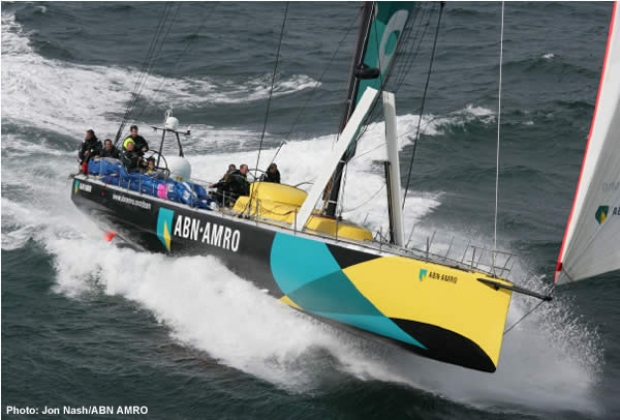
VO70 on a diet
Wednesday August 31st 2005, Author: James Boyd, Location: none selected
One of the joys of this year's Volvo Ocean Race is that with just over two months to go until the start, we don't really have a clue who is going to win. Boewe Bekking's movistar team is being touted as favourite due to the time they have spent on the water and their impressive 24 hour record, but would you really bet against Paul Cayard or Neal McDonald or Torben Grael?
Then there is ABN AMRO. The Dutch bank-sponsored team were first to launch a Volvo Ocean 70 back in February this year and have also had a healthy amount of time on the water, despite the downtime they experienced due the keel ram breakage they suffered earlier this summer. They are also the race's only two boat campaign, their 'A' boat skippered by New Zealand America's Cup and round the world race veteran Mike Sanderson while their 'B' boat is being sailed by a crew of sub-30 year old sailors led by French singlehander and Vendee Globe competitor Sebastien Josse. ABN AMRO is also the only team to be fielding what could just about be described as the first second generation VO70.
The new ABN AMRO, like their first boat, has been built by Killian Bush in Holland to a design by Juan Kouyoumdjian and his Valencia-based team. Launched two and a half weeks ago ABN AMRO 1, as the new boat rather confusingly is to be called, was christened in Rotterdam last weekend, with much pomp and circumstance at an event attended by around 1,500 guests, including thedailysail.
Aside from the ABN AMRO lemon and lime corporate colour scheme, cosmetically the new boat has black component to its paintjob instead of the white of ABN AMRO 2 and within the team is known as 'the black boat'.
If the first boat (known as the 'white' boat) was unusual in many ways - having a reverse Dreadnought-style bow that Sanderson refers to as "the nose", slab sides, Lombard Open 60-style chines in the aft run of the topsides and a 45 degree angled piece between the deck and hull (for which we don't have a name), the new boat is definitely a close relative, maintaining all these features save for the Dreadnought bow. This 'Juan K feature' has been dispensed with in favour of a vertical stem.
Tied up alongside it is hard to tell the differences in hull shape, but designer Juan Kouyoumdjian assures us there have been marked improvements. "It has a chine and the topology of the shape is probably the same, but the boat is a lot more stable, the transom immersion is different, the volume at the front is different. There are a lot of differencies," he says.
In essence the hull shape has more beam, increasing its form stability and improving performance power reaching. "I don’t think we have gone in the direction people expected us to go with the second boat," says Sanderson referring to the added beam. "If anything we have got further away from everyone else and we are happy about that." In the waterline beam stakes the ABN AMRO boats we would guess are in the middle ground between the Farr boats and the extra fat Aussie boat.
Having additional stability works in the boat's favour 95% of the Volvo Ocean Race argues Juan K: "I think in any sailing that requires stability, the black boat will be a lot better. In less than 10 knots of wind speed downwind, stability is a bit of a detriment, but in anything over that you even use it downwind. In 12 knots of wind speed you are VMGing downwind with the keel at 40 degrees."
The forward half of ABN AMRO 1's deck is the same as her predecessor, but the aft half is very different and this is where it starts to become apparent just how zealous the team have been in attempting to shed weight from within the boat's hull and gear. If this were important with the old VO60, where any weight saved in the hull was immediately shed to the bulb to gain stability thereby increasing power, it is all the more so now with the VO70, where the bulb is at the end of the canting keel swung 40 degrees up to weather.
Sanderson explains: "The more testing we did the more it became apparent that your bulb weight as a ratio of your hull weight is more critical again than it ever was with the VO60s. It is the be-all and end-all. Everyone talked about Assa being a rocket ship because it had maybe a 100kg heavier bulb. With these it is exponential, whereas all the VO60s had the same amount of water ballast. So we've pushed it really hard."
Due to the VO70 rule there are only so many areas where weight can be shed. The hull and deck for example have panel weight limitations and there is also a minimum weight and centre of gravity constraints for the rig. And yet the VO70 box allows 1.5 tonne variation allowed in all-up displacement. Thus if you could build your VO70 down to 12.5 tonne minimum weight (this we understand is far from easy) in theory it would be possible to simply add an extra 1.5 tonnes to the bulb (ignoring the additional structure and resultant weight spiralling required to cope with the extra loads coarsing around the boat from carrying this enormous piece of lead). The question which causes VO70 designers to get tight lipped is over whether this additional stability outweighs the penalty of extra displacement. Although the team won't confirm this we suspect ABN AMRO have kept to minimum weight and the maximum bulb weight and stability allowed within this.
Back to the cockpit and compared to the first ABN AMRO boat, changes have been to save weight, but also to improve functionality. The cockpit sole aft now slopes down to the transom and many of the pleasing luxury (and heavy) features such as recessed winches have been dispensed with - as has the recess for the shroud chainplates. The main sheet track has dropped down from a raised track to the deck (wasn't that a development we saw a decade ago in the VO60s?). The tracks and sheet lead cars for the headsails have also disappeared and in their place is a matrix of dog bones/soft padeyes from which the crew can rig up rope strops to barber haul and adjust the clew height of the headsails: Very smart and very light.
Generally everything seems squarer (curves are heavy) and more robust. "The side decks are wider because the stack is bigger than we anticipated," says Sanderson. "So we wanted more room and we straightened all the runs up to save weight."
Compared to the first boat, the scaffolding around the twin wheels appears much more 'built for the Southern Ocean' or possibly World War 3 but Sanderson says that this has not come with a weight penalty. "The secret of it is to make sure it is not all additional. In this race what happens is that you build a pedestal and a wheel that are strong enough to do the job. And then people say 'we need a helm bar that are going to stop the sails when they are stacked from falling in on the wheel', so then you add that. Whereas what we have done is say if we have got to have that bar, then it can all be part of the structure so the pedestal can be half the weight, because we now have the support for it. That is a classic example of where having time has led to something else becoming lighter and stronger."
This is another principle difference between the first and second ABN AMRO boats. The first boat was Juan Kouyoumdjian's best guess at how a VO70 should be without tank test time or large amounts of CFD work. By the time Sanderson has been appointed and he had selected his crew, the first boat was well into construction. However with the second boat Sanderson and all the team have had the chance to apply creative thought to every aspect of the boat to make it light, yet strong.
Above the deck, the way the new boat is rigged is the same as the first boat with four spreaders and jumpers to support the topmast ( movistar has this too, but not Ericsson) but the principle difference is that the team have moved to Southern Spars instead of HallSpars who built the carbon spar for the first boat. Southern have also built the rigs for movistar, while the Pirates have gone for Hall. Sanderson says the reason for the change was due to familiarity with the Kiwi mast builder. The new spar as well as the spare and the new rig for ABN AMRO 2 are also to be built by Southern.
Rigging (as with all the Volvo Ocean Race boats) has been supplied by Future Fibres in PBO - another new development since the 2002-3 race. To give some idea of the increase in rig loads between the VO70 and the VO60s, the V1s on the new boats are -91, whereas on the old boats it was -60 rod. Standing rigging for all the VO70s weighs 55kg, the backstays 28kg, then there is the addition weight of around 12kg for titanium turnbuckles or less for those boats such as Ericsson where there is no turnbuckle, the V1 simply connecting to the carbon fibre chainplate by a pin. Future Fibres' Tom Hutchinson says that despite the increased loads in the VO70 rig, the change to PBO rods represents a weight saving of around 150kg over the old VO60 steel rod package.
Beneath the foredeck the weight saving continues - there are no hydraulic ram downhauls to tension headsail luffs. Instead the new boat has a system borrowed from the 60ft trimarans where the downhaul goes to a 3:1 purchase with a jammer built into the deck. As a concession to sail handling the new boat has a furling Solent going up to a lock at the fourth spreader - a configuration which Sanderson says is exactly the same as they had on the Pindar Open 60 when he sailed her singlehanded in The Transat last year.
Aside from the gear, weight was also saved in the build. While the first ABN AMRO boat was constructed over a male mould, the second - like Ericsson and the Pirates - was built in a carbon fibre female mould and thus required minimal finishing. "I know Ericsson get their kicks out of saying how they think they have built the lightest boat, but there is literally no bog on this boat," says Sanderson. "On the deck we have non-skidded over all of the carbon and you can even see all the taping still. Without lying, I have never seen anything like it in my life. We thought the Oracle boats were built that way, but man, this is a whole different league."
The team have also gone to considerable lengths to optimise the structure. While the VO70 rules specify panel weights there is still plenty of flexibility for structural engineers to play with positioning, number and type of bulkheads and ring frames inside the boat. The result on ABN AMRO 1 is very different to all the other VO70s but exact details of how are under wraps at present.
"We asked second opinions of Herve Devaux and Will Brooks," says Juan K of how they optimised the structure. "We came up with what we believed was an optimised structure and gave it to them and said ‘give us a second opinion and we managed to take 100kg off that thanks to them." This saved weight, of course, was slapped straight on to the bulb.
Down below the teams have also been spending considerable time and resource looking at ways of reducing weight from the twin hydraulic rams used to drive the canting keel. The VO70 rule prevents one-off gear being built in titanium but the cunning Volvo teams have managed to source off-the-shelf rams built in both titanium and carbon fibre presumably for the aerospace industry. Exact details of who has what is closely guarded, but one thing is certain - this gear is far from cheap.
Ironically having a rule that places so much emphasis on bulb weight and thus requiring such a ferocious assault on on board weight, has effectively scuppered any possibility of curbing costs with the VO70 as Volvo had hoped. Sanderson maintains that the price tag of the new ABN AMRO boat was not far short of Mari Cha IV, a boat twice the length, with twice the number of rigs and several times the volume - such is the price of building to a rule. "The aim of trying to keep the cost of the boat down could not have backfired any harder than what it has," says Sanderson. What Volvo must consider for next time is a way of limiting maximum bulb weight (either as an outright measurement or as a proportion of overall displacement) as well as placing more material constraints on the rams.
Aside from having a much much smaller budget to play with, Open 60 designers avoid having to undergo such a stringest weight saving regime for their boats by having the famous 10 degree rule, a static test whereby the boat must heel by no more than 10 degrees when its movable ballast is fully deployed on each side. "It is not make or break in an Open 60," says Sanderson of the bulb weight/weight saving issue. "Everyone goes on about the 10 degree rule being bad for that class, but I think it is one of the best things, because it lets the old boats live."
Aside from having enormous bulbs, the performance of the canting keel is very different on the VO70s compared to the Open 60s. In singlehanded ocean racing having a hydraulic ram system that fully tacks the keel in one and a half minutes is acceptible. On the VO70s canting the keel through 80 degrees (40 degrees either side) happens in less than eight seconds says Sanderson. "That is basically for the inshore, but it has brought a huge amount of safety into the offshore as well, which we hadn’t really appreciated and that is your ability to gybe. You can get the main through and get recanted all in one wave whereas in the VO60 you had this awful time when you had to get the stack to leeward and then you had to try and dump whatever water you had and then you were really slow going into the gybe. Whereas we are out on top, we can stay doing 20+ knots as the guys are setting up and moving the stack, pick a nice wave, and - woosh - we just gybe on one wave. We came in [to Rotterdam] in 26-30 knots and we did five or six gybes with the boat speed at 24-27 knots. So the inshores are going to be very exciting for the public."
Having the first ABN AMRO boat as a trial horse, the team had the advantage of taking measurements from a 'real load case' and as a result were further able to fine tune the structure and size of gear - thereby making further weight savings. Other tests with the first boat included examining the appendages, in particular how relatively toed out the twin asymmetric daggerboards should be. Compared to their VO70 rivals the ABN AMRO boats have the most appendages with twin rudders and twin daggerboards (the Aussie VO70 has twin rudders, but a single board, the Farr boats twin daggerboards but one rudder).
Obviously the twin daggerboard arrangement is the same on the ABN AMRO boats as found on many Open 60s except that the boards are much much longer. The team have also been studying the effects how much board to use. "The boats are going very fast upwind," says Sanderson. "They are much bigger boats than 70 foot long - they are full-blown maxi boats. You just have to look at the size of the V1s. Looking back at fast boats like Sayonara, now you are going 0.75 knots faster upwind and more than a few degree higher. It was not that long ago that Sayonara was king of the hill upwind."
So the new ABN AMRO boat has a much lighter all-up displacement that her predecessor and a bulb that is believed to be several hundred kilos heavier. Sanderson will not be drawn into discussing the relative performance of the new boat versus that of the old one, except that it is better all round, particurly when power reaching. If the weak point is is downwind in light conditions, then he says they will have to make up for that in the sail wardrobe.
But will it faster than the Farr teams? We'll tell you in Cape Town...
For more of a photographic comparison see the following pages....

Most Read
Most Commented
Comments
Businesses

Pro businesses
-
France
-
France
-
-
Italy
Editor's choice
Member blogs
-
 Ned Collier Wakefield: MOD70 round BarbadosWell that was intense. 12 hard fought for seconds for the win. In idyllic conditions, Tony Lawsons MOD ...
 -
 Mini Transat leg 2 reportThe second leg of the Mini Transat started on 31st October, just over a month after ...
 -
Leg 1 reportI’ve been working towards the Mini Transat now for three years. In 2013 I was part ...
Business blogs
-
 The Island Sailing Club in Cowes, Isle of Wight, is delighted that Prince Michael of Kent ...
 -
Peta Stuart-Hunt chats with the 25 year-old British solo sailor Lizzy Foreman before she sets sail ...
-
The 2015 Student Yachting World Cup (SYWoC), an ISAF-recognised event hosted and run by students for ...
Editor's Choice
All time favourites...
-
 Three legs down into Ian Walker’s
 -
 Winning all but two races at
 -
 For the first time in its
Latest Comments
Add a comment - Members log in