
Flood!
Monday January 17th 2005, Author: Conrad Humphreys, Location: none selected
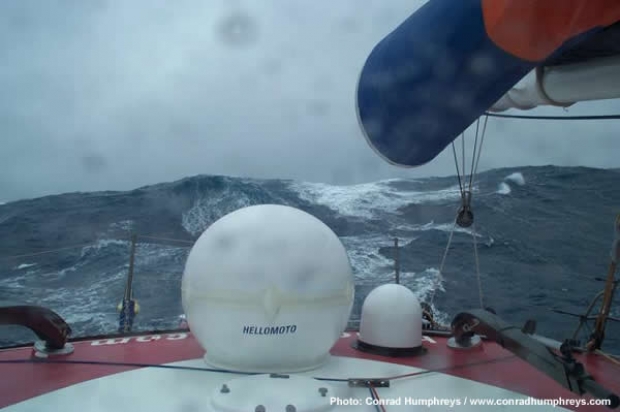
At 1900 GMT, in the middle of my last Southern Ocean storm before rounding Cape Horn, I felt
Hellomoto surge foward, the acceleration was breathtaking and I wondered exactly were this wave would end.
Hellomoto started to round up and I could hear the pilots struggling to keep her on course, eventually they succumbed and we ended up side on, skirting along the wave like a surfer in a tube. The sound was terrifying as the crest of the wave landed and the impact threw me across the cabin. As I landed so too did
Hellomoto, her powerful beam held her at 90 degrees, the mast in the water and angry foaming sea all around.
I ran on deck, expecting carnage and to me surprise apart from all the sheets and contents of the deck bags strewn everywhere, everything else was fine. The autopilot blinked '109' - no wind data - and above at the masthead I could just make out the vertical wand bent at 90 degrees. I reset the pilot and headed back down below to get my camera.
The waves by now were unbelievable, towering, arching with white water cascading down their faces, these were true Southern Ocean 'Grey Beards' and I wanted to capture them on film. I snapped a few pictures and just as I was about to head below, a wave caught my eye in the distance. It was 10 feet taller than the others and absolutely vertical in stature. I was momentarily transfixed by it as it reared up behind the boat. Then the top broke free and the crest fell like a waterfall. It hung there for ages, water tumbling down its face about five metres behind the stern of the boat. I dived down the cabin hatch, forgetting my camera and watched it sink below the stern of Hellomoto. What a spectacular sight!
I quickly prepared some dinner, beef stew, and ate it straight out of the pouch. The wind speed, I guess was now gusting the forecast 60 knots although without any wind instruments, I had no way of telling. The boat felt comfortable and apart from the occasional mad surf (one surf clocked 2 3knots with storm jib alone) I felt happy and climbed into my sleeping bag for some shut eye. As I drifted off listening to the wind outside, I became acutely aware of the sound of water swishing past the hull, only this time it sounded like there was more water swishing inside the boat than outside! Fighting the urge to sleep, I pulled on my boots, grabbed a head torch and went to investigate.
At 1945 GMT, I opened the internal hatch to the aft rudder compartment and suddenly became engulfed in icy southern ocean. The water level inside the compartment was at least half a metre and I could see exactly were it was coming from. A small plastic hatch that gives access to the life raft box had imploded from the force of the waves hitting the stern of Hellomoto and the water level was rising...fast. I had no time to think, I had only a few minutes at best before the autopilot's electronics, gyro compasses and communications aerials would all be under water. I ran back through the hull, visualising what I would need...Bilge pump hose extension, bucket, something to block the hole up with, survival suit.... I ran the hose and grabbed some batten lengths.

Autopilot electronics - vulnerable in a flood
There was no time to put the survival suit on, so I plunged back into the icy water and searched for the hatch that had been blown off the liferaft box, finding it right in the aft section by the port rudder quadrant. The water level now was above the doorway and water was running into the next compartment. The autopilot electronics where being splashed by the surge of water inside and much of the wiring was already underwater. The bilge pump was running, but not sucking and I could hear the motor running dry. I had to reduce the level of the water and the only way left was to open the hatch onto the deck and start bailing as fast as I could.
With one foot holding the liferaft cover hatch in place and the other trying to support me from the surge of water as Hellomoto rolled downwind, I opened the deck hatch outside, praying that there would not be too much water breaking over the boat. I began to bail and reckoned that after 30 minutes, I had reduced the level buy a third, with perhaps 1:4 buckets coming in through the top hatch and running straight down my neck! After an hour, I had reduced the level to the point that I could now try and fix the liferaft hatch. The emergency grab box floated past and I grabbing that and the battens, I wedged the grab box over the hatch, securing it using the battens. It still leaked, but would hold while I looked for something to make the repair more permanent.
Wading back through the next compartment, I suddenly felt overwhelmed by the size of the task. I had to find a fix to the liferaft hatch or head the boat more across the waves which increased the risk of being rolled. The water inside the hull was everywhere and it was only a matter of time before some essential electronics became wet. If I lost a pilot at this moment in time, I would have been forced to let the boat drift at the mercy of the waves. I became deeply concerned and shivered at the thought of failure. It was pitch black, apart from the dim light of my head torch and for the first time this race I felt really scared.

Above: the repaired escape hatch
I gathered some Sikaflex, tape, Vectran for lashing, more battens and some tools and returned to the aft rudder compartment to find the grab box had broken free, the hatch had ripped off and once again the water was flooding in. With my foot pressed against the hatch, I started bailing again and after another hour had the water level back to a safe amount. My brain must have been numbed by the cold, because it took me a while to find a more permanent solution to the hatch. The force of the water hitting it was immense, so much so, that at one stage, I thought the liferaft must have been sucked out.
Finally with a combination of lashings, battens and the grab box, I blocked the hatch. I bailed the boat dry and switched on the heater for the first time since the generator broke down to try and dry the boat out.
My next job was to make sure the autopilot electronics were still okay and I carefully worked through all the junction boxes ensuring no water had got in. No sooner had I inspected the first B&G pilot, the alarm was ringing and the boat off course. I switched to the emergency pilot and was very relieved when this fired up and began steering the boat downwind.

Above: new aft wand arrangement
Over the course of the next five hours, I had dried all the pilots and erected an emergency wind wand onto the stern of the boat. The storm had passed and while the seas were still huge, I felt like I had regained control of the situation. I changed into some dry clothes, had a pretty emotional moment with my shore team, before finally climbing into my sleeping bag at 1900 GMT 24 hours later the next day for some sleep.
Conrad
07:44 January 17th 2005
Position 300 miles west of Cape Horn.

Most Read
Most Commented
Comments
Businesses

Pro businesses
-
United Kingdom
-
France
-
-
Editor's choice
Member blogs
-
 Ned Collier Wakefield: MOD70 round BarbadosWell that was intense. 12 hard fought for seconds for the win. In idyllic conditions, Tony Lawsons MOD ...
 -
 Mini Transat leg 2 reportThe second leg of the Mini Transat started on 31st October, just over a month after ...
 -
Leg 1 reportI’ve been working towards the Mini Transat now for three years. In 2013 I was part ...
Business blogs
-
 The Island Sailing Club in Cowes, Isle of Wight, is delighted that Prince Michael of Kent ...
 -
Peta Stuart-Hunt chats with the 25 year-old British solo sailor Lizzy Foreman before she sets sail ...
-
The 2015 Student Yachting World Cup (SYWoC), an ISAF-recognised event hosted and run by students for ...
Editor's Choice
All time favourites...
-
 Three legs down into Ian Walker’s
 -
 Winning all but two races at
 -
 For the first time in its
Latest Comments
Add a comment - Members log in