
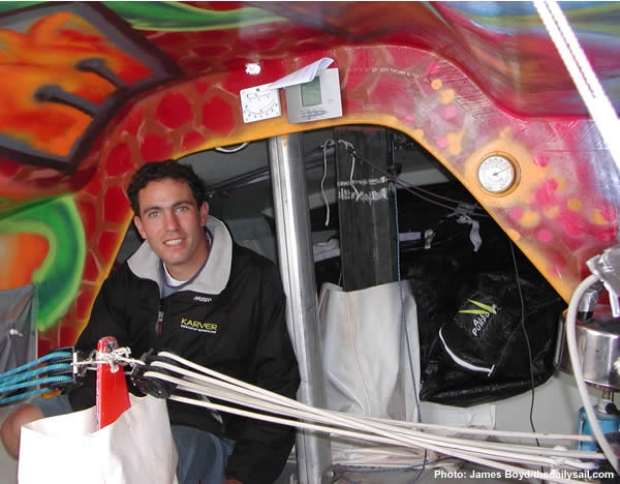
Designer-builder-sailor
Tuesday September 20th 2005, Author: James Boyd, Location: France
For race boat designers looking to make their mark in the world the Mini class holds the joint benefits of an open rule combined with relatively low cost for what is a high tech yacht.
The last decade in particular has seen a number of young naval architects taking their first steps professionally in the Mini, not only as designers, but also as builders and sailors: Sebastien Magnen, won the biennial Mini Transat in 1999 and 2001 aboard his design Karen Liquid, while Sam Manuard - today the most prolific of the 'proto' designers - came close to winning the 2003 Mini Transat before his boat was dismasted. (To confuse matters there is another Mini designer who's surname is Magnan).
For this Mini Transat the designer-sailor-builder mantle has been taken up by another former Southampton Institute graduate, Tanguy de la Motte, who's Set Environnement Pour Mecenat Chirurgie Cardiaque, aside from winning the prize for the longest boat name, is currently flying towards Lanzarote in 18th place (of 72) on the race's first leg.
While there are a couple of other skippers in the race who built their own boats, de la Motte is the only person to have handled the complete package on this occasion.
De la Motte is no stranger to boats of this type. In his final year at Southampton Institute in 2000 he worked as shore crew for Ellen's then brand new Open 60 Kingfisher over the period when the girl wonder was putting herself on the map by winning the monohull division of the Europe 1 New Man STAR, before embarking on the Vendee Globe.
In 2001 de la Motte worked as shore crew for Brian Thompson's Mini Transat campaign, sailing on board with Thompson in any two handed events. Thompson's Mini, a Simon Rogers design, went on to be sailed in the 2003 race by Olympic medallist and America's Cup sailor Jonathan McKee.
Following on from his work with Thompson, de la Motte set about his own Mini project. Between August 2002 and 22 February 2003 a total of 2,800 hours man hours were put into building the boat at a yard in Lorient.
The construction of the hull of Set Environnement Pour Mecenat Chirurgie Cardiaque is in carbon/foam sandwich, but all the internal structure was cut from pre-preg carbon/Nomex panels constructured by Green Marine. Unfortunately having seven months to go until the start date proved inadequate to qualify for the 2003 Mini Transat and with a big demand for places he found himself still on the waiting list come start day.
Having sailed and worked on Thompson's Mini extensively, his boat shares the same basic appendage concept with a keel that not only cants but can slide fore and aft, although he has improved upon it.
For starters the keel now slides fore and aft on plastic rather than metal track, that is not prone to corrosion. He has also moved the pivot point of the canting keel down to the hull exit. "That wasn’t the case with the Rogers boat - they had side to side movement and a big hole in bottom, which was not easy to fair. Mine is right on the bottom so it is only a 80mm gap, so it is pretty slick at the bottom," he says.
While the hole in the bottom of the boat to allow the keel movement is narrower sideways it is longer fore and aft as he has increased the distance the keel moves in this direction - the keel forward and aft positions are now almost a metre apart. The 1.2m long hole is partially covered by a plate on the outside of the hull and the underside of de la Motte's Mini also has a better shape to keep this plate fair with the hull. However the remainder of the aperture is filled by what he describes as 'lips'. "They curl inside the keel box rather than stay flat under the boat. On Brian’s boat it stayed flat so it was coming all the way back with a not-so-good fairing. With my curling system it is like a closed loop - so the back lip uncurls when the front lip curls, they follow each other [when the keel is moved fore and aft]. There are two pieces, attached in the middle - it is very simple."
A block and tackle system is used to move the keel sideways, while the lines controlling the fore and aft movement of the keel are led to the cockpit where while sailing they are operated from a winch - the keel can be moved fore and aft by hand when the boat is at standstill but not when it is loaded up.

De la Motte says basically the keel is put forward upwind and moved aft, to help keep the bow out downwind, but it is not quite this simple. "It also depends upon wind strength. When it is light wind downwind you put it forward to reduce wetted surface area at the back and that really helps. That is maybe one of the best uses of it." When it is light he can also lift the weather rudder out of the water. Being able to move the keel fore and aft also allows him to trim the boat so for example moving it fully aft downwind in big conditions makes a marked difference in enabling the pilot to steer the boat.
As Minis are so short and so light, weight is best concentrated around the mast. "I can keep all the weight pretty central, whereas people who can’t move their keel they have the keel far back and they put the weight further forward, which is worse, because the weight is a long distance apart and the centre of gravity is all over the place. And then the boat pitches too much in the waves."
With the canting keel his Mini uses another daggerboard to prevent leeway and as on Thompson's boat, de la Motte's design has a single daggerboard, which cants side to side like the keel. However a new variation is that instead of it being fixed and symmetric it is possible to rotate his board by up to +/-5 degrees to increase lift to weather.
De la Motte says that he only uses this rotation upwind. Attached to the top of the board are two purchases - the forward one is used to cant the board (like the keel) while the aft one is used to pull the trailing edge to leeward.
While the present trend for Minis is to go for maximum beam and derive righting moment from the hull shape, de la Motte says that the hull shape of his boat is not so extreme and doesn't have Bmax at the transom. "Mine is quite powerful. It is quite flat at the bottom with flat topsides and it has got a lot of rocker to use the longitudinal keel. It is quite powerful at the back and I tried not to have too much wetted surface, but as you have a wide boat you have to compromise between the two. The bow is fine and the topsides are pretty flat."
Since building the boat for the 2003 race, the Mini rules have changed to allow carbon masts. De la Motte says he would have liked to have designed a wingmast, but the cost was too great. Mini rigs tend to be very lightweight and the wingmast was also heavier. "I thought about different options and my rig was already designed, so I decided not to change the chainplate positions." His new carbon fibre mast is a tube of the same section built by Profil Composites (he built the carbon spreaders) and the result is now both stronger and more than one third lighter than his old alloy spar.
While most Minis have heavily swept-back spreaders to help protect their rig from user error with the runners, the lower spreaders on de la Motte's mast have just 10 degrees of angle to them. This enables him to tune the rig more and get more power from the sails. He adds that you have to be careful with the runners even if the spreaders are more swept back. "With the masthead rig you have to use the runners, so I don’t see the point [to have swept back spreaders]. It is harder with swept-back spreaders to take the mainsail down and it can damage the mainsail when you ease it too much." He uses Harken Magic Boxes to fine tune the runners.
Aside from going to a carbon fibre mast, the most dramatic development with his rig was going to only masthead sails. "My solent is masthead and 18sqm whereas most of the other boats are 14sqm on average and I have two reefs in my Solent whereas the other boats only have one and they reef to 10sqm and my first reef is 14sqm and then 10. So it is like having another sail. My first reef is always in position at the tack and I have a 2:1 rope like a Cunningham which I can operate from the cockpit and I just need to put a new sheet on the jib. So pull one rope and you don’t need to go on the bow. With the second reef, I don’t put it permanently, but I can use the same system in the same block and it will work exactly the same."
For downwind and reaching his boat has three spinnakers and a genniker - all of them masthead. A specialist sail he carries is a narrow heavy weather kite which can be gybed in front of the forestay. "It goes from the end of the pole to the masthead - it is very far forward. If I put it on the mid-pole it is not lifting the bow enough. So I go forward and usually I will keep my keel all the way back and the boat is pretty safe like that. I sailed like that in 35 knots with the spinnaker but that is a high range for solo sailing. Solo I would take it up to 30 knots before taking it down - it is still 45sqm."
He keeps two halyards permanently rigged for the downwind sails and a third for the Solent.
The biggest spinnaker he carries is just under 90sqm. "With the spinnakers, it is not just about area, it is about how balanced your boat is and light you are to go fast downwind. At the end of the day if it is 92 or 88sqm there is not much difference. If you go up to 110 - which you can on a Mini - then the skirt will always be in the water and if you make one little mistake you’ll be fishing. So you have to keep in mind that you are solo for 20 days and if you make one mistake one night..."

Obviously such sail combinations make for a fast boat. To date the speed record on board his boat is 19.6 knots - in 35 knots of wind with two reefs and a masthead kite. He says his record in the Mini was two handed with Brian Thompson when they hit 21 knots under fractional kite and one reef...at night.
To get to Lanzarote on the first leg de la Motte will also be relying on his autopilots and being able to maintain power for them. While Minis traditionally carry the smallest imaginable petrol generator, de la Motte says he has never used one on board and is relying on solo panels only. He has one mounted permanently on a special pole off the transom and he carries two additional flexible panels each able to generate 120w.
When he is not steering the autopilot is switched on. He uses a brain made by the French manufacturer NKE but with Raymarine electric (rather than hydraulic) rams. NKE he says came out with a new electronic ram last winter, but he hasn't had a chance to test it. "I know they are strong enough and it is quite cheap on energy," he says of the Raymarine rams. He also carries a back-up pilot system, a TP20, that is entire independent coming with its own built-in compass and plugging directly into the batteries.
While skippers are obliged to take time off the helm to sleep, eat, navigate, etc in the race's present downwind conditions they will stuck to their helms, as de le Motte says hand steering these boats downwind makes a marked difference in performance. Ideally he says he would like to sleep for five hours each day, but he can make do on four.
After the Mini, de la Motte says he would like to do the Route du Rhum and he would also like also to sail around the world - but not solo. "At the moment I want to be a technical sailor and then I want to be a yacht designer who sails. I think it is important to do both."

Most Read
Most Commented
Comments
Businesses

Pro businesses
Editor's choice
Member blogs
-
 Ned Collier Wakefield: MOD70 round BarbadosWell that was intense. 12 hard fought for seconds for the win. In idyllic conditions, Tony Lawsons MOD ...
 -
 Mini Transat leg 2 reportThe second leg of the Mini Transat started on 31st October, just over a month after ...
 -
Leg 1 reportI’ve been working towards the Mini Transat now for three years. In 2013 I was part ...
Business blogs
-
 The Island Sailing Club in Cowes, Isle of Wight, is delighted that Prince Michael of Kent ...
 -
Peta Stuart-Hunt chats with the 25 year-old British solo sailor Lizzy Foreman before she sets sail ...
-
The 2015 Student Yachting World Cup (SYWoC), an ISAF-recognised event hosted and run by students for ...
Editor's Choice
All time favourites...
-
 Three legs down into Ian Walker’s
 -
 Winning all but two races at
 -
 For the first time in its
Latest Comments
Add a comment - Members log in