
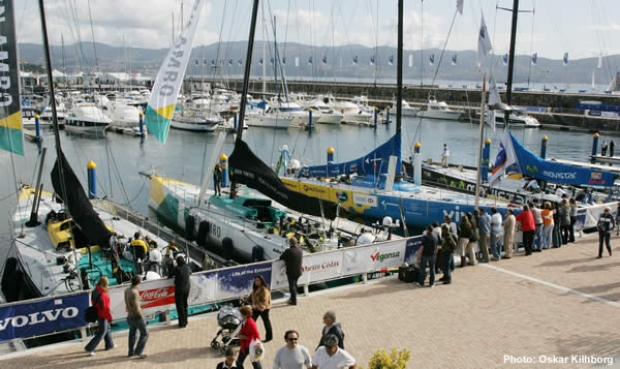
The Volvo 70s lined up outside Sanxenxo's Real Club Nautico
Letter from Sansenxo and leg one preview
Thursday November 10th 2005, Author: James Boyd, Location: none selected
Following last Saturday's in port racing, the start of the Volvo Ocean Race, the ninth fully crewed around the world race with stops since the inaugural Whitbread in 1973, kicks off in anger this Saturday. Oddly while all the build-up to the event has centred around the Galician seaside town of Sanxenxo, Saturday's start will be off Vigo, roughly 17 miles away by sea or a 45 minute drive once you have negotiated the numerous 'rias' along this stretch of coast.
At present the boats are moving to and fro between their show position outside the enormous brand new Real Club Nautico de Sanxenxo yacht club and the make-shift boatyard at the end of the docks where most of the teams have their containers and offices and two travel lifts seem to be in perpetual motion lifting boats out for final bottom scrubbings. The only boat not present this morning is movistar, Bouwe Bekking's Spanish entry which disappeared yesterday to Vigo where she and the Volvo Ocean Race were presented to 5,000 children from nearby schools. This was followed last night by an official reception at the Quinones De Leon museum in Pazo de Castrelos hosted by the Mayoress of Vigo Corina Porro. Movistar is due back in Sanxenxo later this afternoon.
The VO70s will be heading down to Vigo in a parade tomorrow (Friday) afternoon and will be berthed at the Darsena de a Laxe Friday night prior to the start at 1400 local time (1300GMT) on Saturday.
The question remains - will there be six or seven VO70s taking the start line on Saturday? Grant Wharington's Australian VO70 Premier Challenge only arrived in Sanxenxo at the beginning of the week and despite having her keel hacked around considerably is still having major rating issues. These are mainly to do with the trim of the boat and as a result the team are currently in the process of lowering the position of the front bearing for the canting keel pin. Fortunately the design of their canting keel accommodates this without the need to realign rams, etc.
The good news is that the Aussie campaign has a sponsor in Sunergy, who sponsored the Dutch Brunel Sunergy team in the 1997/8 Whitbread. The Dutch solar power company seem willing to back the team at least for part of their round the world record, however first the Aussie boat must become a VO70. The job list is still long, the boat is still out of the water and the clock is ticking.
The start on Saturday off Vigo will see the boats first head a mile up the Ria de Vigo to a turning mark before the boats return, recrossing the start line and on through three more gates close to the south side of the river before they head out into the open sea. There are spectator fleet demarcation zones, but if the water-born melee returns of a similar proportions or bigger to the one we saw last weekend for the in-port race, then the prospect of the spectator flotilla following the VO70s up the Ria in the strong wind conditions forecast and then the VO70s rounding the top mark before heading back through the spectator fleet seems like a disaster waiting to happen. Maybe the folks down in Vigo will be better behaved.

Above: the direct route according to the mandatory marks of the course. Below: the more realistic course taking into account a lap around the St Helena high pressure, normally located in the middle of the South Atlantic. Images courtesy of Expedition Navigation Systems

Once the start is out of the way, the wind conditions look set to be exceptional for the VO70s. A cold front is due to pass over northwest Spain in the early hours of Saturday morning, but once this has passed through 30-35 knots are forecast from a fraction west of due north, trade winds from the Azores high, positioned just north of the Azores. The forecast for the first 24 hours is more of the same with the high shifting slightly further north causing the gradient wind to veer round to the NNE. The boats will therefore depart Spain on starboard gybe and probably continue on to the right of the course as the wind veers - starboard gybe will still be favoured but they will have to start playing the angles. The advantage of heading right is that it will take them to the west of the Canaries and Cape Verdes, although when the trade winds are blowing it is important to give these islands room to weather in order not to get caught in their wind shadow.
If the speed of the VO70s is all that is promised and there is no flaw in the trades as the forecast at present indicates, then the boats should be past the Canary Islands within 48 hours and be tackling the Doldrums by day five. At this morning's press conference the navigators spoke to were anticipating a fast Doldrums crossing. Beyond this it is too early to say with any accuracy what conditions will be like once they reach the South Atlantic. At present the St Helena high looks like it will be a long long way south with a majority of the winds being easterly or northeasterly all the way down to 30degS.
After the start the next mark of the course is a waypoint gate off the Brazilian archipelago of Fernando de Noronha. The order of the boats here counts for half the full leg points (as do in-port races).
From Fernando de Noronha, the boats will normally have to sail almost due south in a giant parabolic curve to get to the finish line off Cape Town, in order to avoid being becalmed within the St Helena high. During this period the boats are likely to get their first taste of the Southern Ocean as they dip before 40degS, before emerging north towards the Cape Town finish.
There are many rumours flying Sanxenxo about the first leg taking as little as 17 days (illbruck took 29.5 from Southampton four years ago), but the likelihood is that the leg will be complete in 20 days barring hold ups in the South Atlantic.
Most Read
Most Commented
Comments
Businesses

Pro businesses
Editor's choice
Member blogs
-
 Ned Collier Wakefield: MOD70 round BarbadosWell that was intense. 12 hard fought for seconds for the win. In idyllic conditions, Tony Lawsons MOD ...
 -
 Mini Transat leg 2 reportThe second leg of the Mini Transat started on 31st October, just over a month after ...
 -
Leg 1 reportI’ve been working towards the Mini Transat now for three years. In 2013 I was part ...
Business blogs
-
 The Island Sailing Club in Cowes, Isle of Wight, is delighted that Prince Michael of Kent ...
 -
Peta Stuart-Hunt chats with the 25 year-old British solo sailor Lizzy Foreman before she sets sail ...
-
The 2015 Student Yachting World Cup (SYWoC), an ISAF-recognised event hosted and run by students for ...
Editor's Choice
All time favourites...
-
 Three legs down into Ian Walker’s
 -
 Winning all but two races at
 -
 For the first time in its
Latest Comments
Add a comment - Members log in