
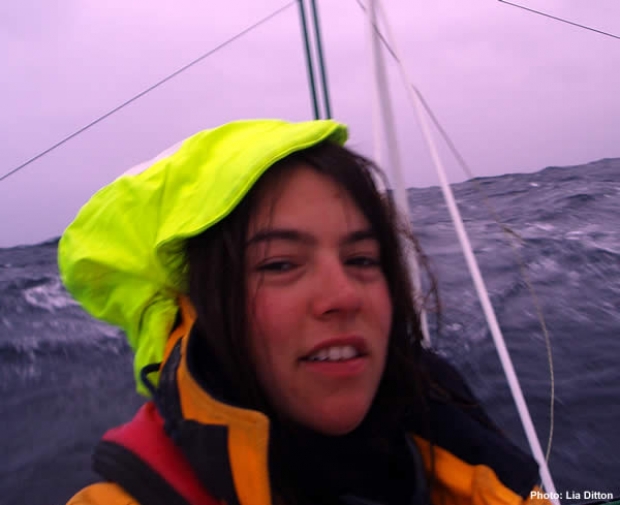
Bailing, bailing and more bailing
Monday June 6th 2005, Author: Lia Ditton, Location: Transoceanic
Lia has been sitting in a fog bank with 1.7kts wind, so after the stress of the previous day's weather and leaks, she has dropped the main and is currently concentrated on fixing some of the jobs to be done up the rig. She has the chafe on the halyard to fix and there is some work to be done on the the foil, which is basically falling apart but that appears not to matter in the short term.
She is not going to attempt any repair on it, as it is apparently too difficult. It doesn't look like its going to become any more damaged and the jib is still up and working fine. Lia has talked of maybe sewing loops on the old jib if the foil goes completely, so has a
backup plan in case of further problems.
Unfortunately Lia has some very small cuts on her hands, which are becoming pussy and swollen, but she has been in touch with Medlink to find the appropriate treatment in the comprehensive first aid kit aboard.
Lia is driving herself hard to complete all the jobs on the boat, and she is determined that nothing is going to stop her from getting to Newport. It's amazing that she still finds the time though to write so much about her experiences, giving us such a great insight to her voyage:
It is circa 5.30am your time. There is very little wind. We are trundling along making a few knots in the right direction. I write perched, as usual on the stretcher bunk. The 'luminous outline of the Muster Station' sticker glows on the wall in front of me, the O'ring heads of the Muster station family amusing me as usual, as my sole piece of home decor.
Dan [a.k.a Big Dan] , from Kentucky, Tennessee was working on a power boat with his girlfriend Mary, [a.k.a Big Mary] when I met him. He was keen to get in some racing on big boats. Big Dan proved such good comedy value, that he ended up joining us on the 'Bright Star,' (78ft R/P sled) for the whole season. Dan however was not a 'yachty' and
would complain, 'them rockstar racers are at it again, telling them same disaster stories.' He was refering to the America's Cup Contingent we had on the team whose favourite topic of conversation appeared to begin with, '...when I was...' or as Big Dan phrased it, 'No shit, and there I was!'
It was this phrase that sprang to mind this morning [WHEN I WAS..!] bailing out about two feet of water from the main cabin. Except it rang, 'No shit, here I am!'
At 7.29 BST I rang Simon. He had said ring anytime, although whether that was a phrase he meant or whether it was any anytime between Office hours [Monday to Friday 9am til 5] I wasn't going to deliberate now. I couldnt keep up with the inflow of water. Now leaks dont just happen. Unless you hit something [which I hadn't knowingly] they're on the whole a gradual process and I had come down below to thaw and catch a few ZZZZs after an uneventful night. I hadn't been down in the cabin for some time and we had been cracking some good speeds, so I simply put the excess of water underfoot, down to the standard waterline hatch leakage. I climbed into the bunk, paused to think about the volume that I had just mopped and peered over the side again. Da-nah! As if by magic the same volume of water had appeared again. There was no reason why a 3 litre [3pint Fl Oz] measuring jug should have found its way onboard [we had pre-mixed all the generator fuel] but I was suddenly very glad that it had. 'Got that sinking feeling?!'
I chuckled to myself. How many jugs full later, I wish I had counted, but the situation was clearly starting to become exasperating. A quick torch flash down 'The Energy Shop' [Appropriately branded with a Mastervolt sticker for its contents of everything vital: generator, batteries, pilot, electrics] and to my enormous relief, I see that the leak does not stem from there. It is coming instead from the main bulkhead area and trickling downwards. My first priority was to preserve the contents of 'The Energy shop,' whereby I built a small dam out of drybags and hoicked the rest of the contents of the floor [a further assortment of drybags containing spares] up and onto the bunk. I am not easily panicked, but the dam I had built would only be able to resist a water height of 3/4 of a foot max. The hour glass had been tipped and the sand was pouring out. Feeling furiously along the bulkhead and cabin walls, peering in for signs of cracks, it was at this point I stood back and rang Simon. I needed someone else to think with me and quickly. Perhaps there was something obvious I was missing. Finally I tore away the storage pockets and the small second shelf pocket on the port side exploded with a gush of water. The speed and depth [Transducer] wires fed through there from the forward compartment. The problem clearly lay forward.
What was happening appeared to be the standard bath-tub overflow affect whereby here, the water was being forced out under pressure around the electrical wiring cables. I could only conclude that there must be one heck of a lot of water up forward. Drastically, I cut the speed and depth cables [what was more important right then, ebbing the flow or observing the speed of which and depth to which we sank?!!] and looked around. What could I plug the cable holes with? Sikaflex wouldn't work, chewing gum would pop out. I didn't have a wine bottle cork to hand... But I did have a rather curious addition to my 'boat building repair kit;' a zippered pack labelled 'Kollision Kit.' Yep, Kollision with a 'K,' which I could only assume had been packed in by carbo-composite guru friend James Walker, and provided courtesy of the Ministry of Defense, who responded to an article in the Evening Herald [local Plymouth Newspaper] about me before the start. The instructions were very clear. Cut a piece of the fibre, apply a splodge of pot A [white in colour] and a splodge of pot B [black in colour] with the sticks provided and there were no prizes for guessing which colour these were to be mixed to. Miraculously the Kollision Kit patch stemmed the water and I breathed out a sigh of relief. My autopilot/instrumentation would get to live another day.
Armed now in full foulies, it was time to seek out the cause and I went up forward with the bailer, leaving my lifejacket behind. Now the forward hatch is not designed for access by a large person [the boat was built in the 1980's!] and I had early on in the race, frightened myself quite considerably, by leaning into the forward hatch to
retrieve something, with my lifejacket on. At this point a wave slammed the hatch cover into my back and my attempt to exit the hatch was foiled by my lifejacket which had ensnared itself round one of the handles. With feet dangling in the air, and head down the hatch, I was briefly reminded of a cartoon image I had seen in the American Yachting magazine 'Sail Magazine,' whereby a solo sailor in the Chesapeake, had had to be rescued because his automatic-inflating lifejacket had gone off while he was pulling his spinnaker down through the forward hatch. Luckily in my case, I was wearing a manual-inflate lifejacket and managed to wriggle my way out unharmed.
I attempt to peer in through the hatch but cant see anything through he drips of condensation that have gathered on the window, not a good sign in itself. The forward compartment is half full! No wonder that Shockwave has been ploughing water like a combine harvester ploughs a field. I begin to bail. And bail. And bail, using my body as a barrier between the hatch opening and the waves breaking over the foredeck. This worked as well as two steps forward and one step back, so it was time to address another dam-build and ease off the sails. With a collection of lines and fenders, I rigged a small barricade around the mouth of the hatch and climbed inside. The timing of the discovery and my desire for a nap had of course coincided beautifully, but I was now facing several hours at least of serious bailing, which could not be postponed. I would have to watch out I didn't become tired and overwrought. On the one hand, Appendix 13 [of the Team Shockwave contingency plan- impressively laminated and spiral bound by friend Andy Dare] claimed 'If serious flooding has occurred, stability may be affected and the trimaran may capsize.' On the other hand, Appendix 15 voiced the instruction - 'STAY CALM- Shockwave will float upside down.'
I did not, of course sit down and read this at that point, but had had a good chuckle at it some days earlier with that now clearly arrogant state of mind, 'that will never happen to me.'
I had said that I would ring back in an hour with a progress report. One hour had somehow become four hours and when I finally clambered over the cockpit pile-up of the contents of the forward compartment, I was still none the wiser as to the cause of the flooding. Unfortunately my absence from communication had caused some alarm and Falmouth Coast Guard and the Race committee had both been alerted that there was a problem. That there was and I was starting to grow a little fraught that I had as yet not found it. It was back to the forward compartment to get to the bottom of it.
While climbing back into the hatch, I noticed a small whitish shiny shape, which looked like a jellyfish. A jellyfish, from a distance one might mistake it for, but on closer inspection, the shape was distinctly round. It was a marble! 'How the hell did that get there?!' Before the thought had barely formulated, I knew the answer. Right before the start of the race, I had shaken hands on a bet with friends James and Simon, that I would find all illicitly-stowed items before Friday. It was now Sunday and I had clearly lost. The weazels! Marbles are dangerous!. I put it, along with its various six or so friends I continued to find, in my pocket all the same and relinquished myself to the fact that I was not yet a third of the way into my 2,500 mile treasure hunt.
Ecover support offshore sailing in more ways than just Mike Golding. Getting out of a drysuit or shedding a jacket, two fleece mid-layers and the arms of one's foul-weather salopettes approx every four hours for the simple necessity of needing the toilet is not only exhausting, but ruins my enjoyment of extreme offshore sailing. Surely I am not
alone, I thought? What do lady astronauts or fighter pilots do? Get plumbed in?! The answer presented itself quite swiftly into my qualifying passage, when the zipper of my drysuit got jammed. The trick was in finding the most suitable and structural bottle
[preferable tall and thin] to fit in down the trouser leg. My spare Ecover toilet bottle, now presented the solution to a further problem. The dinghy inspection-hatch cover was of too small a diameter for the measuring jug. The dinghy inspection hatch cover, sealed a further compartment beneath the forward compartment, which forms a very large bilge [spanning to the bottom of the hull] and is reinforced along the underside by a carbon fibre backbone. The contents of this second area, was annoyingly spilling out into the compartment in which I was sitting and in which I had thus far, spent close to five hours in total, bailing out. In shifting around some of the petrol containers, I discovered two now tragically wet magazines; 'Eve' and 'House Beautiful!' [Was that Simon's joke?] Not my usual choice of magazine by far, in fact I barely pick one up except to pass the time at the dentist surgery or while waiting for the hairdresser, but for some reason I was quite tempted to take a temporary 'abort mission' on the bailing and pick my way through their soggy pages. I suppose its like clearing out the spare room or the top shelf of your cupboard - one can easily get caught up reading old newspapers, letters and school books. However the buddist mantra 'Patience and Persistance and you are bound to be successful' restored my focus and I martred on with the bailing.
Several more marble discoveries later and all three foreward compartments [including the bilge and crash box] were now as good as dry. The thru-holes both appeared to be fine. I was hoping to find something easily rectifyable, but instead was drawing a blank. I went back and retrieved a flash light and lay on my front to reach in through the inspection hatch and feel along the join of bulkhead to daggerboard casing with my hand. It all seemed solid, except, uh-oh, about an 8ml thick by 100ml slot forward of the daggerboard's fore-aft alignment. I could stick my fingers in. The glass was soft. Any damage greater or further in from that point, I realised was out of my control. I couldn't get at the inside of the daggerboard sleeve even if I had seen something untoward. I confirmed my resolve at this point, to paddle if necessary in order to finish the race: I would just have to avoid any pounding in big seas. Another sticky patch from the 'Kollision Kit?' I considered. No, this was a job for sterdier stuff- time to break out the Under Water epoxy. Unlike pots A and B in the 'Kollision Kit,' clearly designed to make grey, there was no indication of what shade of green, to which I was intented to mix blue and yellow.
Judging by the size of the pots, 50/50 would not be too far off the mark! And so I concluded the morning's activities sticking green goop into a gap [we dont know if it was a hole]. I was fortunate that the weather eased off for the rest of the afternoon, in order to wipe and repack everything away. At 14.52 BST I finally climbed into bed. Only the imminent depression on Tuesday will determine if my efforts were a success.
Most Read
Most Commented
Comments
Businesses

Pro businesses
-
Italy
-
France
-
United Kingdom
-
Editor's choice
Member blogs
-
 Ned Collier Wakefield: MOD70 round BarbadosWell that was intense. 12 hard fought for seconds for the win. In idyllic conditions, Tony Lawsons MOD ...
 -
 Mini Transat leg 2 reportThe second leg of the Mini Transat started on 31st October, just over a month after ...
 -
Leg 1 reportI’ve been working towards the Mini Transat now for three years. In 2013 I was part ...
Business blogs
-
 The Island Sailing Club in Cowes, Isle of Wight, is delighted that Prince Michael of Kent ...
 -
Peta Stuart-Hunt chats with the 25 year-old British solo sailor Lizzy Foreman before she sets sail ...
-
The 2015 Student Yachting World Cup (SYWoC), an ISAF-recognised event hosted and run by students for ...
Editor's Choice
All time favourites...
-
 Three legs down into Ian Walker’s
 -
 Winning all but two races at
 -
 For the first time in its
Latest Comments
Add a comment - Members log in