

Damian Foxall - one lucky Irishman
Wednesday November 9th 2005, Author: James Boyd, Location: United Kingdom
This morning from his hospital bed in Brest, northwest France,
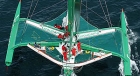
Foncia co-skipper Damian Foxall recounted his near-death experience during the capsize of his and Armel Le Cleac'h's trimaran in the early hours of yesterday morning.
So what happened? "It was a windy start. We had a fast reach [from Le Havre] out to Cherbourg. Then it was upwind so we stayed in contact and tacked down past Ouessant to try and get further south away from the most active part of the front. When we tacked down on to port, we were quick to reduce sail. We were sailing very close to Geant so we could see how we were progressing against them and we were really conservative always with at least one reef less than Geant. And in actual fact it paid for us, because we took 10 miles out of him over that evening period. I think some of their changes were costing them more because they were doing them later. So we were sailing conservatively and correctly and I think that is what helped us to be where we were."
We pause for a moment as a nurse changes a bandage to the occasional groan of excruciating pain from Foxall.

"And then the wind died from 35-40 knots to 20 for a period, but we still kept our three reefs in and the ORC up because we knew the most active part of the front was coming. We actually wanted to tack early because the front was coming towards us so we didn’t feel the need to go looking for it."
Foxall says they had been advised that the second cold front was "very active" with gusts of up to 50. This was subsequently moderately slightly by their weather router to 45. "It wasn’t anything that we didn’t expect. Maybe it seems silly now, but we were expecting it."
The capsize happened as they were about to go back onto the south-going starboard tack. "We were changing helm - so Armel took the helm and I was going down into the cockpit, just to organize the tack. The boat was pretty flat in the water with 20 knots of wind and just at that time a big gust of 45+ knots came through, with a big lift, and the boat just came up and by the time either of us managed to ease the sheet the sails weren’t pushing boat any more - the tramp was and over she went."
Most unusual was that the capsize was not a pitchpole - the trimaran was flipped over to starboard the mast crashing against the water before the boat fully turned turtle.
"Armel was at the helm and he fell as the boat capsized onto the main and he managed to get out from under the boat. I was in the cockpit. I managed to hold on to some lines [on the port side of the cockpit] and when the mast and boom hit the water I guess the mast must have broken because the boom was able to come and crush me against the cockpit winches, so my sternum was on the winches and my back was on the boom underpinning me. Then I guess a wave moved the boom and I was able to get out and get a quick breath of air from underneath the tramp and then swim out from underneath the boat. Then Armel helped me get on the boat. I had quite a lot of pain in my chest so I felt I needed to lie on my back so we found a place on the boat and I was pretty cold, so I had quite a few blankets, and my survival suit. Then Armel phoned ashore and organised things. He did a really good job."
In short Foxall can thank his lucky stars that he wasn't crushed between the boom and the winches. "Yes, the boom could have pushed a little bit harder or not moved. As it was it pushed all the air out of my lungs, so I didn’t have very much operating time. I was lucky enough that the boom did allow me to get free and get out." He was also lucky that once he had got away from the clutches of the boom and was caught under the trampoline (normally underwater when the boat is inverted) wave movement had allowed him to come up out of the water and get some more air before emerging aft of the back beam.

The ORMA fleet are fitted with an escape hatch in the underside of their main hull for this exact eventuality and Le Cleac'h had been able to quickly climb back inside the boat to call for help.
Foxall says he was surprised how quickly the trimaran capsized. "It lifted very quickly, and then it was like ‘this is it’. There is a point where you can’t do anything because the tramp and everything is what the wind is pushing against, so then you know you’re going over. Then there are a few seconds while the mast dampens the capsize effect. We didn’t have a lot of sail up so the boat was able to go over quite quickly, whereas if you capsize with full main it must go a lot slower. So it was quicker than I thought and we didn’t have time to react. It was a case of ‘jeez, here we go', hang on and then we were under water."
Normally the usual cause of 60ft trimarans capsizing is either because some key structural component such as a cross beam breaks - as happened to some boats in the 2002 Route du Rhum or the boat is under genniker and pitchpoles, tripping over its leeward bow. It is extremely rare for a 60ft long by 60ft wide trimaran, particularly one being sailed conservatively upwind, to be blown over by a gust.
Part of the issue was that the giant gust struck as they weren't trimmed up and sailing fast due to their being just about to tack. "At the time we had no manoeuvrability because there was only 20 knots of wind and we had very little sail up."
Once the rescue authorities had been alerted it was a case of stabilising the situation and waiting. While the incident of course happened in the middle of the night, rescue in the form of a French helicopter didn't materialise for 12 hours as they were 250 miles offshore. In his condition with what at time was thought to be a broken collar bone and bruised/fractured/broken ribs, Foxall was high-lined off the capsize trimaran and up to the chopper in a special basket. With the Ravussin brothers on board Orange Project to pick up subsequently, it was the helicopter crew who put Foxall on a drip and gave him pain relievers. Once the Ravussins had been rescue they touched down on the French helicopter cruiser, Jeanne d'Arc to refuel before heading on Brest on the northwestern tip of France and hospital.

In the hospital Foxall was X-Rayed and found that he was suffering from severe bruising as a result of his near-crushing. "Apparently I am okay. I think I might have dislocated something at some stage, a rib or something, but nothing is broken and it is just a case of three or fours weeks to recover. While I can now walk, it is quite painful. So now I am sitting in a chair but I am more comfortable lying on my back - it is more of a comfort thing. I was pretty weak."
At the hospital he consulted the doctors about how long it will take him to recover. They advised him that there should be no problem with him making the start of the second leg of the Volvo Ocean Race which he is due to sail as part of Torben Grael's Brasil 2 team.
What is most worrying about this incident are the potential repercussions for the ORMA class. While there was some reasonable excuses for the capsizes and demolition in the Route du Rhum three years ago when the boats were struck by 70 knot winds (in comparison for example the boats in the Volvo Ocean Race which had finished a few months earlier had rarely seen more than 35 knots), for a trimaran to be flipped in moderate conditions, even by an extreme gust, will demand some questions of the class. Yes, the incident happened when they were down-speed preparing for a tack when the gust hit, and this might have stood up as a reasonable excuse were it not for Orange Project flipping in a similar way just 25 minutes earlier...
"What could we have done differently?" continues Foxall. "Maybe we could have had the ORC on the deck rather than up at the time. Maybe if we hadn’t been doing the transition at the helm, then one of us would have been at the sheet so it wouldn’t have been a problem. It was a mix of bad circumstances really but unfortunately the Ravussins went over as well, so that is two boats that capsized around the same time. I think the boats that broke, aren’t necessarily the newer boats. The boats that are out there sailing now are the boats that have been sailing and racing hard all year.
"Two of us capsized and of course that is not ideal, but that is the bad end of the sport. I am not saying it is acceptable, but in Formula 1 there is usually a driver who crashes every race. I am not saying this is what we are trying to achieve with the ORMA class, but I think you can’t take every factor of risk out of the sport because to a certain extent that is what people like."
Foxall cites the example of the new Volvo Open 70 that is exciting interest in the yachting community because of its speed and crash and burn appeal, but which also bumps up the danger of sailing it in the process. "You can’t have an extreme and a fast boat without a certain element of risk attached. But I think the good side is that if you look at all the capsizes from the Rhum and the TJV, no one to date - or recently anyway - has had any serious injuries, so that is a positive."
Perhaps one issue that French race organisers such as Pen Duick, who run both the Route du Rhum and the biennial Transat Jacques Vabre, is over the timing of the start of their races - November is perhaps not the smartest time of year to be sending off a yacht race from the English Channel region.
"There is a certain value in that argument," agrees Foxall. "Starting from Portugal is a lot nicer than northern France or England. Having said that the boats are quite safe upwind, but certainly in more clement conditions it is safer. When you are going through active fronts like that it does make things a little more dodgey. I guess it is not ideal, but then the balance needs to be made between the hurricane season in the southern north Atlantic and the storm season up here. Even a few weeks earlier would help because November is traditionally the start of the storm system and every week you can gain in the other direction is probably worth it."
As the Foncia shore team head out into the Atlantic on board a fishing boat to recover the upturned trimaran tonight, so there are fears that the team's estate agent and property management sponsor, might not take kindly to this latest set-back. Foncia's skipper Armel le Cleac'h has only taken over from Alain Gautier as skipper for this season and it would be a shame if Foncia decided they didn't want to continue so early in their arrangement with their talented young French Solitaire du Figaro winner skipper. "I hope that any outside perception that we went off like mad dogs, are dispelled because we sailed conservatively and correctly and quite level. I think Armel has done a great job this season and he is going to go far. And the more I sail in this class the more I see I can be competitive in this class as well. I certainly feel now that I can sail with the best of them." Foxall for a while now has had his sights levelled on getting the first Irish ORMA 60 trimaran.
"I am just very sorry for everyone who has followed us and helped us. Everyone deserved a lot better than that and I know Armel feels that way too. We feel very responsible for what happened. I feel quite responsible. We’ll have to make up for it another time."
Most Read
Most Commented
Comments
Businesses

Pro businesses
-
United Kingdom
-
-
Italy
-
France
Editor's choice
Member blogs
-
 Ned Collier Wakefield: MOD70 round BarbadosWell that was intense. 12 hard fought for seconds for the win. In idyllic conditions, Tony Lawsons MOD ...
 -
 Mini Transat leg 2 reportThe second leg of the Mini Transat started on 31st October, just over a month after ...
 -
Leg 1 reportI’ve been working towards the Mini Transat now for three years. In 2013 I was part ...
Business blogs
-
 The Island Sailing Club in Cowes, Isle of Wight, is delighted that Prince Michael of Kent ...
 -
Peta Stuart-Hunt chats with the 25 year-old British solo sailor Lizzy Foreman before she sets sail ...
-
The 2015 Student Yachting World Cup (SYWoC), an ISAF-recognised event hosted and run by students for ...
Editor's Choice
All time favourites...
-
 Three legs down into Ian Walker’s
 -
 Winning all but two races at
 -
 For the first time in its
Latest Comments
Add a comment - Members log in