
Any other business
Tuesday November 15th 2005, Author: James Boyd, Location: United Kingdom
Before the boats got underway in the Volvo Ocean Race proper on Saturday we spoke to Neal McDonald, skipper of the Farr-designed
Ericsson and Mike Sanderson on the Juan Kouyoumdjian-designed
ABN AMRO One about some key technical and boat management issues.
To pole or not to pole
With teams hungrier than ever to reduce weight up top, one area of variation between the boats has been over whether or not they carry a spinnaker pole. The ABN AMRO boats made the call not to take one early on and the Pirates opted for this route much later in the proceedings. Meanwhile, Brasil 1, movistar and Ericsson are taking a pole. The arguments for and against are relatively straightforward. If one takes a pole there is the possibility of running deeper and making a performance gain on this point of sail. At present for example the boats are running and the lack of pole on the ABN AMRO boats perhaps explains why they are slightly further to the north west having not been able to sail so deep. Yet, they are not dropping off the pace.
Considering the speed of the VO70 and that the apparent wind angle, like a multihull or an Open 60, will be ahead of the beam most of the time, the occasions when boats need to square the pole are greatly reduced. No pole represents less weight and while the crew are limited to using A-sails, this comes with an ease of handling benefit that should help conserve energy for what is effectively a short-handed crew.
Spinnaker handling
Under VO70 rules - perhaps rightly or wrongly - masthead gennikers and spinnakers cannot be furled so teams have been looking at other ways of making their handling easier. On the ABN AMRO boats for example they use a spinnaker sock - a favourite on cruising yachts, but which a few companies such as ATN in Miami have developed for use on big multihulls and Open 60s. The sail is hoisted inside a lightweight sock with a composite hoop at the bottom. A line runs up the side of the sock in a separate pocket and when pulled this hoists the hoop up the mast, unleashing the sail, until the hoop is at the masthead, the bunched up sock above it. To dowse the sail another line attached to the hoop is used to pull the sock back down dowsing the sail enabling the socked spinnaker to be easily dropped. The theory is all fantastic except that spinnaker socks are notoriously prone to becoming entangled.
The weight issue
Another interesting issue is over each team's philosophy about weight. All teams are in agreement that with the VO70 able to cant its keel, popping the bulb up to weather, having the maximum percentage of the all-up displacement of the boat in the bulb is even more important than it was with the VO60. The VO70 box rule allows a displacement range of 12.5-14 tonnes and most of boats are believed to be on or close to the upper displacement limit. Simply - having more lead in the bulb and therefore more stability is faster than having a lightweight boat.
However where there seems to be some disagreement is over whether or not bringing on board more unmeasured weight such as crew gear is a good thing.
On Ericsson Neal McDonald is taking the traditional half a toothbrush approach: "The same rules as ever - no books, music, towels, no rubbish. Boots or shoes - you can use one or the other. Certainly in terms of spares we have been as sparce as we think we can but there are more unknowns this time than we would if we knew the boats inside out."

With this in mind in the days prior to the start Ericsson navigator and chief number cruncher Steve Hayles (above) was doing considerable head scratching over the calculation for how much fuel they should take. "That is a pretty scary number because we are reliant on it for so many things," he told us. The fuel drives the generator used to charge the batteries to power the all-important electronics on board, from the comms to the computers, performance instruments, radar, the pumps for the canting system, etc. "Lots of the media kit has only been fully operational recently, so we have had two days of working very hard to try and find out about that. So if you take full tanks that is 250kg potentially - but how much you need to take is a hard number to arrive at. We could not worry about it and play it safe but everyone is going to push quite hard as it is a downwind fast leg."
ABN AMRO One's Mike Sanderson takes the opposite view: "We are working pretty hard on seeing how much stuff people can bring!" There is no limitation under the rule regarding the amount in weight terms that the crew can take on board as personal effects and Sanderson takes the view that if all of this can be stacked there is potentially more righting moment to be gained from this. "We have built a stacking machine," he says. "The boat is very biased on getting weight on the rail. That is half of the reason why it is wider to give us more stacking power..." However he also admits that if the wind goes light then the added displacement on board will make it tough for them.

Watch systems
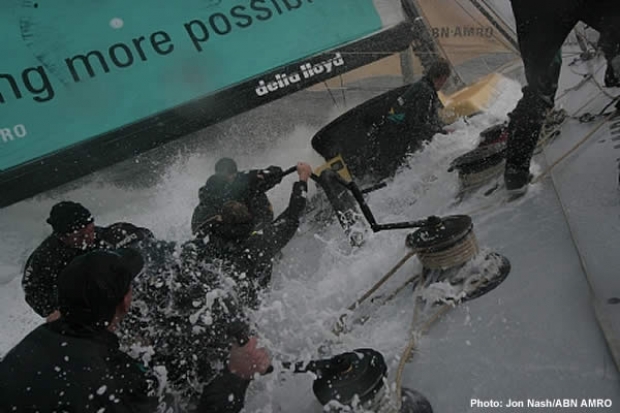
With 10 crew racing a more powerful 70 footer as opposed to 13 last time sailing the VO60, the new boats are effectively being sailed short handed and this will have some effect on the watch systems employed. The ABN AMRO boats and Ericsson use different watch systems but their skippers are in agreement that they will have to be more flexible about the watches than they have in the past.
"In essence we run a standard two watch system," says McDonald. "Within that there is a built-in standby type of regime. So we have got a clear plan of how we want to start but we are also very open minded about whether we need to change that process during the leg."
With McDonald and Hayles out of the watch system it will be effectively four on, four off and no standby. "It is going to be difficult to know how to use our time most efficiently," McDonald continues. "In the last race it was obvious that one of us, navigator or skipper, had to be up all the time. Maybe there won’t be that luxury this time. Maybe we have done three sail changes, Steve and I have been up 18 hours and we both have to go to sleep. That is going to be difficult to manage, but I have to try and monitor it. My biggest decision will be how much time I spend on deck. Inevitably I am going to spend more time than I did in the last race, but I have to monitor that I don’t get tired and then don’t monitor what is going on around us. That will be tricky, especially in these first few days."
On board both ABN AMROs they are running a rolling watch. "We may look at changing the watch system," says Mike Sanderson. "We have to make sure the guys don’t get too tired. So we run this rotational system, where there are two guys coming on every two hours and only keeping two watch captains. And it works really well, it's really smooth. I think it started on EF and we’ve been using it on Mari Cha. So there is no changing of the guard, the guys still get four on, four off, but it is two new people every two hours." As with Ericsson, skipper and navigator on ABN AMRO are out of the watch system.

How long to Cape Town?
One of the most impressive aspects of the new VO70s are their speed and one of the best indications of this are the first leg times that were being forecast prior to Saturday's start. While illbruck took 29.5 days to get from Southampton to Cape Town four years ago (Vigo is perhaps three days sailing down the track from Southampton, say 26.5 days), predictions last week were as little as 16 days to cover the 6,400 mile leg to South Africa. In fact the distance sailed is likely to be closer to 7,100 or 7,200 miles as the boats have to round the St Helena high in the South Atlantic, meaning that the boats will have to cover 450 miles day in day out to be there is 16 days. Unlikely...
"I have heard some ridiculous numbers," confirms Steve Hayles. "16 days? That’s bordering on impossible. Maxi-cats don’t get down there that quick. This is a fast forecast, but I’ve done hundreds of runs through 40 years of weather information and it comes out at 22 days average. I have heard lots of people say that their average is 18 days, but that is just plain nonsense. These boats just aren’t that quick. That is a sustained speed of nearly 400 miles a day every day for 18 days through the Doldrums, through the South Atlantic the whole way down through this leg. Getting down there in around 20 days would be quite reasonable. The models struggle to tell you how slow you are going to go through the Doldrums. You go ploughing through there at 12 knots on the VPPs with all the weather models but we all know that is not the case."
Mike Sanderson is being more optimistic. "I think inside 20 days. We have had some runs of 16-17 but most are 17-20, but we only know what is going to happen for the next few days. At the moment the runs are very quick because the South Atlantic is setting up as well, but it is way too far away. The scary thing is that they are talking about 6.5-7 days to Fernando de Noronha and that is quite impressive."
Maximum speeds
At present the maximum speed seen between ABN AMRO and Ericsson has been 34.4 knots seen on ABN AMRO 2's GPS. "That was on the white boat early on, but the speedo comes out of the water pretty early," says Sanderson. "Everyone is talking about the great runs that they have done and you hear about the huge mileages that people are pulling out. It is quite interesting for us to wonder around and see where everyone’s speedos are. Those who have them a long way forward I can tell you haven’t been upwind or downwind in big breeze, or they’d be moving their speedos aft, because otherwise they are measuring wind speed!"
Confirming this Neal McDonald says that they have seen low 30s on Ericsson, but beyond that their speedo has come out of the water. "Everyone talks about this massive 40 knots. But if we are going 40 knots I’m blowing up my lifejacket! You can only go so fast in a monohull. The average speeds will be high, but I don’t think the top speeds will be spectacular."
While speed and crew experience will be key features of winning this Volvo Ocean Race, none will be more important than minimising downtime. This is particularly important considering that the Volvo Open 70 is a new genre of boat and a majority of the boats in this race lack sea time. Neal McDonald expands on this: "Minimising downtime will be important - whatever format that takes: a ripped sail when you only have four spinnakers is going to be devasting. Any structural failures are going to make a big difference. But I think at the end of the day it is a case of keeping the guys together and learning as we go along. The people who learn the most in these early legs and put it into the rest of the race are the ones who will do well."

Most Read
Most Commented
Comments
Businesses
Pro businesses
-
Netherlands
-
United Kingdom
-
-
France
Editor's choice
Member blogs
-
 Ned Collier Wakefield: MOD70 round BarbadosWell that was intense. 12 hard fought for seconds for the win. In idyllic conditions, Tony Lawsons MOD ...
 -
 Mini Transat leg 2 reportThe second leg of the Mini Transat started on 31st October, just over a month after ...
 -
Leg 1 reportI’ve been working towards the Mini Transat now for three years. In 2013 I was part ...
Business blogs
-
 The Island Sailing Club in Cowes, Isle of Wight, is delighted that Prince Michael of Kent ...
 -
Peta Stuart-Hunt chats with the 25 year-old British solo sailor Lizzy Foreman before she sets sail ...
-
The 2015 Student Yachting World Cup (SYWoC), an ISAF-recognised event hosted and run by students for ...
Editor's Choice
All time favourites...
-
 Three legs down into Ian Walker’s
 -
 Winning all but two races at
 -
 For the first time in its
Latest Comments
Add a comment - Members log in