
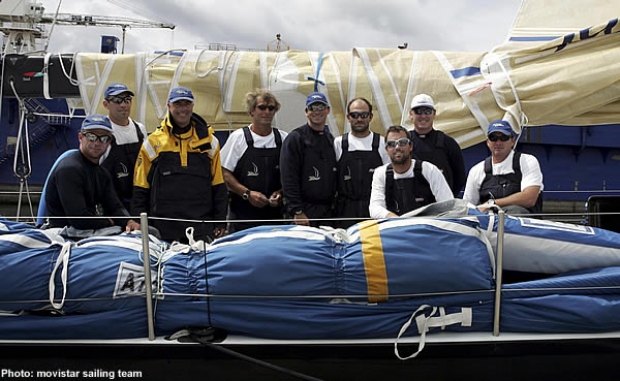
Spanish Volvo 70 reaches port
Thursday May 5th 2005, Author: Melendy Britt, Location: United Kingdom
Since she left Newcastle, Australia, on March 23rd, the Spanish Volvo Ocean Race boat has sailed a whopping 8.100 nautical miles, has crossed the always menacing Cape Horn, and has broken a world record by sailing 530.19 nautical miles in 24 hours.
It was a journey in which the movistar yacht has had to battle many adversities, including winds gusting over 40 knots, snow, humongous waves and a collision while sailing at speeds of over 20 knots. “It has been a typical Volvo Ocean Race leg," said skipper Bouwe Bekking, while grinning after experiencing four other prior editions of the VOR. "We have lived through the best and worse of ocean racing, but the final outcome couldn’t be better”.
“Everyone in the team is very excited with the results of the first leg," continues the General Manager and inshore helmsman of the team, Pedro Campos. "The journey from New Zealand to Rio de Janeiro is the most demanding one of the entire Ocean Race, and we have completed it in an impecable manner. Now, the crew will take a well deserved break to gain back strength, to spend time with their families, and to get ready for the next leg that will take them from Río de Janeiro to Galicia, Spain, where they will arrive in the beginning of June”.
The VO 70 movistar arrived to Rio de Janeiro shadowed by massive thunderstorm with 40 knots winds that propelled the Spanish boat during her last few miles. “After rounding Cape Horn, we gradually noticed that we were dressed overly warm; for which we were grateful for," recalled Olympic gold medalist, Xabier Fernández. “In a few days we went from 5ºC to almost 30ªC. Only on the final home stretch did we experience strong winds”.
“Most of us have sailed this race more than once before," continues Bekking, "but I must admit that on this occasion it has proved to be especially tough, as we have to get used to push to boat with a relative smaller amount of crewmembers than on the Volvo 60”.
“The shorecrew has been working flat-out since the arrival to Río. The boat has been out of the water, the rig has been taking apart, new appendages have been installed and all systems have been serviced, all according in the same timeframe as the next years stopover”.
On board diary: From Cape Horn to Rio
2.400 miles to Rio: Navigation from Cape Horn started off in harsh conditions, a very gusty wind blowing from the snowcovered mountains, very choppy seas, 25 to 30 knots of breeze, and extremely cold.
2.000 miles to Rio: Early this morning the weather was clear, a clear blue sky, 15 knots and the Falkland Islands were in sight. It is incredible what a little sunshine can do to people’s mind. Even though it is still quite cold on deck, the water temperature has gone up a bit.
1.750 miles to Rio: We have had a few days with almost no wind, somewhere between 5 and 10 knots, so we aren’t going as fast as we hoped. 1.750 miles in the Southern Ocean this would take us about three days and half, now it will be double. But that’s the way it is, we can’t change it. We just know that every mile more North means it is getting warmer…
1.000 miles to Rio: The water temperature is already 21ºC; it is a bonus to be able to take layers of clothes off. Last night, at last, the wind began to blow and we have been moving again fast miles towards our destination.
500 miles to Rio: Today has been slow, the breeze is coming again on the nose and very soft in pressure, plus a very nasty swell, it made navigation very uneasy. But now, we are starting to move again … The temperature is almost 25ºC, but we still need to have the foullies on, I tried not wearing them, big mistake. The three waves that hit us today, managed to hit me; so it is best that we all keep wearing them.
It is almost a full moon and we are enjoying the sight of a fascinating display of lightning of massiv thunderstrom far on the horizon. It is a beautiful show, but we are all thinking the same thing; ‘please don’t let it reach us'.
180 miles to Rio: We are in the middle of a huge thunderstorm and for a change; we have 25 knots of breeze… from behind!! We are “smoking” fast, doing 20+ knots straight to the barn.
Technology will make it possible to sail onboard movistar
The 2005-2006 edition of the Volvo Ocean race will have to comply with a new rule that brings major changes with respect to previous editions of this Round the World race. In the words of the VOR organization, the new VO70 rule was developed “with the goal of promoting innovation, creativity and skill, preventing big budgets from obtaining any advantages”.
The VO70 is a wholly new boat. Nobody has sailed on it before; all that is known about her is what her computers say about performance and theoretical behavior. The lack of actual data on the boat’s behavior before ocean sailing trials start is the same for all entrants. Bouwe Bekking, movistar's skipper,has no doubts about it, and that is why he is so keen on the training program. “Every mile sailed means information and experience. Everyone must get acquainted with a boat we have never sailed in before; many changes will have to be made before the race starts on November 12.”
Equipped with an impressive array of technology on board to assist him, Navigator Andrew Cape has his own views on this data collection exercise: “We have 30 sensors distributed all over the boat. The main ones measure boat speed, compass direction, wind speed and angle, and GPS position. During sailing, over 100 variables are recorded every second for control. All this information is compiled, analyzed and stored; we use it later to generate tables on the most appropriate adjustments for every different condition, to apply them during the race.”
“We use customized software developed specifically for this purpose, and record data around the clock. Our goal is to make comparisons as fast as possible to make the best decision, and therefore, the best way to sail the boat.”
Communication is one of the priorities in this year’s edition of the Race. “The boats will spend several weeks sailing on their own," says team head Pedro Campos, "but thanks to onboard technology, we will follow their every move as if we were there”.
Every boat will be equipped with 7 state-of-the-art TV mini-cameras and an editing studio to produce the weekly 20 minutes of tape that the organization demands (on earlier editions, only 8 minutes had to be filmed every week). “Shooting, editing and sending images via satellite is going to keep me busy several hours a day when I’m not on duty), commented Pepe Ribes. The Alicante-born Bowman will be in charge of choosing the best images of movistar, compress then and send them through the specialized equipment onboard.
This impressive display of technology aims to take this human challenge to a mass audience, through media coverage unparalleled in the history of sailing. “We have a red button on deck to capture the most relevant moments" says Ribes. "When you push it once, the cameras start shooting everything that happens. The mere thought of being able to tape what goes on at the Indian Ocean or rounding Cape Horn gives me goose bumps”.
The following equipment will be installed onboard the “movistar” for the reception and transmission of all the data required for navigation:
4 satellite-networked computers;
1 stern-mounted Fleet 77 satellite for high-speed data transmission (such as video transmission or weather data reception);
1 Fleet 33 medium-sized satellite (for lower power transmissions);
2 robust Satcom C satellites for low-speed transmissions (such as e-mail or position data reception);
1 radar;
1 satellite telephone.
“The movistar will be permanently online through the satellite," says Pedro Campos, "whatever her position on the planet. This is quite a landmark for communications”.
Eight months before the start of the race, communication experts from the Livewire company are working in the fine tuning of the system that will allow the boats to be constantly in contact with Volvo Ocean Race headquarters in Whiteley (south coast of England), the center for storage and distribution of all race-related information.
Despite the actual possibility of installing Internet onboard, the race organizers have chosen to restrict its use. “All the weather information will be received through the race office, every six hours", says Bekking, "and they will also handle all external communications. No external assistance is permitted during the race, and the use of Internet is strictly prohibited, to prevent any outsider from supplying information that may represent and advantage over the competitors”.
Andrew Cape adds: “In fac there are only three ways to know exactly where our competitors are: visually, if they are really nearby, through the mast-mounted radar, or waiting for the information update received every six hours from VOR headquarters.”

Most Read
Most Commented
Comments
Businesses

Pro businesses
Editor's choice
Member blogs
-
 Ned Collier Wakefield: MOD70 round BarbadosWell that was intense. 12 hard fought for seconds for the win. In idyllic conditions, Tony Lawsons MOD ...
 -
 Mini Transat leg 2 reportThe second leg of the Mini Transat started on 31st October, just over a month after ...
 -
Leg 1 reportI’ve been working towards the Mini Transat now for three years. In 2013 I was part ...
Business blogs
-
 The Island Sailing Club in Cowes, Isle of Wight, is delighted that Prince Michael of Kent ...
 -
Peta Stuart-Hunt chats with the 25 year-old British solo sailor Lizzy Foreman before she sets sail ...
-
The 2015 Student Yachting World Cup (SYWoC), an ISAF-recognised event hosted and run by students for ...
Editor's Choice
All time favourites...
-
 Three legs down into Ian Walker’s
 -
 Winning all but two races at
 -
 For the first time in its
Latest Comments
Add a comment - Members log in