
Technology comparison 1905 v 2005
Monday May 9th 2005, Author: James Boyd, Location: Transoceanic
In 1905, the New York Yacht Club's transatlantic race saw that era's most advanced yachts competing for the Kaiser's Cup. On 21 May the Rolex Transatlantic Challenge will be raced by their 21st century counterparts - a perfect showcase demonstrating the massive leap in sailing technology over the last 100 years.
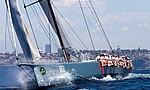
If, in winning the Kaiser's Cup, Wilson Marshall's 185ft (56.4m) Atlantic is taken as the benchmark boat from the 1905 race, then her equivalent a century later is Robert Miller's 140ft (42.6m) Mari-Cha IV.
Atlantic was built in 1903 at Townsend and Downsey in New York to a design by William Gardner of Gardner & Cox. In overall concept she had a 'classic shape' with long overhangs at the bow and stern - then considered radical for an ocean-going yacht. ("How would they handle slamming into Atlantic waves?" queried the press of the day.) Below the waterline, she had a long keel culminating in her rudder, but unlike similar yachts of her time, her centreplate and internal ballast had been removed and replaced by a lead keel just prior to the start of the 1905 race.
In comparison, Mari-Cha IV was built by JMV Industries in Cherbourg, France and launched in September, 2003. Her design team included naval architects Philippe Briand, Greg Elliot and Clay Oliver; project manager Jef d'Etiveaud; and racing helmsman Mike Sanderson. Her deck is much flatter, while her hull has more flair and is generally squarer with a near-plumb bow and a squared-off transom. As a result, Mari-Cha IV's overall length is some 45ft (13.7m) shorter than Atlantic's, but only six feet (1.8m) less at the waterline.
Below the waterline, design has advanced considerably over the last century with the rudders and keels now separated and becoming ever deeper and more slender. Mari-Cha IV has the latest in keel design, with a keel foil and 10 tonne bulb that can be canted up to 40 degrees each side driven by a powerful hydraulic ram.
Surprisingly, there are similarities between the two boats above deck, as both are schooner-rigged. Atlantic had three masts of increasing height going aft. Her principal sails - foresail, mainsail, and mizzen sail - were all hung off gaffs while each mast could be extended with a top mast, enabling extra sail in the form of a topsail to be flown above the gaff. From her bowsprit, Atlantic's crew could hoist a wide variety of headsails - including yankee-like flying jibs and obscure ones like the balloon jib topsail - to suit the conditions, with additional sails flown off the front of mizzen and main masts.
Among large, modern race boats, Mari-Cha IV is unusual in being a schooner (in her case with two masts of equal height). Compared to Atlantic, her sail plan is much simpler, with no gaffs or topmasts and with fewer, though generally larger-sized, sails. Developments such as roller furling headsails and powerful winches driven simultaneously by a number of pedestals have resulted in the need for fewer crew to tend the sails. The greatest developments, however, are in the materials used in her rig. All of Mari-Cha IV's spars are made of strong lightweight carbon fibre rather than wood, as on Atlantic, and her modern moulded North 3DL sails are lighter and hold their shape immeasurably better than the cotton sails used on Atlantic.
The most dramatic difference between the two boats is their weight. Atlantic was built of steel, while Mari-Cha IV was made from carbon/Nomex. While Atlantic was luxuriously fitted out below decks "like a Fifth Avenue apartment", Mari-Cha IV's interior is stripped bare in the modern race boat fashion, her accommodation free from any extraneous weight or luxury. But the biggest contribution to Atlantic's weight was her engine. Aside from being a powerful sailing yacht, Atlantic was fitted with a steam engine capable of delivering 300hp, but weighing over 50 tons - more than the up-all weight of Mari-Cha IV.
In essence, Mari-Cha IV is more powerful and lighter than her 100-year-old forebear, and perhaps the best demonstration of this is her performance. While Atlantic's best 24-hour run in the Kaiser's Cup was 341 miles (then a new record), Mari-Cha IV has covered more than 500 miles in one day and is thought to be capable of much more.
Yet not all has been forward progress. Over recent years, some older technology has begun to reappear on modern offshore race boats. Examples are rope lashings, to replace metal turnbuckles on standing rigging, and 'dog bones', versatile loops of rope with a toggle in one end, used in a variety of application from attaching the outhaul to the boom or sheets to sails.
Comparison specs:
Atlantic
LOA: 185 ft. (56.4m)
LWL: 138 ft. (42m)
Beam: 29.5 ft. (8.9m)
Draft: 17.5 ft. (5.3m)
Mast height: 125 ft. (38.1m),132 (40.2m), 137 (41.8m)
Weight: 206 tons (186,000kg)
Mari-Cha IV
LOA: 140 ft (42.6m)
LWL: 132 ft. (40.24m)
Beam: 31.5 ft. (9.60m)
Draft:21.3 ft. (6.49m)
Mast height: 140 ft. (42.6m),140 ft. (42.6m)
Weight: 49 tons (49,000kg)
Most Read
Most Commented
Comments
Businesses
Pro businesses
-
Italy
-
United Kingdom
-
-
France
Editor's choice
Member blogs
-
 Ned Collier Wakefield: MOD70 round BarbadosWell that was intense. 12 hard fought for seconds for the win. In idyllic conditions, Tony Lawsons MOD ...
 -
 Mini Transat leg 2 reportThe second leg of the Mini Transat started on 31st October, just over a month after ...
 -
Leg 1 reportI’ve been working towards the Mini Transat now for three years. In 2013 I was part ...
Business blogs
-
 The Island Sailing Club in Cowes, Isle of Wight, is delighted that Prince Michael of Kent ...
 -
Peta Stuart-Hunt chats with the 25 year-old British solo sailor Lizzy Foreman before she sets sail ...
-
The 2015 Student Yachting World Cup (SYWoC), an ISAF-recognised event hosted and run by students for ...
Editor's Choice
All time favourites...
-
 Three legs down into Ian Walker’s
 -
 Winning all but two races at
 -
 For the first time in its
Latest Comments
Add a comment - Members log in