
Last British hope
Tuesday October 11th 2005, Author: James Boyd, Location: United Kingdom
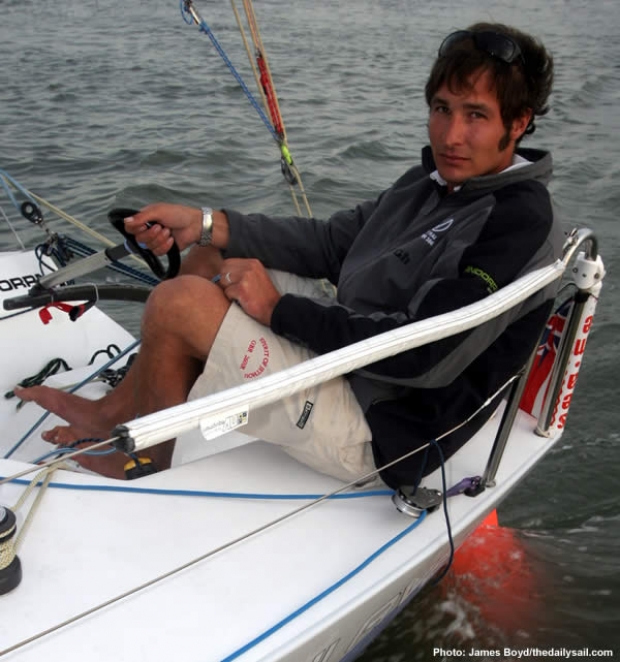
While Phil Sharp and Nick Bubb's ambitious circumnavigation of the Canaries may have left them wallowing at the back of the Mini Transat fleet, so British hopes now lie with Anglo-Swiss Mini sailor Tobias Hochreutener, this morning lying sixth in the 70 strong fleet.
Tobias has one of the strangest accents we have come across, mainly a light Irish lilt, but with flashes betraying his Swiss roots and the occasional Antipodean - inevitable for anyone who has hung around the international boating scene for some years.
Swiss born and bred, Hochreutener started his sailing on Optimists at an early age, and competed on the European circuit. When he was ten, his family moved to the UK and he graduated up to racing Toppers and then Lasers on Chichester Harbour out of Bosham Sailing Club.
Among his most formative years were the two he spent studying naval architecture at Falmouth College. During this time he was fortunate enough to meet the late Sir Peter Blake and get a summer job working on the then Team New Zealand boss' private yacht, Archangel. "Peter said if I passed my course - which was an issue that summer - I could come to New Zealand and work for Team New Zealand," Tobias recalls. In the end he helped deliver Archangel from Tahiti down to New Zealand and then worked on the weather team and as part of the shore crew at Team New Zealand for two and a half years during the 2000 Cup cycle.
Since the America's Cup Tobias has continued working on race boats around the world, most notably Adam Gosling's Yes! and Clay Deutsche's Swan 70 Chippewa in the US. For him the Mini is a step in the opposite direction - a opportunity to do some sailing for himself.
"Originally I wanted to do the Mini in 2003, but I was in the same boat as Nick [Bubb] - I was one place behind Nick on the waiting list. So here we are again...." he says. "I started doing my qualifiers really early in the spring of 2003 and didn’t make it. It’s funny because this time it has gone the other way. A lot of people who qualified early this year have not had a problem getting in because a lot have dropped out. For me, I guess it just wasn’t meant to be in 2003. In some ways it is not a bad thing, because it gives you another couple of years to prepare the boat properly, which basically it wasn’t for 2003."
Hochreutener's Mini, Complete Freight, he bought in 2002 from a guy he says had half built it and then bodged together the rest, sailed it in one race before choosing to quit with both money and girlfriend difficulties. "When I got, it was in quite a state, so we basically rebuilt it from scratch," he says.
The boat is a Proto, designed by Pierre Rolland, but differs significantly from most of the other modern Protos in that it's shape isn't like the forward 21ft of a 30 footer, with a massive saw-off transom as has been the popular trend among top Protos for a number of years now. Complete Freight has virtually the same beam max but in contrast has a relatively narrow transom. Significantly instead of having a canting keel, she has a fixed keel and is water ballasted.
"The last Transat was won by Moulin Roti, a water ballasted boat and there was a couple of water ballasted boats which consistently do well on the circuit," says Hochreutener. "I think upwind water ballast is possibly still faster on these boats than a swing keel. Power reaching, that is where the swing keel really comes into its own. I think most of it is still how you sail the boat and not the boat you have. The name of the game is pushing hard, getting lucky and finishing."
In addition to this, the boat is ultra light. While Minis normally weigh 800-1,000kg, Complete Freight is just 740kg. "When you are ballasted up you are up to about the same weight as your average Mini," he says. Being among the lightest Minis and with a narrower transom, Complete Freight prefers light conditions or sailing upwind or downwind - in contrast to the powerful transom boats relish power reaching.
Due to work constraints Hochreutener has done the bare minimum of racing allowed in order to qualify for the 2005 race. His best result to date in his own boat was a ninth place in the 2003 Course de Lyons, singlehanded in the Med, but sailing doublehanded with Phil Sharp they scored a second place in this year's Odyssey d'Ulysses. He says that to date Complete Freight hasn't had a massive speed deficit to the other boats, but the main issue has been in successfully keeping his boat together. During the Mini Fastnet this year his rig came tumbling down 400m from the finish line. "I needed to finish that race to do my one race this year to qualify," he says. "I was holding up the headsail and driving with the masthead over the back of the boat! Thank God it was downwind - and I finished, still in the top third of the fleet." The alloy mast broke at the top halyard exit for no apparent reason - it was blowing 12 knots and he says there was no handling or runner errors - however for some reason the spar manufacturer had drilled two halyard exits at the same height up the mast.
Complete Freight's new carbon fibre mast was made by Fibrespars in Croatia and Tobias says is considerably stiffer than his previous alloy one. The new spar is a lightweight tube. "The whole wingmast concept wouldn’t really work on this boat because it so light, I have to reef so early anyway. This boat is way powerful enough as it is and once you start reefing, basically the top of the wingmast becomes drag and it is not really necessary on this boat."
Down below the boat is 'massive' compared to other MInis. Her original owner was 6ft 4in tall and the boat was built with a slightly raised coachroof and there is no canting keel to take up the middle of the accommodation. "It has been known as the MiniBago on the circuit. I have had Nick [Bubb] come around and stay occasionally because his boat is too small. There is plenty of room on here."
In Hochreutener's opinion to do the Mini in a Proto currently costs between 60,000 Euros just to compete or around 160-170,000 Euros if you want to win. "I am running a middle of the road program in that respect, but like with Nick, our expenses have been going through the roof because we have been doing it for so long."
For the Mini he has Complete Freight as title sponsor. They are a two year old shipping company who are attempting to get the business shipping the Mini Transat yacht back from Brazil. They are perhaps best known for having shipped Mari Cha IV between the US and Europe. Tobias says he is running a 60-40 program between sponsorship and his own money. "I have been fortunate, because a lot of the time - like last year - I only did one Mini race and the boat was out of the water all the time. I have been busy working on boats and I haven’t had a chance to spend the money - but that has all gone now!"
While a few of the French teams are fully sponsored - there is massive interest in the event in France - and even Belgium sailor Peter Laureyssens has substantial backing from Wellments, a lot of Mini sailors, particularly in the Series fleet are amateur sailors who pay for their campaigns themselves. "The production boats are fantastic. You turn up with them at a regatta put them in the water and off you go. They are all pretty solid boats and you can still go and be competitive with them." Laureyssens has been achieving top 10 or top five results overall in the fleet throughout the year, despite sailing a Pogo 2 Series boat. To do a basic Series campaign Tobias reckons could be done for 40,000 Euros all up.
Currently 25 years old Tobias kids himself that he is doing the Mini to find out whether or not he enjoys singlehanded offshore racing. In fact one gets the impression there is no doubt he enjoys it. He would very much like to do an Open 50 campaign for 5 Oceans or his own Vendee Open 60, however the financial prospects of taking on either project are daunting. In the short term he reckons he'll be back working in an America's Cup team after the Mini.
On the first leg he ended up a disappointing 24th proto home. "I thought I sailed better than what my results reflect," he says. "I think it was a boat issue - it was not the right boat for that sort of sailing. I am not happy with the result, but I am happy with the finishing time, considering we are only seven hours behind 10th place and there is still all to play for. I am just hoping in the next leg we are better suited." They certainly have been and yesterday he and Complete Freight were lying in third place, although he is now sixth overall, the boat relishing the light upwind conditions.
Back to the first leg and the new generation Protos were able to make massive gains in the power reaching conditions. His start, like that of Nick Bubb, was slowed when six hours into the race - in the middle of the night - he ran over a fishing net. "It stopped the boat dead from about 12-14 knots and it was a serious bow down situation. Water came back pretty much to the end of the coachroof and then it fell on its side. The keel came out of the water so we cleared the top of the net, but when the boat recovered and we were heading back in the right direction there was this crazy crazy vibrating and I was worried that the keel might fall out of the boat or that we’d damaged the keel. So I was sailing downspeed for about 3-4 hours with three reefs and no headsail and no kite and then it stopped suddenly and another massive bit of fishing net came out of the back of the boat. After that it was all sails back up and off we went."
Apart from this, the big downwind conditions were the main feature of the first leg he says. "The whole way the conditions were pretty awesome. We were doing 200 mile days one after another which is pretty unusual on a 21ft boat. The waves and conditions out there allowed us to go fast. We could have gone faster but the sea state got pretty bad towards the end and we ended up sailing with fractional spinnakers when you could have had a masthead kite up but with the way the seas were it would have just pulled the rig out of the boat."
However the big conditions also proved mentally most challenging. "It didn’t once allow for much rest. There was never a period where you could put the autopilot on and sail the same speeds you would if you were driving. So it was really hard to get into any routine. We averaged close to 20 knots wind speed for the whole leg. The wind itself wasn’t the problem, we had quite a confused sea state and you couldn’t really let the autopilot drive with masthead kite up so if you ever wanted to get any rest you had to change down to fractional or even genniker. It was a Catch 22 situation - every time you wanted to get some rest you changed down and sailed down speed but then you can’t get any rest because you know other people are sailing faster than you. I slept about 1.5 hours a day all the way down here."
During the first leg a majority of the problems boats faced were rudder damage due to collisions in the Bay of Biscay - Hochreutener says he kept a log book of all the things he hit - and sail damage due to wrecking kites in the big rolly conditions. However compared to previous years the carnage was small. "The general consensus is that the fleet is so much better prepared than in the past. You can’t just turn up any more and go sailing, you have to do a fair amount of sailing just to get into the race. They [Classe Mini] have tightened up on the rules and on what you need to carry and if they see something they don’t like or won’t hold. They won’t let you start until you’ve fixed it." On board Complete Freight he suffered no gear damage on the first leg.
When we spoke to Tobias on Friday he was looking forward to the second leg and the forecast conditions. "A bit of upwind and a bit of downwind and then some light stuff through the Doldrums would suit us fine. It is going to be very crucial to pick your way through this upwind stuff and through the change over period before the Trades kick in. There will be massive gains and losses all round. It almost makes the times of the first leg fairly insignificant because the times are so close in the top 30."
The Doldrums, as ever, will be the trickiest part of the course where the biggest gains and losses stand to be made. "I am working with Commanders Weather and a few other people on that and the problem is that but there is going to be a slow start to the leg which delays our arrival at the Doldrums even further. Which means that anything they forecast is going to be even more inaccurate. They are going to give me likely scenarios and I am just going to have to make a decision after the Cape Verde. So it will be make a plan and stick to it. Two years ago people went way out west and made massive gains. It will be very position dependent as well. If you are right up there you might as well sail a little conservative but if you have got nothing to lose, you might as well try something else."
While Classe Mini are anticipating a crossing to the finish at Salvador de Bahia of as little as 18 days, Tobias reckons his time will be closer to 22. "We are all working on 25 days for food."
More photos of Complete Freight on page 2...

Most Read
Most Commented
Comments
Businesses

Pro businesses
-
United Kingdom
-
United Kingdom
-
Italy
-
Editor's choice
Member blogs
-
 Ned Collier Wakefield: MOD70 round BarbadosWell that was intense. 12 hard fought for seconds for the win. In idyllic conditions, Tony Lawsons MOD ...
 -
 Mini Transat leg 2 reportThe second leg of the Mini Transat started on 31st October, just over a month after ...
 -
Leg 1 reportI’ve been working towards the Mini Transat now for three years. In 2013 I was part ...
Business blogs
-
 The Island Sailing Club in Cowes, Isle of Wight, is delighted that Prince Michael of Kent ...
 -
Peta Stuart-Hunt chats with the 25 year-old British solo sailor Lizzy Foreman before she sets sail ...
-
The 2015 Student Yachting World Cup (SYWoC), an ISAF-recognised event hosted and run by students for ...
Editor's Choice
All time favourites...
-
 Three legs down into Ian Walker’s
 -
 Winning all but two races at
 -
 For the first time in its
Latest Comments
Add a comment - Members log in