
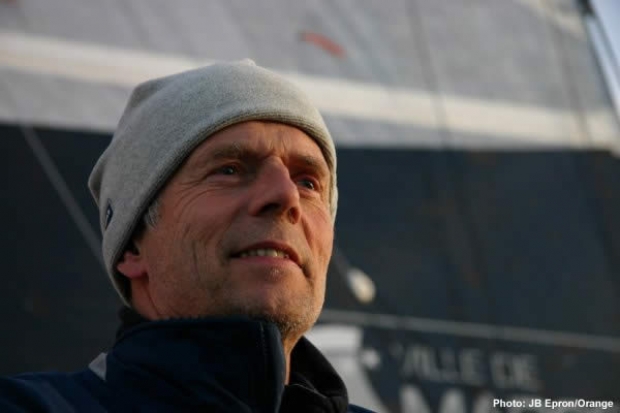
From the chart table of the world's fastest boat
Tuesday March 1st 2005, Author: James Boyd, Location: none selected
A man who has spent most of the last month huddled in 'his office' at the stern of the starboard hull inside a fast moving 120ft multihull is Swedish serial round the world sailor/navigator/doctor in one Roger Nilson. Although well known for his five round the world races on the Whitbread/Volvo Ocean Race, Nilson has been sailing large ocean going racing multihulls with skipper Bruno Peyron sporadically since the 1980s and is now a complete convert to these boats.
"I think in my sailing life it beats anything I have ever experienced in sailing, I can tell you," says Nilson of his present voyage as navigator on the 120ft maxi-catamaran Orange II.
Over the 36 days Orange II has been at sea so far on her present voyage, ten have been spent covering more than 600 miles every 24 hours, 18 days have been between 500 and 600 miles, just four have been between 400 and 500 and another four between 300 and 400. On their slowest day the orange and black-hulled maxi-catamaran covered a mere 350 miles. On their fastest day they covered almost twice this distance - 697 miles. Orange II's speed is nothing short of exceptional, when you consider that it was only eight years ago that the record for the biggest distance covered in a day on the ocean wave stood at just 540 miles. More than half Orange II's round the world voyage to date has been spent in excess of this speed. Few would contest that Orange II is now the world's fastest ocean race boat.
"So far we have been truly very very lucky except at the beginning of the Atlantic above the Cape Verde islands where we had two very bad days. But we still got to the Equator in 7 days and 3 hours," says Nilson of the weather they have encountered to date. "Since then of course we did a lot of gybing in the Southern Ocean because we had a lot of westerlies and dodging a lot of ice. If we had been able to sail freely [ie if they hadn't had to go north to avoid the ice in the Southern Ocean] we probably would have been another day ahead."
While the light conditions to the north of the Cape Verdes were unforecast, to date Orange II has not encountered light or majorly adverse conditions on her voyage. Despite having few weather hurdles to jump this time around nonetheless Nilson has been having to work hard. "Down the Atlantic I don’t think I slept more than four hours a day and in the South I think it was a little bit better - six hours maybe. And now it is very tough because there are so many things to check out and do all the time."
On the Jules Verne Trophy/non-stop round the world record anything goes in terms of routing and shore-based assistance. Nilson says he has been working with the team's Swedish computer guru Eduardo Valderas who has been compiling all the data Nilson requires and regularly beams it across to the boat. "I also have some meteorological advice when I need it from Roger Badham. But he is working for Team New Zealand so it is not like it is full time work for him but je is very helpful," says Nilson.
While the crew have been lucky with the weather, this is also part of the 'big cat' experience. When you are able to average 25 knots, only the fastest moving weather systems overtake you. Thus it is possible to play the weather, to place the boat into the optimum part of a weather system for sailing fast, such as the northeast corner of a Southern Ocean depression where the wind is northwesterly and the water relatively flat.
Nilson says that the only occasions they have backed off was due to the sea state. "Wave action made us a little bit careful. In general terms we have been very lucky not to have too strong wind. The strongest wind we have seen was coming up to the Falklands when there was 50 knots. We hadn’t seen that before. Part of that period we were behind the Falklands so that was quite good, but before the Falklands we had some very rough seas and 50 knots of wind when the front passed. So you take it a bit easy then."

But they have not had to back off nearly as much as the older generation maxi-multihulls and this is the principle reason why Orange II has been able to make such a quantum leap in speed across the ocean compared to earlier G-Class maxi-multihulls. "On the old boats you would be under three reefs and a staysail, yet we managed to keep up two reefs and a staysail, which is amazing," says Nilson of how they coped in 50 knots. He previously sailed around the world in The Race on board Innovation Explorer (subsequently Kingfisher II) one of the three Mk1 Ollier & Associates G-Class maxi-catamarans.
More specifically they have been able to drive the boat much harder due to Orange II's massive freeboard that keeps the cross beams, particularly the forward beam, clear of the water. This development in ocean racing multihull design, that reduces the occasions the boat is slowed when at best the forward beam buries or at worst when the boat trips over its leeward bow, has also proved a feature on Ellen's new B&Q Castorama trimaran and Steve Fossett's PlayStation.
"On the old boats as soon as waves hit the crossbeams you have to slow down," says Nilson. "On this waves have never hit the crossbeams hard. The boat has never stopped. I call the boat a 'flying sailing ship'. Of course the freeboard is higher. It is mainly to do with that. It could also have something to do with the size, the waterline length." Orange II is 120ft (36.8m) compared with 110ft (33.5m) of the first generation Ollier G-Class maxi-cats.
With the fear of burying the forward beam or pitch poling all but removed and modifications made over last winter to her rudders, the crew's enjoyment of sailing the boat has vastly increased says Nilson. "I think the helmsmen love the boat now. Last year there was no trust in the boat because the rudders were wrong or too small and there was a feeling of insecurity about the boat. Now the feeling is the opposite. The boat feels very safe. We have had no cavitation or spin out. Nothing. And of course Bruno is extremely skilful, like a Formula One driver, in knowing when to push and when to back off a little bit. It is not like you can push full on in every condition because you can’t do that in a multihull - you have to back off. And then there is the key factor of the crew who is also very responsive to that."
Her high freeboard along with a lack of heel also hides how fast the boat is going. Usually on big mulithulls the only way to tell the speed of the boat (aside from cheating and looking at the B&G) is examining how far off into the distance you can see the wake or whether the blast of apparent wind across the deck is strong or very strong.
Even when the daily runs are approaching the 700 mile mark Nilson says the ride does not feel that scary. "We did one 687 mile day and one 690 and both these days we would have easily broken the 24 hour record if we had pushed - easily - but there was no aim to do that. 690 miles - it was a nice day! The more scary thing is sailing at night and in fog during the day when there is no radar."
In fact Nilson has bolder claims to make: "I reckon that this boat is a lot safer than any monohull I have ever sailed in the Southern Ocean. It is a lot safer for many reasons - firstly the crew is a lot safer. They are never thrown around by waves and they have a very stable platform. Of course there is a risk you can tip over a boat like this, but with a full professional crew you don’t do that. You can get thrown over by a very vicious squall in the middle of the night in the Southern Ocean, but Bruno is very careful and when you have these conditions you underpower the boat at night because you can’t see squalls. You have to be smart and wise, but the platform, as a place to be on, I have never felt more safe in my life going around the world than I do on this boat." Nilson was part of a concerted effort made during and immediately after the last Volvo Ocean Race to get the fully crewed round the world race to adopt large multihulls instead of another monohull.
The greatest hazard on this voyage has been ice. Following the reports from the MRCCs in New Zealand and Chile, along with the sightings in the Vendee Globe, Orange II sailed many miles further north than she needed to while she was in the Southern Ocean. Hitting an iceberg of any size on any vessel is dangerous, but on one with the speed of Orange II it can be fatal, says Nilson: "If you bang into something at 30 knots it is like crashing a car into a brick wall at that speed - you kill people just from the impact. So the skippers of these boats with good reason are very prudent, very careful."
Their new radar set hasn't worked since the start of their round the world voyage, but Nilson says that even if it had it is likely they would still have stayed north in the Southern Ocean. "The radar can create a false sense of safety. You see the big bergs but not the small ones and you can be lured in."
They have also been extremely fortunate to have suffered no major gear breakage or failure. Nilson attributes this to the crew. "We have a very good, very professional crew. They are extremely careful with the boat, continuously checking things. The boat has not been slowed down once because of a gear failure, which is extraordinary. Once we bailed out to the south of Australia because it was very bad sea and we broke a block and some teeth in a runner winch which was holding the preventer. It was the preventer block that broke and the winch became overloaded. That was the only damage and that was due to wave action and didn’t influence the speed of the boat. So we gybed and got out of that place and the waves were better.

"Occasionally Bruno slows down a little bit because of fatigue. When he feels that some of the crew members are very tired then he backs off a little bit. But that is what you have to do with a multihull of this type. The crew is a tool. The loads…the main sheet is 20 tonnes and the genniker halyards are the same. It is a crewed machine."
Early on Sunday evening Orange II collided with what the crew assume was a whale and as a result sustained slight damage to her port rudder. But this has had little affect on her pace.
"The sad thing was for this animal - we don’t what it was, a small whale or something," recounts Nilson sadly. "The boat didn’t stop, but certainly it made a big impact. Unfortunately it was in the middle of our Cape Horn dinner. It was the first time we were all together. This trip we had a total of two bottles of wine and we were each drinking one fifth of a mug of wine and eating duck being thankful for getting out of the Southern Ocean without damaging the boat with ice or anything, when we hit the whale or whatever it was. I looked out of the cockpit and it was just a big whirlpool of blood and turbulence behind the boat. Some people saw the tail fin going down. It was bleeding very heavily. It is like when you hit something on the road. I hope the shock took care of it, because it was not in good shape."
The whale collided with the daggerboard and the rudder on the port hull. The daggerboard appears to be okay - it still goes up and down - but the blow to their port rudder ripped off the cavitation flange/plate that goes around the rudder one third of the way down from the hull.
"From the outside you see the rudder very often out of the water and it looks like a black band, 5 inches wide vertically right across, like a black tape put around the middle of the rudder," Nilson describes the damage. "Obviously it is one skin, the outer longitudinal which has come off. The boat builders don’t know exactly if we can do something. We have lamination gear for underwater work, and we will stop and have a look at it when we cross the trough between this system and the high pressure and the trades."
While there appears to be no structural damage to the rudder the worry is that with the rudder going through the water at such high speed the impacted area could start to peel open. Since the incident the crew have been able to keep the boat on port gybe relieving the pressure on the rudder. Tommorrow once they're into the light winds of the transition zone they will stop the boat and send a diver overboard to assess the full extent of the damage, but at present the assumption is that the damage is not serious and it is almost full steam ahead to the Ushant finish line.
Even with a stop tomorrow in theory the team are still on track for a sub-50 day circumnavigation, making Bruno Peyron the first person to take the non-stop fully crewed round the world the world record below 80 days, 70 days and (touch wood) 50 days. Nilson rightly won't be drawn into theorising about this. With this collision they have been lucky. Last time when they set the record on Orange 1 a break in the titanium ball on which the mast sits nearly suppered their chances in the North Atlantic.
"We have a long way to go," is all Nilson the wise will commit to.
Most Read
Most Commented
Comments
Businesses

Pro businesses
-
United Kingdom
-
United Kingdom
-
France
-
Editor's choice
Member blogs
-
 Ned Collier Wakefield: MOD70 round BarbadosWell that was intense. 12 hard fought for seconds for the win. In idyllic conditions, Tony Lawsons MOD ...
 -
 Mini Transat leg 2 reportThe second leg of the Mini Transat started on 31st October, just over a month after ...
 -
Leg 1 reportI’ve been working towards the Mini Transat now for three years. In 2013 I was part ...
Business blogs
-
 The Island Sailing Club in Cowes, Isle of Wight, is delighted that Prince Michael of Kent ...
 -
Peta Stuart-Hunt chats with the 25 year-old British solo sailor Lizzy Foreman before she sets sail ...
-
The 2015 Student Yachting World Cup (SYWoC), an ISAF-recognised event hosted and run by students for ...
Editor's Choice
All time favourites...
-
 Three legs down into Ian Walker’s
 -
 Winning all but two races at
 -
 For the first time in its
Latest Comments
Add a comment - Members log in