
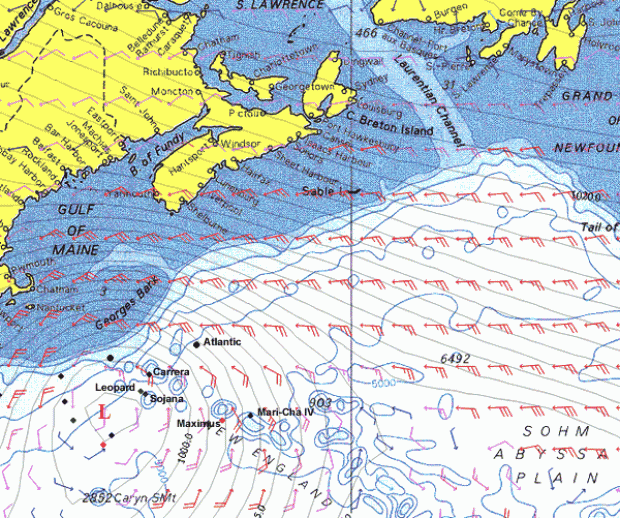
Positions and weather at 2000GMT
Getting into hot water
Wednesday May 25th 2005, Author: James Boyd, Location: Transoceanic
Positions at 2000GMT
| Boat | Cl | Position | DTF | DTL | Crs | Spd |
| ATLANTIC (1905) |

|
40°19' N 64°47' W | 2523.3 |
|
105 | 8.5 |
| MARI-CHA IV | GP | 38°36' N 63°08' W | 2537.2 |
|
118 | 10.8 |
| MAXIMUS | GP | 38°30' N 64°00' W | 2569.6 | 32.4 | 122 | 10.2 |
| CARRERA | GP | 39°37' N 66°17' W | 2603.7 | 66.5 | 122 | 7.6 |
| SOJANA | P1 | 39°08' N 66°24' W | 2626 | 88.8 | 129 | 7.9 |
| LEOPARD | P1 | 39°12' N 66°33' W | 2628.5 | 91.3 | 129 | 7.7 |
| DRUMBEAT | P1 | 38°55' N 67°07' W | 2659.8 | 122.6 | 138 | 7.6 |
| STAY CALM | P2 | 39°16' N 67°48' W | 2671.9 | 134.7 | 141 | 6.9 |
| WHISPER | P2 | 39°15' N 67°51' W | 2673.9 | 136.7 | 142 | 6.9 |
| WINDROSE** | P1 | 38°46' N 67°41' W | 2686 | 148.8 | 145 | 7.9 |
| SARIYAH | P2 | 39°07' N 68°06' W | 2687.9 | 150.7 | 147 | 6.9 |
| TIARA | P1 | 38°38' N 67°56' W | 2700.4 | 163.2 | 150 | 7.5 |
| ANEMOS | P1 | 38°46' N 68°27' W | 2713.9 | 176.7 | 155 | 7.1 |
| OCEAN PHOENIX | P2 | 38°55' N 68°43' W | 2718.4 | 181.2 | 158 | 6.9 |
| TEMPEST | P2 | 38°08' N 68°06' W | 2725.6 | 188.4 | 155 | 8 |
| NORDWIND | CL | 38°54' N 69°05' W | 2845.5 | 308.3 | 113 | 4.8 |
| MARIELLA | CL | 38°40' N 69°25' W | 2855 | 317.8 | 118 | 4.6 |
| STAD AMSTERDAM*** | CL | 38°40' N 70°51' W | 2856.3 | 319.1 | 128 | 3.8 |
| SUMURUN | CL | 38°39' N 69°16' W | 2858.1 | 320.9 | 117 | 4.8 |
| PALAWAN | P2 | 38°14' N 69°15' W | 2882.6 | 345.4 | 122 | 5 |
| SELENI | P2 | 36°49' N 68°44' W | 2971.1 | 433.9 | 133 | 6.5 |
|
|
|
|
|
|
|
|
| *Position at 20:42 |
|
|
|
|
|
|
| ** Position at 17:06 |
|
|
|
|
|
|
| *** Position at 16:00 |
|
|
|
|
|
|
Thankfully, the 30-50 knot headwinds forecast yesterday have not materialised for a majority of the Rolex Transatlantic Challenge fleet.
On board the 174ft (53m) Drumbeat, navigator Adrienne Cahalan reported conditions as being generally light, although it had piped up to 20 knots during the night. "It is changing a lot with the path these lows are taking. You are still going to have to stay below 40°N, and we might get some strong southerlies near the end of the week. At the moment it is not too bad." The noon position update showed Drumbeat in third on the water in the Performance Cruising class 1.
Up until last night, the massive ketch Drumbeat had been match racing her sloop-rigged near-sistership Tiara. "They disappeared off south," continued Cahalan. "We didn’t want to dive south, and they didn’t come up on the last position report, so we are wondering what they are up to."
While conditions are light and sunny down the fleet, they couldn’t be more different for the leaders in the Grand Prix class. "We have a lot of wind right now - 40 knots from 200 degrees (south-southwest)," reported Mari-Cha IV navigator Jef d’Etiveaud. "We are just changing from a No. 4 jib to a storm jib. We are doing between 25 and 30 knots, averaging probably 24 knots. We are pushing 30 in the gusts." Now into the Gulf Stream, the seas are hammering the state-of-the-art 140-foot maxi schooner. "This morning we had to slow down the boat, because it was so bad," continued d’Etiveaud. "It was a big sea with square waves, very big waves."
Later d'Etiveaud reported that the wind had pipped up to 45-50 knots from the south. At this time they had even dropped the mizzen as the boat was "getting difficult to control planing constantly up to 35 knots. Of course, that is when the bottom rudder bearing started to leak heavily - the pressure during the broach had popped out a lip seal. Damien and Vincent emptied the transom of 4 tonnes of water and repaired the leak. We still have a bit of home keeping to do but are back on track at pace in 40 kts of wind".
Racing helmsman Mike Sanderson added his piece: "Basically we are having to slow the boat down to a speed were we are happy that it won't just go too fast, launch off a massive wave and do some major damage. Even when doing this we still come out of a wave to this deafening silence as the boat starts to fall and then an ear piercing crack as it hits the water. The two Watch Captains, Sidney [Gavignet] and Brad [Jackson], and then Jef and I, when trying to sleep, sleep in the bunks which are the most forward - up along side the nav station - and we are at the stage of nearly having to tie ourselves in just to stay there as the big girl leaps off the waves".
Tactically Mari-Cha IV and Maximus continue to take a long loop south while Joe Dockery’s Carrera perseveres with the great circle route, closer to the shore, just south of the severe headwinds but with the wind more easterly. This morning, Mari-Cha IV was leading on the water. At the noon GMT update, Carrera had once again regained first place, sailing the more direct course to the north. But this evening Mari-Cha IV and Maximus have overtaken Carrera.
Mari-Cha IV has been maintaining its southeasterly course in order to get across the path of the oncoming depression and into favourable winds on its eastern side. D’Etiveaud believes the present blustery conditions will stay with them for the next 20 hours. Yesterday, they celebrated owner Robert Miller’s birthday on board with a cake.
Meanwhile a battle of the Brits is taking place for the lead of Performance Cruiser 1, with Peter Harrison’s ketch Sojana just two and a half miles ahead of Mike Slade's smaller sloop Leopard of London - the two boats within sight of one another.
In Performance Cruiser 2 there is another tight battle Clarke Murphy and the crew of the Stay Calm and John 'Hap' Fauth's Whisper, also just two miles apart and in contact. These two boats could not be more different. While Whisper is a 116ft long Ted Hood cruising boat, Stay Calm the British Swan 70 is the smallest boat in the fleet and is being sailed by familiar names such as Ian Budgen and Abby Seager.
Navigator on board is Mike Broughton. "It has been a bit bumpy," Broughton described conditions at lunchtime. "We have 10 knots from the north east, and we are pushing the boat as hard as we can to drive ourselves through the centre of this flabby area of low pressure, which is making it all a bit difficult. The next 15 hours will be quite tricky for us." Conditions have been "fitful" on board Stay Calm, the wind going up and down between 5 and 15 knots. A light spinnaker has shred seam-to-seam and is now in the process of being fixed.
Like most of the leaders, Stay Calm is currently heading for the Gulf Stream, some 200 miles offshore. "We are aiming for the top of this warm core eddy, and hopefully that will keep us moving," said Broughton. Planting themselves into a favourable north-easterly-flowing eddy can add three or four knots of boat speed (see chart below), but to achieve this, they must monitor sea temperature closely. "The temperature started at 14 degrees Celsius back in New York, went down to 8 and up to 14, and now we’re at 16-17. We are hoping in the next four or five hours it should go up quite a lot, and then we should get into the stream properly."
To date , Stay Calm’s track has been with the more northerly group. "Some of the boats farther south will get into the westerlies quicker," explained Broughton, "but will be dead downwind in lighter conditions with quite a choppy seaway, which might be quite dodgy with spinnakers. Whereas we’ll be closer hauled, which should help us drive through the waves."
In the Classic class, Dr. Hans Albreicht’s Nordwind is leading on the water over race chairman A. Robert Towbin’s Sumurun.
From on board Atlantic 100 years ago Frederick Hoyt wrote of their progress on day two:
"A fresh westerly breeze and bright warm weather greeted us when we came on deck this morning. It was the first day warm enough to get a morning bucket over one and as fresh baths are forbidden the water supply being limited it helped out wonderfully.
"At 0930 a small hole developed in the spinnaker and to save it from growing the sail was taken in. As it continued to breeze on, it was decided not to risk carrying that sail and the square sail was set in its place with the weather raffee above the yard. The same weather continued with a fresh westerly breeze the ship going between nine and ten miles – the sea making up all the time but the rolling of the yacht being very easy and not in the least uncomfortable. Toward evening the breeze came more westerly and to save it from banging to pieces, the mainsail was taken it. A beautiful night followed with just enough breeze to keep the sails quiet. The moon added to the beauty."
The Rolex Transatlantic Challenge is sponsored by Rolex and also by Moran Towing Corp., Sandy Hook Pilots, P&O Ports North America, and MedLink. The race is supported by the City of New York and Mayor Michael Bloomberg. Showboats International is the event's official marine publication; program sponsors include Rolex, North Fork Bank and Holland Jachtbouw.
Most Read
Most Commented
Comments
Businesses

Pro businesses
-
-
Italy
-
United Kingdom
-
France
Editor's choice
Member blogs
-
 Ned Collier Wakefield: MOD70 round BarbadosWell that was intense. 12 hard fought for seconds for the win. In idyllic conditions, Tony Lawsons MOD ...
 -
 Mini Transat leg 2 reportThe second leg of the Mini Transat started on 31st October, just over a month after ...
 -
Leg 1 reportI’ve been working towards the Mini Transat now for three years. In 2013 I was part ...
Business blogs
-
 The Island Sailing Club in Cowes, Isle of Wight, is delighted that Prince Michael of Kent ...
 -
Peta Stuart-Hunt chats with the 25 year-old British solo sailor Lizzy Foreman before she sets sail ...
-
The 2015 Student Yachting World Cup (SYWoC), an ISAF-recognised event hosted and run by students for ...
Editor's Choice
All time favourites...
-
 Three legs down into Ian Walker’s
 -
 Winning all but two races at
 -
 For the first time in its
Latest Comments
Add a comment - Members log in