
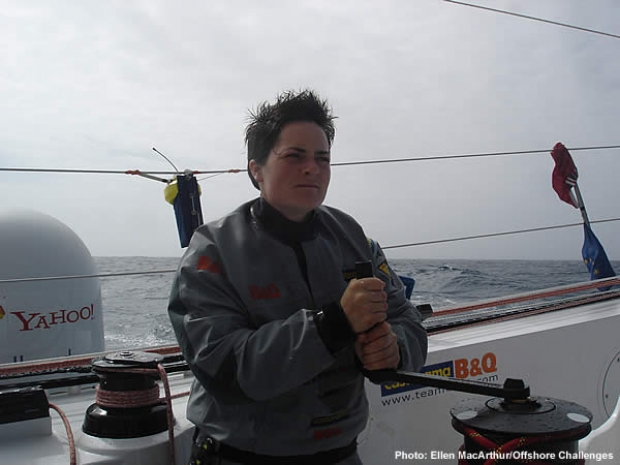
Ellen describes her ordeal
Monday January 10th 2005, Author: James Boyd, Location: none selected
Prior to the start of her record attempt the prospect of Ellen beating Joyon's record looked slim. A year ago Joyon had reduced the solo non-stop round the world record time down from Michel Desjoyeaux's 2000 Vendee Globe time of 93 days 3 hours and 57 minutes to an incredible 72 days 22 hours nd 54 minutes. 10 years earlier Peter Blake and Robin Knox-Johnston had only managed 74 days 22 hours 17 minutes fully crewed on board
ENZA New Zealand. Prior to Joyon the previous solo multihull record had been set by Olivier de Kersauson (in an earlier 75ft incarnation of Joyon's 90ft tri) with a time of 125 days.
But in yet another of her incredible singlehanded offshore sailing feats to rank alongside her second place in the last Vendee and her Route du Rhum and OSTAR monohull class wins, Ellen MacArthur this morning is just over five days ahead of Francis Joyon's supposedly unbeatable solo round the world record pace.
"Yes, if someone had said 'you’d be four days ahead at Cape Horn' I think I would have fallen off my chair to be honest," Ellen told thedailysail from the Southern Ocean. "I can’t believe it really, but equally it is just a figure and we still have 10,000 miles to sail and we’re a long way from home and anything could happen. We might have a good lead - I’d rather have five day’s lead rather than half a day’s lead but at the end of the day we have to get all the way home and it is a very very long way and there are lots of obstacles."
One of the oddities about offshore racing and in particular record breaking is that it is always too early to celebrate. You feel uplifted, perhaps slightly more confident, but there are still a million and one things to go wrong. "I am far from celebrating at the moment," confirms Ellen. "People keep saying ‘massive lead - surely you are going to break the record’ and I say ‘come on – we’re still 10,000 miles away from home, we’re on a boat that is getting tired and the skipper is getting tired. I am mentally and emotionally absolutely zonked and we have all that passage to sail. And it’s not going to be easy no way.”
While five days lead is certainly better than zero days or even being behind Ellen does acknowledge that it may allow her more of an opportunity to back off when she returns up the Atlantic. "You can definitely take less risks and you don’t have to push so hard coming up the Atlantic. But at the same time there is also a risk you can lose time." She cites the famous example of Geronimo's Jules Verne Trophy attempt in 2003 when de Kersauson and his crew were at one point 1,200 miles ahead of the record holder Orange's time only to lose six days on the way back up the Atlantic subsequently failing to break the record. "So the harsh reality is that it’s not over until it’s over and wind-wise it is not over until it’s over. So you have to make that compromise how you hard you push and how much you lose. It is not that straightforward."
Since the weekend as she eats up the final miles of the Southern Ocean to Cape Horn, Ellen has been sailing at considerable pace - covering 501.6 miles yesterday and 496 miles on Sunday - in the strong westerly winds that look set to propel her all the way into the Atlantic.
Ironically on large multihulls sailing at high speed only takes place when conditions, in particular sea state, allow and there are plenty of occasions when the ride gets more scary. Prior to the wind shifting to the southwest Ellen joked that while B&Q Castorama had been setting a new personal best for her, it had also been the occasion she'd managed to catch up on sleep.
"It is still pretty stressful. Although it has been fast the conditions have been relatively stable so over the last 24 hours and I have managed to get more sleep than I’ve had over the last two weeks. So I’ve made the most of fact that the conditions are stabler to sleep, but at the same time when the boat is sailing at 22-23 knots, that’s pretty full on and everything loads up and you come off the top of a wave… it’s just a constant tension. Sheets in the cleats in the cabin… it is very very stressful. You are waiting for something to break, you are waiting for something to go wrong. The wind alarms keep going off all the time. There is just a constant tension and not being able to switch off."
Racing a large multihull singlehanded round the world must rank as one of the hardest feats available in our sport. Ellen confirms that it is in a different league to racing an Open 60 around the world. "It is an absolute world apart. I knew this was going to be hard, but it has been really really hard. The not being able to sleep is absolutely brutal. I have never been on a boat where I haven’t been able to sleep before. Very very rarely. Maybe just before a storm or something when you are all wired and there is a lot of adrenalin in your body and you can’t switch off. I have spent days here when I couldn’t sleep. And when you are so tired and you can’t sleep - that is the worst situation. You can’t pull yourself back. 18 hours ago I was trying to sleep and the conditions were so unstable I just couldn’t."
Before the wind backed to the southwest and returned to being variable Ellen managed to bank 7-8 hours in one 24 hour period - on some days when conditions have been particularly bad or shifty she has had as little as 1 to 1.5 hours. "I have just crammed in sleep because I know it is not going to happen from now on. I need to bank up before we get the horrendous southwesterlies that will be very unstable and also so I can get a little more kip before Cape Horn, because that will be an extremely tiring corner to go around. And then we have the Falklands...."
Since entering the Southern Ocean both boat and skipper have taken a hammering and yet both are still hanging in there, motivated by being ahead of the record and the imminent swing north into the Atlantic.
"We’re doing okay," says Ellen. "The steering system is hanging in there - touch wood - although we broke one of the fuses again yesterday and so I have replaced it. We are on our last set of fuses which is slightly concerning with 10,000 miles to go. But at least we will be out of the Southern Ocean and a lot of the trouble you have with the steering is because the waves are so big and they’re whacking the rudder. At least the Atlantic should be a bit less stressful for the system than here.
"Otherwise the boat is generally pretty good. The technology is okay. The sails are in good shape. The ropes are getting a bit worn. I’ll probably have to end for end the sheets going up the Atlantic. That is one job - I’ll have to resplice them all - but that’s not the end of the world."
The fuel/oil crisis due to the problems with her generators has been delayed. "We are fine. I have gone back to the main generator for the moment. I have said myself I’m going to use that until I go around Cape Horn because I just can’t deal with having to restart the air-cooled generator every 5 or 20 minutes when it is rough. It was just taking everything out of me and it meant that for six or seven hours a day when it was running I just couldn’t sleep at all. So that is very very frustrating. So I have gone back to the engine. If I have to go back to the air cooled I will, but I will do that in the South Atlantic. I will have to monitor what the oil consumption is like - I might be able to get all the way home on the main one."
Ellen believes she will round Cape Horn in the early hours of Wednesday morning (12 January) and even she admits it won't be too soon. "Definitely from a sleep perspective and a human battering perspective - we have certainly have had our fair share down here. It hasn’t been easy and it will be a relief for the boat as well. It has been hard on her. We have really taken a battering in these storms. Every storm - it has not been a nice 30 knots downwind, it has been a nasty 40 knots on the beam so reaching in that has been horrendous. And it does take its toll on the boat and it would be nice to give her a rest."
Finally Ellen credits her current success on this record attempt due to a mixture of luck with the weather and just plain sailing the boat as fast as possible. "We have tried to do the best with the weather that we can. It has not been perfect it has been very very rough. The fact that we are so ahead of the record is a huge credit to Nigel Irens and Benoit Cabaret and a huge credit to BoatSpeed and the guys who built the boat and all the guys who prepared the boat."
If Ellen can hang on to her five day lead then she will cross the Ushant finish line on 4 February in a time of round 68 days - some four days off the record Bruno Peyron and the crew of Orange established in the Jules Verne Trophy in 2002. If she can pull this off Ellen will truly launch herself into immortality in the sailing community (if she isn't there already), but with almost a third of the course still to sail it is far too early to be making such predictions.

Most Read
Most Commented
Comments
Businesses

Pro businesses
-
France
-
United Kingdom
-
-
United Kingdom
Editor's choice
Member blogs
-
 Ned Collier Wakefield: MOD70 round BarbadosWell that was intense. 12 hard fought for seconds for the win. In idyllic conditions, Tony Lawsons MOD ...
 -
 Mini Transat leg 2 reportThe second leg of the Mini Transat started on 31st October, just over a month after ...
 -
Leg 1 reportI’ve been working towards the Mini Transat now for three years. In 2013 I was part ...
Business blogs
-
 The Island Sailing Club in Cowes, Isle of Wight, is delighted that Prince Michael of Kent ...
 -
Peta Stuart-Hunt chats with the 25 year-old British solo sailor Lizzy Foreman before she sets sail ...
-
The 2015 Student Yachting World Cup (SYWoC), an ISAF-recognised event hosted and run by students for ...
Editor's Choice
All time favourites...
-
 Three legs down into Ian Walker’s
 -
 Winning all but two races at
 -
 For the first time in its
Latest Comments
Add a comment - Members log in