
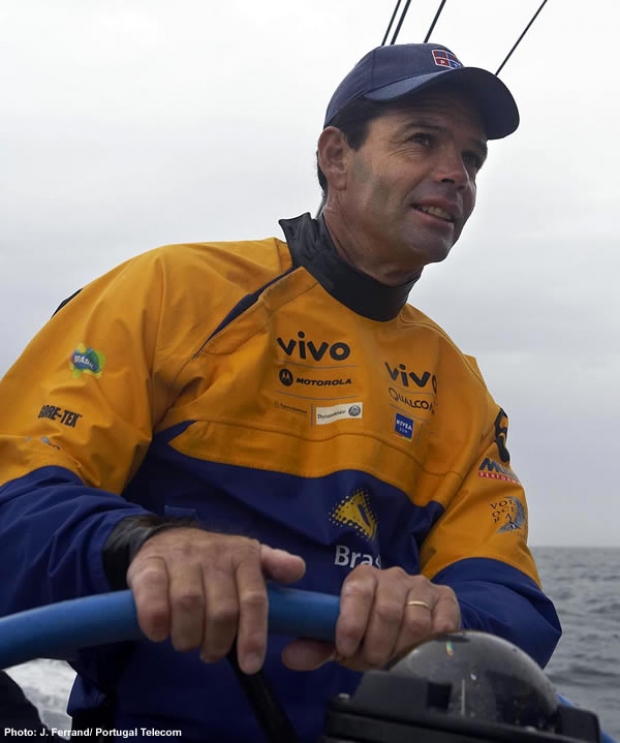
Rumba round the world
Friday October 28th 2005, Author: James Boyd, Location: none selected
Much like the entry of South Africa, Germany and China campaigns for the America's Cup, so it is great news for the Volvo Ocean Race that they have a team for the first time from Brazil, particularly when it is led by the iconic Torben Grael, a man with five Olympic medals including two Golds, and two America's Cup campaigns at the aft end of Prada under his belt.
While he may not be known as an offshore sailor Grael has had some experience of the fully crewed round the world race when he sailed part of the 1996-7 race with Knut Frostad on the Norwegian entry Innovation Kvaerner. Ironically eight years on and the tables have turned with Frostad now forming a key component of Grael's Brazilian team.
"I was going to do the whole race with Knut on Kvaerner, but I couldn’t do it, because I was hired by Prada at the same time," admits Grael. Decisions, decisions. "So I had to choose. I had no experience at all of match racing so I thought it was a very good opportunity to do the America’s Cup and I would always have another opportunity to do the round the world race. And I think it was a good decision. This time it was kind of clashing as well, but I have done two America’s Cup and I said ‘this is something I am going to do’." Grael expects to rejoin Luna Rossa after the Volvo Ocean Race.
Equally integral to the team as Grael has been is fellow Star sailor and past World Champion, Alan Adler, who has been focussing on the commercial side of the Brasil 1 campaign. "He began this company which set up Match Race Brazil which was a huge success," says Grael. "We’ve just finished our third year and we have good sponsors and very good relationships with potential sponsors and media too. And that made a whole new way of people understanding sailing, people that watch it on TV and that made it possible for us to get funding for the round the world race. That was very important, Alan’s involvement. We are still looking for part of the budget, so things are not easy, but, for sure, it's a dream come true."
Brazil returing with a crop of sailing medals from the Athens Olympics also helped. "The results in Athens was the final push to get this project going," confirms Grael. "If it wasn’t for that, I’m not sure we would be here today. But it is still not easy to get good money for Olympic sailing, even though sailing is Brazil’s best Olympic sport. It doesn’t make a lot of sense in a country like Brazil with so many good sportsmen that sailing is the best sport, but it is."
Despite the Olympic success, Grael says sailing still has a long way to go to reach mainstream consciousness in Brazil, a country which is sport-crazy in much the same way as Italy and Spain. "There is a very small percentage of the population that is interested in sailing. There are a lot of people who like to follow us and it has been very good the way our sponsors are getting more sailing into the media which again brings more sponsors into it and brings more people into sailing. But it is a small sport compared to other sports like - and there are a lot of them - volleyball, basketball and of course football is on another planet. But Brazil is wonderful for sailing because we can sail all the year round all along the coast and it is warm, good winds and nice waves."
Through Adler's development of Match Race Brazil and the relations with sponsors developed through that, the Brasil 1 campaign came about. The principle sponsor is Vivo, a mobile telecoms company in Brazil, which ironically is co-ownered by Portugal Telecom and the Spanish phone company Telefonica, sponsor of Bouwe Bekking's Volvo Ocean Race entry.
"Presumably they use Ericsson mobile phones?" we put it to Grael, who doesn't bite. In fact Motorola is a team sponsor as is Qualcom, the company producing the technology Vivo uses in Brazil.
It was only when a majority of these companies had come on board that the campaign formally fired up last October. "Raising money for projects like this in a country which didn’t have a culture for projects like this is very hard, so Alan did a great job there. I think other sponsors are pretty happy. The race is about to start and they have already had a lot of coverage already."

As the sponsor hunting had been going on so they had been looking for a designer, builder and suppliers. Although they did approach other designers, for a first time campaign from Brazil, Farr Yacht Design was the obvious choice. "We had to be very careful not to make some difficult choices that would put us on a difficult spot in the future, so we basically went very conservative," says Grael. "I think Farr has won more round the world races than anybody, so he was the most conservative choice. And there are more Farr boats in this race so they should be similar in speed. If you go with a different choice it can either be the same but more likely faster or slower."
The above deck package has come from New Zealand - North for the sails and Southern Spars for the rig - both of whom have a good reputation in the round the world race.
Important for the campaign, Grael feels, is that the boat was built in Brazil. "If say you make a $15 million project and you send all the money abroad and bring in everything from abroad people say ‘this is not a Brazilian project’. So I think it was very important to the project to have the boat built there, because it gave the media and the public a view of the project."
Brasil 1 was built at ML Boatworks in the small city of Indaiatuba just outside of Sao Paulo.
Seeing Brasil 1 moored up in Sanxenxo, we get the impression that she is narrower than her sisterships The Black Pearl and Ericsson, however this may just be an optical illusion from her blue and yellow paintjob. One source in the know confirmed to us that she does have 'the standard Farr hull'.
"If you go to Farr normally he gives you I believe his best choice and then if you have different input you can tell him, 'I want a boat more orientated to this or to that', but you have to trust his judgement and our boat is a standard boat," says Grael.
While many of the names in the Brasil 1 crew may not be household ones on the international sailing circuit, they all come with considerable talent. The line-up is roughly a 50/50 mixture of Brazilians and 'gringos'.
The Brazilians all have coastal experience in smaller boats but their main talent is in the Olympics. Aside from Grael the team includes his burly Star crew Marcelo Ferreira, who's claim to fame is that he has one more world championship title on his mantlepiece than Grael has. Andre Fonseca finished sixth in the 49er in Athens and competed in the 470 in Sydney. João Signorini was Brazil's Finn representative in Athens, while Kiko Pellicano is a two time Olympic Tornado sailor winning bronze in Atlanta.
In addition to this comes some heavyweight offshore racing experience in their star navigator, Adrienne Cahalan, the sole woman competing in the Volvo Ocean Race who has experience of three Whitbread/Volvo campaigns starting with Dawn Riley's Heineken in 1993/4, and was navigator on Steve Fossett's maxi-cat Cheyenne when she set the new non-stop round the world record. Irishman Damian Foxall is no stranger to these pages, having raced on Tyco four years ago and is one of the top non-French ORMA 60 sailors - he is standing down from the first leg as he is sailing Foncia in the Transat Jacques Vabre. Foxall has already sailed around the world once this year in the Oryx Quest with Brian Thompson, as has Brasil 1's mast specialist Andy Meiklejohn.
Norwegian Knut Frostad, equally needs little introduction having skippered Innovation Kvaerner and then djuice dragons in the last two round the world races. More recently Knut has been racing a 60ft trimaran in the Nokia Oops Cup.
Roberto Bermudez-Castro (aka Chuny) this year has been helming the TP52 Caixa Galicia, but was on board Assa Abloy four years ago as was Stu Wilson.
Over the course of the year they have lost Guillermo Altadill, who was injured and then signed up once again with his old skipper Neal McDonald on Ericsson and Justin Clougher who did likewise with Cayard.
"I think it is a very interesting combination we have with very talented Olympic sailors and some very experienced offshore sailors," says Grael. "It is going to be a steep learning curve for these sailors but it is probably easier for somebody who is very good technically to learn about big boats than the opposite - a guy who is good in big boats becoming good in small boats. And I think it was very important too to have a strong Brazilian percentage on the team, otherwise there wouldn’t be the bond that we wanted."
In addition to his core squad Grael says there are a number of other highly qualified sailors he can draw on if he needs to.
While he is known for his Olympic campaigns and his role at Prada, for Grael personally this is the first time he has stepped into such a key management role within a team. "It is very different and I do respect some people more after being in this role! It is not easy."
Grael says he is fortunate to be working alongside a lot of highly qualified people such as Technical Director, Horacio Carabeli, a naval architect who project managed the construction of the boat and, we learn, will be sailing the first leg to Cape Town. Alan Adler, with business partner Enio Ribiero, handles the commercial side of the campaign but has also had input on the technical side while former Club Med/Amer Sport man, Herve Le Quilliec runs the shore side. "We have a very good shore crew, but they are 'working their arse off' as people say in English. But it is a good experience for all of them."

Grael obviously sailed on the VO60 Innovation Kvaerner before and says that in comparision the VO70 is a very different beast. "The 60 was a kind of a normal boat. It had water tanks and it was more powerful and it was a fast boat for that time. But this is a completely different thing. I am not sure the loads are going to be so much bigger - it depends upon the sailing you are doing. If you are going downwind you are going so fast it doesn’t have so much load. But when you are going so fast your crashes are worse."
Although Grael admits they lack experience sailing the boat in heavy air downwind conditions they have still seen speeds into the early 30s and very often in the high 20s. Are there any weak spots in the performance range? "They are very good and they still sail fast upwind, but they smash a lot because they are very flat. So if you have hard waves upwind it is going to be tough on the crew and on the boat. But downwind it is a whole different thing, it is easy, although I don't know how it will be in strong winds." Reaching, he says, they are weapons.
From a crew perspective, as has been pointed out on countless times, the new VO70 is a bigger faster boat, with bigger heavier sails and 10, rather than 13 people to work them. If the Brasil 1 team have a weakness it is that they are with the exception of barrel-chested Marcelo Ferreira, smaller physically on average than the other crews.
"I don’t think we are very strong physically, but when you are sailing a race like this is a good to be strong technically as well as physically. We try to get as fit as possible with the boat and we are still working on that. But these are very good sailors too and very good drivers and this will be a race where we need very good drivers," says Grael. While Grael doesn't expect this to affect the number of sail changes they make, he admits it might take them a little longer.
While Brasil 1 in many people's eyes is a 'B' team in the Volvo Ocean Race, it is safe to predict that they will have their day.
Most Read
Most Commented
Comments
Businesses

Pro businesses
-
United Kingdom
-
-
-
Netherlands
Editor's choice
Member blogs
-
 Ned Collier Wakefield: MOD70 round BarbadosWell that was intense. 12 hard fought for seconds for the win. In idyllic conditions, Tony Lawsons MOD ...
 -
 Mini Transat leg 2 reportThe second leg of the Mini Transat started on 31st October, just over a month after ...
 -
Leg 1 reportI’ve been working towards the Mini Transat now for three years. In 2013 I was part ...
Business blogs
-
 The Island Sailing Club in Cowes, Isle of Wight, is delighted that Prince Michael of Kent ...
 -
Peta Stuart-Hunt chats with the 25 year-old British solo sailor Lizzy Foreman before she sets sail ...
-
The 2015 Student Yachting World Cup (SYWoC), an ISAF-recognised event hosted and run by students for ...
Editor's Choice
All time favourites...
-
 Three legs down into Ian Walker’s
 -
 Winning all but two races at
 -
 For the first time in its
Latest Comments
Add a comment - Members log in