
New horizons
Friday November 18th 2005, Author: James Boyd, Location: United Kingdom
One of the latest trends in the professional racing community is for high profile individual sailors to run a team of sailors and/or their own races, be this Coutts and Cayard with their proposed fleet racing grand prix circuit, or OC Group's stable of racers and The Transat and now the Barcelona World Race, while in France Michel Desjoyeaux's company Mer Agitee ran Vincent Riou and Seb Josse's Vendee Globe projects, Yvan Bourgnon's company runs the multi-class Brossard campaign and likewise Philippe Monnet's company manages a similar deal on behalf of Quicksilver subsiduary, Roxy.
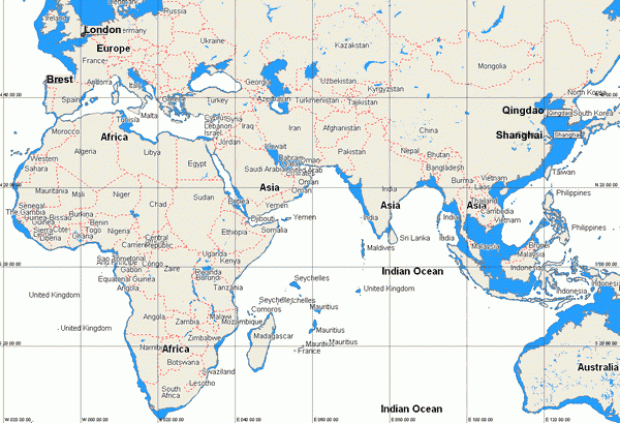
Latest to embrace this corporate expansion has been Mike Golding who in July won the tender process with IMOCA, the Open 60 class association, to run the China Race from London to China, beating other bid from organisers looking to start in Brest and Monaco.
Ostensibly we are reading here about another major new yacht race entering the already crowded racing calendar and it is easy to be sceptical about whether such a event is going to take place. The difference in this case is that the China Cup holds the significant advantage of being part of the IMOCA calendar and having the full blessing of the Open 60 class. It was the class who initiated the idea for this event, inviting tenders from potential organisers.

Dominique Wavre, currently sailing with Golding in the Transat Jacques Vabre, makes the interesting point that IMOCA are trying to avoid the situation the ORMA multihull class have got themselves into; not the repeated capsizes and structural failures, but their inability or even a lack of ambition to expand beyond France. "We [IMOCA] are a bit afraid by the example of the ORMA 60s who are so French they are collapsing into themselves. So in IMOCA we are really trying to find another way with more international racing, and if you make international developments you can be certain of other [international] teams coming in. So the China Race it is spot on for this new kind of deal. French people are a bit afraid of it becoming so international."
"It is in the class’ interested to make this race work," continues Golding. "There was an EGM recently, because there have been one or two bad influences in France for the China Cup it was necessary to have it validated [voted upon] by the membership and in that vote there were 50+ people there, 1 voted against, 2 abstained and the rest voted for. So that is the measure of the commitment of the class to the concept."
The attraction of the Golding proposal is that symbolically it represents an event which starts from a major economic power house within Europe and ends in an equivalent financial centre within Asia. "There is more commercial interest and we will hopefully provide up and coming sailors with the opportunity to strike new sponsorships that wouldn’t previously have been possible," says Golding.
The China Cup will be a doublehanded race and Mike Golding says that there were initially three options over the course.
- the shortest route - round Cape of Good Hope up across the Indian Ocean through the Philippines. The problem with this is that you cross the Doldrums diagonally making the course laborious and secondly the direct route passes through one of the world's worst prolific areas for piracy.
- the longest route - round Cape of Good Hope, into the Southern Ocean and then up leaving Australia to port. This avoids the piracy, adds a healthy dose of Southern Ocean but adds around 3-4,000 miles to the route.
- the westabout option, round Cape Horn, north up into Pacific to find the favourable trades and then directly across to China. There has been previous precedent of Open 60 class races rounding Cape Horn 'the wrong way' in the Gold Race between New York and San Francisco.
In the event Golding says the most likely course will be a variation on the first option. The boats will round the Cape of Good Hope and then be required to sail along the north coast of Australia before turning left to head directly north to China. Whether this involves leaving New Guinea to port has yet to be decided.
"We’ll find an island that is a waypoint," says Golding. "From a routing point of view it makes sense as well because if you go directly you are crossing the ITCZ at a very bad angle particularly when you are south of Hong Kong, so it is probably faster."
For Golding who has now been around the world westabout three times and two and a half times eastabout, along with countless transatlantics, there is understandable joy in the China Cup being on a course represents is 'virgin territory'. "Once they go around the corner they will be on regular turf until they start piling north and it will be ‘shall we stay south and go north later’ so there will be some real first time choices which are kind of interesting."
Since the tender was won there are now two more stopover ports. The race build-up is to be in Canary Wharf, London and if conditions allow there will be a start in the Thames. If not, then there will be some sort of 'event' by Tower Bridge and a start proper further out into the Thames Estuary.
The race will then stop in Brest - as a majority of the competition are expected to be from France - and it will then end up first in Qingdao, home obviously of the sailing component of the 2008 Olympics, before ending up in Shanghai.
Getting such an event organised in such a short space of time is of course quite a challenge. Golding has set up a management team to organise the race who have so far made two trips to China, while a delegation from Shanghai visited London recently to see their counterparts at City Hall, specificially to see the potential facilities the London start are offering. "We took them to the Transat Jacques Vabre start race village to understand more what the circuit is about. They are bright people, but they are unfamiliar with the set-up in Europe and the type of yachting we do," says Golding.
Meanwhile in China the race management have been busy getting permissions to run the event from both the city governments in Shanghai and Qingdao and the Chinese central government. "We are now very close to entering into a contract arrangement with the Chinese Yachting Association with a view to not only running this race, but subsequent races into China, and that is a very positive step both for us as organisers and IMOCA as a class," says Golding. "Hopefully we’ll get our permissions soon as that one act will trip a lot of other things, which are sitting there waiting for that permission to happen: other partnership sponsors coming from China and it will engage the authorities fully in Quindao and Shanghai who are waiting for that approval."
A provisional Notice of Race is also shortly to be issued.
So who will do it? With just four months until the start and a majority of the fleet currently about to complete the Transat Jacques Vabre race to Brazil, there is not a great deal of time for boats to be shipped or sailed back to Europe and be prepared for a major 18,000 mile race.
Golding says he is ideally looking for 10 boats to take part, but would run the race with seven. Part of the deal is that the organisers will repatriate the boats or at least go a majority of the way in covering this cost. So at present Ecover, Roxy, Sill and Virbac are committed to doing the event and Golding reckons that there are another dozen on the sidelines waiting to see how development of the race infrastructure progresses.
In agreeing to host the China Cup, the Chinese are also looking ideally to field a campaign as they have done with the America's Cup. "They don’t just want to be the hosts, they want to be in it," says Golding. "So we’ve created this leg from Qingdao to Shanghai as an integrated leg, with the idea of having Chinese sailors and journalists on board to help communicate it."
As part of this process they were looking for any suitable Chinese sailors, but at present there simply aren't any. "There are a couple of sailors down there who I met who sailed a boat back from the Mediterrnaean to China. It took them 190 days or so and they got national coverage! There is another guy with a boat sailing up and down the Chinese coast on a sailing education program. The skipper of that was put in front of us as a potential candidate. He was a very bright guy - he turned out to be literally a rocket scientist! He had learned navigation intuitively. But he had done 6,000 miles of sailing, never done a race, and had no formal training."
Golding thinks it likely that either his company or Offshore Challenges will manage a Chinese Open 60 campaign at some point in the future. "The Chinese are not aware of the skill set involved in shorthanded sailing and they think it is much simpler than it really is. But the truth is that our goals have to be to go there, to educate and inspirate and with the aim that in the next China Cup there will be a Chinese team.
"Team China is under quite a lot of criticism in China for failing to deliver results," Golding continues. "That is totally unfair: Given the rapidity of that project’s development and the level of the class, it is not surprising they are failing to attain a high level of success. And this was one of the things which put me off trying to get a Chinese entry into the China Cup because it would meet with the same problem. So the solution I have presented is a no lose solution, because you will have a Chinese crewmember and a Chinese journalist on the winning boat in the China Cup." This will be for the final leg between Qingdao and Shanghai.
Setting this part of the course will present its own challenges on a coast line that has had very little pleasure boat sailing on it. "There are sand banks there that go out 60 miles and aren't well charted," says Golding. "We’ll lay the course so that it is not across those banks, but there are unique problems."
Golding anticipates the China Cup in some form becoming a regular fixture in the IMOCA calendar as a nice break from round the world and transatlantic race. Next time, he says it need not run from Europe to China, but the boats could be shipped out there and be raced back. There are other options such as building a Transpac race into the program, etc.

The IMOCA rule and class development
At an IMOCA meeting recently a number of changes were made to the Open 60 rule. While once upon a time being simply a length limit of 60ft, in line with the OSTAR and subsequently BOC Challenge requirements, the Open 60 rule has evolved over time to include the famous 10 degree rule - a static test whereby a boat must heel no more than this angle with its movable ballast fully deployed. Since the instances of boat inverting and failing to right during the mid to late 1990s a minimum AVS of 127.5° was added to the rule and the skippers had to prove that their boat could be righted from a 180 degree inversion without their rig using their movable ballast alone - as the Volvo Open 70s now have to.
The most significant addition to the Open 60 rule is an AVS requirement of 108° when all movable ballast is deployed. Dominique Wavre explains IMOCA's reasoning for introducing this new rule: "When a boat has its keel fully canted and it is fully ballasted, 108deg should be the worst AVS. There was no limit to that before. With the keel vertical and the tank empty it is 127.5deg. Now we have set a worst case test, because we realised after the capsize of Virbac in The Transat that we need a fixed rule about that to limit the amount of ballast. Each new design evolution was creating boats which complied with the 127.5° but their worst case AVS was steadily getting worse."
Surely the 10 degree rule covers this? "The 10 degree rule governs the beginning of the stability curve and the AVS worst condition is at the end of the stability curve and right at the end is the 180° test. So now we have all the stability curve covered at the critical points," explains Wavre.
Aside from this there have been some more minor adjustments to the rule such as banning tungsten from keel bulbs on new boats, the mandatory fit of more powerful engines and a limitation in foils in a similar but more flexible way to the VO70 rule.A trim tab for example is banned on canting keels - Golding says he was considering this to improve righting movement - but for example could still be fitted to a single daggerboard arrangement. "We made these rules to bring more stability to the rule and to try and prevent the boats from becoming more expensive," says Wavre. "The thinking is to try and keep the boat simple without having to resort to big costs with research, etc."
One of the fears within the IMOCA class, particularly now with the advent of the Barcelona World Race which aimes to entice more sailors from the Volvo Ocean Race community into Open 60 racing, is that budgets will start to go through the roof.
"People have said that for years and it hasn’t happened, but that doesn’t mean to say it won’t happen," says Golding. "The circuit will always be controlled by the fact that it is shorthanded and that will limit the budgets which are available."
As with the America's Cup though, the team with the biggest budget isn't always ensured success. " Virbac Paprec have a big amount of money in their project - they have a lot of sails, three masts, but they didn’t win the Vendee," says Wavre. "So ultimately it is down to an individual’s performance."
Both Golding and Wavre, who has been involved with the America's Cup and is a veteran of four Whitbread Round the World Races, think that sailors who come to Open 60s from the Volvo or America's Cup will be surprised at the level of technology in the Open 60 class. "It is always the same - when you have come from a big budget campaign like the Volvo or America’s Cup it is easy to be a little bit arrogant about those with a smaller budget, but it doesn’t mean the technical level is less," says Wavre. "Nobody from the Volvo or America’s Cup wants to do the Figaro for example."
Golding points out that another misconception about Open 60s is when sailed singlehanded or doublehanded they are raced considerably less efficiently than if they had a full crew on board. It is just not true - the efficiency drop is much less than people think."
For example during the Calais Round Britain Race Ericsson skipper Neal McDonald sailed on board Ecover and Golding demonstrated how in some conditions the autopilot can do a better job than a human. "We were steering on a wicked night up to the Fastnet and it came my stint on the helm and I steered for about two minutes and put the pilot on. And the boat was quicker - we watched it on Deckman," says Golding.
And this is not a comment about Golding's helming... "I was helmsman on Intrum Justitia, and my level hasn’t decreased since I've started sailing Open 60s," says Wavre. "The boat can be steered more efficiently by the pilot."
The fact is Open 60s are designed with a helm that is much more balanced than it would be on a fully-crewed boat for the specific reason that it can be steered by autopilot. The downside is that when the human autopilot takes over steering can be quite hard because the helm is so light and there is little feedback from the tiller or wheel. "Consequently when it is a pitch black night and you have no reference points and it is bloody easy to wander miles off course," says Golding.
Most Read
Most Commented
Comments
Businesses
Pro businesses
-
United Kingdom
-
Netherlands
-
-
Editor's choice
Member blogs
-
 Ned Collier Wakefield: MOD70 round BarbadosWell that was intense. 12 hard fought for seconds for the win. In idyllic conditions, Tony Lawsons MOD ...
 -
 Mini Transat leg 2 reportThe second leg of the Mini Transat started on 31st October, just over a month after ...
 -
Leg 1 reportI’ve been working towards the Mini Transat now for three years. In 2013 I was part ...
Business blogs
-
 The Island Sailing Club in Cowes, Isle of Wight, is delighted that Prince Michael of Kent ...
 -
Peta Stuart-Hunt chats with the 25 year-old British solo sailor Lizzy Foreman before she sets sail ...
-
The 2015 Student Yachting World Cup (SYWoC), an ISAF-recognised event hosted and run by students for ...
Editor's Choice
All time favourites...
-
 Three legs down into Ian Walker’s
 -
 Winning all but two races at
 -
 For the first time in its
Latest Comments
Add a comment - Members log in