
A visit from aFarr
Thursday November 18th 2004, Author: James Boyd, Location: United States
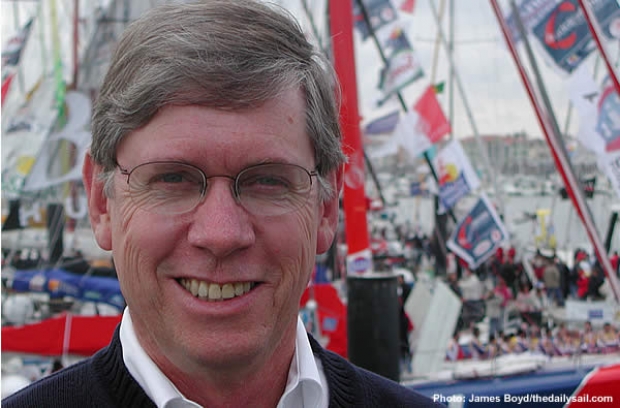
While we were in Les Sables d'Olonne prior to the Vendee Globe we hooked up with Russell Bowler, Bruce Farr's main partner and principle engineering talent at Farr Yacht Design to get his take on the Vendee Globe fleet and to find out the latest news from yacht racing's most profilic design house.
Farr are renowned for their work in one design classes as well as the Volvo Ocean Race and America's Cup and have created their first Open 60 in the form of Jean-Pierre Dick's Virbac-Paprec (to read our guided tour to this boat - click here). For Russell Bowler this was his first taste of a Vendee start.
"It is an event. It is amazing to see 1,000s of people here coming to see the boats. And I think what appeals to the general public is the simplicity of the race - one person, one start, one finish, around the world, it is an extreme event, it is an adventurous event. It is very easy to see how it captures everyone’s imagination. It is interested to be involved with this and the Volvo race which has got more and more complicated in terms of trying to explain it to someone who isn’t a sailing person. Whereas this one has retained its simplicity."
Farr Yacht Design's Open 60 won last year's Transat Jacques Vabre, but has since lost two rigs first in Le Defi Atlantique when a rigging pin pulled out and then in The Transat when the boat was rolled. So having worked on lots of box rules, is it more interesting from a designer's perspective to work on an 'Open class' boat? "Generally yes," says Bowler. "It allows you a bit more freedom but the Open 60 rule is not very open in lots of ways. It is quite a typeforming rule - with the 10 degree limit on the heel at the dock with the canting or ballast system is a major constraint to the design. Although it is very simple it is a major constraint. So that is what you work around and you have some freedom about how you work around that constraint, but it’s there all the time.
"The challenge with the design is to give the boat sufficient stability to go upwind reasonably and to reach reasonably well and at the same be light enough to go fast downwind. That is the mix you have to work between."
Compared to a Volvo project there was not the same amount of budget kicking around, but Bowler says that their approach to the design of their Open 60 was the same. First they commissioned an extensive weather of the course for 30 days around the start date and from that came up with a number of optimum courses. While the Volvo has many stops and these days works on a points system, the Vendee Globe has gates in the Southern Ocean, but otherwise has no stops.
"The other half of the equation is to come up with a VPP that accurately models the things you can change within the class rules," continues Bowler. "The big part of our job with this research program was to get our VPP adapted to this style of boat, so it would handle the light displacement, the multiple appendages, the off-centre appendages, the canting keel and the fact that you have a sole driver that seldom gets 100% of the boat’s potential."
In their work on the VPP they had the advantage of sailing Dick's previous Virbac, the 2000-1 winner PRB which Dick had chartered for a year prior to the launch of his new boat. Some of the Farr designers had the opportunity to sail on PRB to help them understand what Open 60s are all about. They also enlisted the help of Michel Desjoyeaux and others to help teach them about how and when skippers push their boats and when they back off. What would happen to the boat when the skipper was sleeping, in what conditions they would or wouldn't sleep was also analysed and all this data also went into the construction of Farr's Open 60 VPP. "You have to have all that modelled correctly in order to find out what is the fastest combination of stability and sail plan and so on," says Bowler.
Also crucial to the design process was coming up with a boat that balanced well through different wind speeds and directions as well as different appendage positions (modern Open 60s generally have two rudders, a canting keel and twin asymmetric daggerboards). "It is so important that the boat is easy to sail and does quite well on it own and performs by itself to a fairly high percentage of its total potential," says Bowler.
Compared to say Volvo boat, the Open 60s still perform poorly even with the present slate of ever longer and larger daggerboards. The main reason for this says Bowler is their light displacement.
Even the canting keel Open 60s carry water ballast in some form most divided between two or three tanks located along the waterline, a trend set by Ellen MacArthur's Kingfisher in the last Vendee Globe. Aside from benefitting the Open 60 measurement - weighing the boat down effectively increases the waterline beam and the hull form stability - filling these tanks also increases displacement increasing 'power' going upwind.
Bowler agrees this is a useful feature: "It makes a lot of sense. If you want to go fast downwind you have to be light. If you want to go fast upwind you have to be heavy. There were some trailsailers in New Zealand once upon a time with a water ballast tanks that filled up when you launched them and provided fairly good upwind sailing and emptied out as you pulled them out on the trailer. So the concept has been around for a while."
Virbac has many unique features compared to her contemporaries. Her cabintop is quite large to ensure she passes the Open 60 requirement she can be righted from a full inversion without her rig. Her cockpit is a long way aft, etc. Bowler says they tried to design the boat with good all-round performance, that would also behave well in extreme conditions and a hull shape with some lift in the forward section "so that it doesn’t tend to roll its aft beam and bury its nose. That is very difficult to avoid in this type formed boats. It is something you can’t eradicate but you try and do you best to eliminate the downside of it."
Notably Virbac-Paprec also has the tallest rig in the Open 60 fleet with a fixed four spreader carbon fibre tube that strongly ressembles a Volvo 60 set-up. "What pushed us up there was to try and reduce the roach in the mainsail but still have good mainsail area," says Bowler. "We think that is useful because you have got to put the battens in and not replace them for 27,000 miles. It also enabled us to have headsails that could be used for a little bit longer before you went to a spinnaker. We realised that setting and retrieving spinnakers is a major operational issue on these things and if we could avoid some of those or push them off until a little later as the wind came round from behind it might be useful." He adds that the four spreader rig is hard to beat in terms of weight and for reliability it is a well known entity in the sparmaking world. It wasn't their intention to have the tallest rig in the fleet that was just what they arrived at as the best solution.
Most of the canting keel Open 60s have twin asymmetric daggerboards (there are a few exceptions such as PRB which has a single symmetric board immediately forward of the mast that can be twisted) and Virbac is no exception. Where her set-up differs is that her boards are either side of the canting keel and are straight up and down in the boat (when she is at standstill).
"If you toe them out you miss out on a lifting force," says Bowler. "When you are heeled you have the downward force of the rig which is present and in a normal boat you have an upward force of the keel that counteracts each other so your dynamic displacement and gain is in a neutral mode in a normal boat. If you are leaning hard on something that is well canted then you are getting a negative downward thrust and you are getting a negative displacement which is not what you want."
Compared to the box rules Farr Yacht Design has designed boats to or even the 60ft trimarans, which they haven't, generally there is a trend in classes for boats all to become similar the more mature the class gets. Oddly this has not happened in the Open 60 class despite it being around 25 years old. Bowler thinks this is due to the amount of resource designers are able to put into creating the boats. "I think as more and more designers get the opportunity to do the research we did going into this race, the style of boats will wobble into a fairly mainstream look about it and solutions to sail handling will probably become more universal as time goes on."
On Monday we talk to Russell Bowler about Farr Yacht Design's other activities at the moment.
Most Read
Most Commented
Comments
Businesses


Pro businesses
-
Netherlands
-
France
-
-
United Kingdom
Editor's choice
Member blogs
-
 Ned Collier Wakefield: MOD70 round BarbadosWell that was intense. 12 hard fought for seconds for the win. In idyllic conditions, Tony Lawsons MOD ...
 -
 Mini Transat leg 2 reportThe second leg of the Mini Transat started on 31st October, just over a month after ...
 -
Leg 1 reportI’ve been working towards the Mini Transat now for three years. In 2013 I was part ...
Business blogs
-
 The Island Sailing Club in Cowes, Isle of Wight, is delighted that Prince Michael of Kent ...
 -
Peta Stuart-Hunt chats with the 25 year-old British solo sailor Lizzy Foreman before she sets sail ...
-
The 2015 Student Yachting World Cup (SYWoC), an ISAF-recognised event hosted and run by students for ...
Editor's Choice
All time favourites...
-
 Three legs down into Ian Walker’s
 -
 Winning all but two races at
 -
 For the first time in its
Latest Comments
Add a comment - Members log in