
Taking on the corporate world...and winning
Monday March 15th 2004, Author: James Boyd, Location: United Kingdom
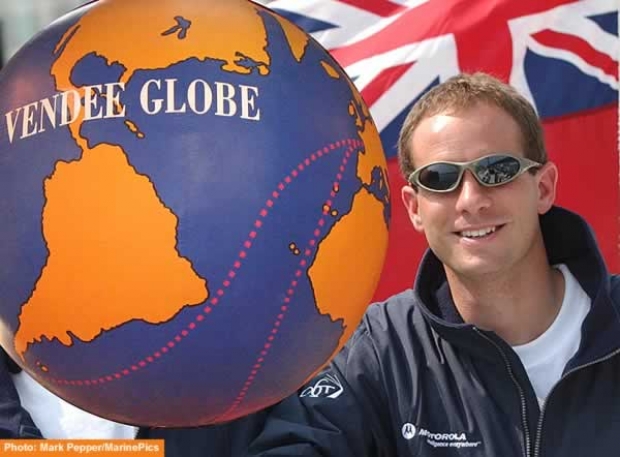
Hats off to Conrad Humphreys. While everyone is scrabbling around trying to raise funds for America's Cup, Volvo Ocean Race, G-class and any number of other multi-million dollar campaigns, the 31 year old 2000-1 BT Global Challenge winner has succeeded in pursuading Motorola, one of the international giants of the corporate world, to
fund a two year Open 60 campaign including November's Vendee Globe. What is most remarkable about this is that he pulled this off this sponsorship deal on his own, without the help of any agency.
"You get very well prepared for a long lonely battle out on the ocean I can tell you," says Humphreys of how hard this has been.
So, how'd he do it? The road to sponsorship for Humphreys was in fact very similar to the way Mark Turner initially lured Kingfisher to back Ellen back in 1998. The European retail giant came on at the 11th hour to carry out a trial sponsorship with Ellen on an Open 50 in the Route du Rhum. On the strength of her performance on the water and Mark Turner's performance on the shore on the PR and communications side, they went ahead with what would prove to be a historic Open 60 campaign.
In the case of Conrad Humphreys, he persuaded Motorola, a company that had already tasted yachting having sponsored a boat in the 1996-7 BT Global Challenge, to support him with a trial sponsorship during 2003. Last year he rebranded the former Volvo Ocean 60 Tyco as Hellomoto (Motorola's advertising slogan) and raced it in the Rolex Fastnet Race and subsequently chartered JP Mouligne's former 1998/9 Around Alone class II winning Open 50 from Offshore Challenges, also branded Hellomoto in which he and Paul Larsen handsomely won their class in the Transat Jacques Vabre.
After the Transat Humphreys returned to the UK for two days and then flew directly to the Motorola HQ near Chicago to talk to the Chief Brand Officer about 'going to the next level'. From early December until 10 February when the contract was finally signed in Europe, were nerve-racking times.
"It has been a steady, slow process," Humphreys admits. "But we got a very good sponsorship in 2003 and just nurtured that and didn’t let it go. There were several times when it could have gone away. We caught Motorola at their toughest cycle, post-telecoms crisis. All telecoms companies were hurting and they were not in a position to be sponsors of anything. But what we’ve proved is that we worked with what they needed and didn’t put too much pressure on in the early stages and then gradually built the relationship and that has now blossomed into full funding. So we’re here.
"Sometimes I think having to put all this together and sail the boat as well is quite tough. I would have liked to have had a Mark Turner as some stages but we haven’t had it, so I've done it - there’s been no one in between, no agency involved and we pulled it off which is a pretty pleasing thing when it all comes together, but you aren’t spared the emotional rollercoaster that goes with it. If I did it again I would protect the skipper from that role because at the end of the day it is very personal - a sponsor is investing in the skipper."
However Humphreys does admit there are occasions when if you are able to present your case in person, adding that personal touch gives you a better chance of success than a third party might. "But you go through the grill. It has been very interesting over the last couple of months reading your articles about how GBR Challenge are going about it. I have to say we all have our ideas about what is the best route and how it should best be done, but there is no easy way at all. I’m just pleased that we have got it and achieved what we have we were going to do and we will be on the start line with a good boat."
In terms of the way Motorola have funded this campaign, Humphreys says they have had to take a leap from how they managed this in 2003, when their arrangement was all based on internal communication. "To get to the next level we needed to get into the external budgets because that is where the real budgets are and product technology and pure external branding, marketing. So we’re going to see much more of a drive on those two fronts than we’ve had before."
Humphreys won't divulge how much the sponsorship with Motorola is worth but we would make a stab at around the £2 million mark including buying Mike Golding's Groupe Finot-designed Open 60 Ecover and running it for two years. The program kicks off this year with the Transat (formerly the OSTAR) in June. This will be used as a qualifier for the Vendee Globe. In 2005 Hellomoto will sail in the Round Britain Race, the Rolex Fastnet Race her season culminating in the two-handed Transat Jacques Vabre.
To run the campaign Humphreys has created the Motorola Ocean Racing Team, based near the university in Plymouth. On the shore support side Humphreys has recruited Joff Brown and Tony Reid both of whom worked on the boat previously for Mike Golding and will be joined this week by former Amer Sport Too bowgirl Liz Wardley, who helped Humphreys with the Open 50 last year.
At present the team are over at Marc LeFevre's V1D2 yard in Caen where the boat is undergoing a refit. While Mike Golding went to the nth degree to keep the boat competitive and it would have been quite possible simply to go racing in the boat as it was, they have been working closely with Groupe Finot's Pascal Conq looking for ways of further developing the boat. "The three things we looked at were reliability and improving her upwind performance and improving the handling," says Humphreys.
They have installed a water cooled genset (the original was discarded promptly following the last Vendee Globe) and have upgraded all the B&G instrumentation.
Although it is a modification they won't have time to make for the Transat they are looking at changing the daggerboards and the daggerboard cases. "In terms of foils, size is king when it comes to upwind performance," says Humphreys. "Currently the foils are as big as they can go with the current boxes. Unfortunately we've run out of time to get new boxes and daggerboards put in before the Transat which was a real shame because obviously it is a race where a lot of it can be on the wind. For the Vendee itself it is questionable whether we need them. For a lot of the race you can be without them, but the last leg coming up the Atlantic is going to be on the breeze that is why we are looking at it and have set aside budget to do it."
Little can be done with Hellomoto's keel. The boat has a carbon fibre foil and, in a fairly extravagant move, Golding fitted a tungsten bulb (tungsten is heavier than lead). This has since been outlawed by the class association, but is allowed under a grandfathering clause. If they modify the keel they will have to swap to a lead bulb.
They, like Golding and Offshore Challenges, will continue working with Bruno Dubois of North France on sail development. "We’ve been looking at the 0-8 knot wind range where PRB and VMI seemed to have an edge in the Fastnet in the really light stuff. We are looking at a new upwind Code zero which will be sheeted inside the deck spreaders. So it will probably have a similar area as the genoa but it will go out to the bowsprit on a furler."
They looked at the possibility of changing to a new rig, but the VPPs show it being only 6-8 hour faster on a Vendee Globe course. All the rigging is PBO and Humphreys says they will stick with that, but they will add another degree of rake to improve upwind performance.
In terms of the cockpit they are extending the coachroof aft slightly to add a protected seating area at the front of the cockpit. "After sailing both Kingfisher and Ecover for the last few years I felt it was a no brainer, creating that extra bit of comfort," says Humphreys. "It is an extra 15kg in weight but you spend large amounts of time sat in that sort of area."
Also new will be a forward-facing Harken pedestal and a centre island for the mainsheet and traveller winches. The pilot controls and the buttons to operate the canting keel will be moved here too. "So if you are going into a gybe you have got everything close to hand whereas before you would have to run forward, dump the keel, run back ease the main, etc," explains Humphreys. "Now you can do everything from around the winch pedestal."
We can also expect the boat to have a vibrant new paintjob.
Obviously with Motorola on board the boat is likely to be kitted out with some state of the art electronic technology. Motorola were one of the original stakeholders in Iridium but now limit their interest in the global satellite communications system consists of making handsets for third parties. However the team are likely to be envy of the fleetwhen it comes to sporting the latest mobile phones, pagers, two-way radios, etc.
CGISS, an offshoot of Motorola which makes serious kit for the military, is likely to be providing military-spec tablet PCs and laptops. Motorola also make in-car computer systems including GPSes which will tell you went it's time to change the oil. Humphreys says it is likely that some of that technology will end up on board. Finally there is the prospect of using a telemetry system Motorola have developed that could be used for collecting and beaming back data from on board.
An interesting aspect to the sponsorship is that additional companies related to Motorola may be attracted to come on board as secondary sponsors. "There is a dimension which is quite a new one," says Humphreys. "A transition that sponsors will make is much more working in collaboration with their customers and suppliers, ie joint sponsorships. Motorola have an initiative called ‘brand ecology’ which is encouraging customers and key supplier to pass on rights, to co-brand things and those sort of initiatives could be very valuable to us. For example, when Motorola built Microsoft’s Windows phone, it was launched and then campaigned by Orange. So three brands came together for a marketing campaign. So that is of great interest for the sport and could mean that along with Motorola we can bring some more customers and sponsors into our program which may bring them into the sport in their own right in the longer term."
Humphreys expects Hellomoto to be relaunched in mid-April. He will sail the boat to Southampton for a systems check before heading off promptly on his 750 mile solo qualifier for the Transat. They will then have two and a half weeks of training prior to the Transat. Being based in Plymouth this race will be an important one, and post-Pete Goss the local media are already taking a keen interest in the project. Humphreys hopes that because Motorola is a US-based company, he can expect good coverage at the end of the Transat too.
Obviously in the Transat Hellomoto will be up against a number of newer generation boats such as Mike Golding's new Ecover, Jean-Pierre Dick's new Farr-designed Virbac, the two new Lombard designs Bonduelle and Sill and a heavily breathed on PRB and VMI.
"I would say that for sure the limiting factor for this year is going to be me rather than the boat. I have a huge amount to learn to get up to speed compared with Mike and all these guys. But we have bought a good boat. I think it is a good Vendee bloat. Mike’s new boat stands as probably being a very very good Transat boat. It has proved itself to be a bit of an upwind flier."
While boats such as Ecover, PRB and VMI have already qualified for the Vendee Globe, Humphreys is likely to be taking a more gentle approach with the Transat as his primary objective is to finish the race so that he can qualify for the Vendee. "The second priority is to learn as much as we can from some of the bigger boys. If you look at the 16 boats on the start line, it is almost more impressive than looking at the tris."
Humphreys has proved himself to be highly capable on the board. Now he will have to repeat this singlehanded on the water.
Most Read
Most Commented
Comments
Businesses


Pro businesses
-
Netherlands
-
-
United Kingdom
-
Editor's choice
Member blogs
-
 Ned Collier Wakefield: MOD70 round BarbadosWell that was intense. 12 hard fought for seconds for the win. In idyllic conditions, Tony Lawsons MOD ...
 -
 Mini Transat leg 2 reportThe second leg of the Mini Transat started on 31st October, just over a month after ...
 -
Leg 1 reportI’ve been working towards the Mini Transat now for three years. In 2013 I was part ...
Business blogs
-
 The Island Sailing Club in Cowes, Isle of Wight, is delighted that Prince Michael of Kent ...
 -
Peta Stuart-Hunt chats with the 25 year-old British solo sailor Lizzy Foreman before she sets sail ...
-
The 2015 Student Yachting World Cup (SYWoC), an ISAF-recognised event hosted and run by students for ...
Editor's Choice
All time favourites...
-
 Three legs down into Ian Walker’s
 -
 Winning all but two races at
 -
 For the first time in its
Latest Comments
Add a comment - Members log in