
Open 60 rig developments - pt 2
Thursday November 4th 2004, Author: James Boyd, Location: France
This article follows on from
part 1
published yesterday
In yesterday's article we looked at the diverse rig configurations on Open 60s and the pros and cons of each. We established that one of the main issues concerning Open 60 designers is removing weight aloft.
Open 60 rig guru Marc Lefevre says that since the first Vendee Globe in 1989, the most major weight savings have resulted in the change from standing rigging made from metal rod to hi-tech fibres, most notably PBO. (To read more about the benefits of PBO read our interview with Future Fibres' Tom Hutchinson here)
In the 2000 Vendee Globe Somewhere and Josh Hall's Gartmore had mainly PBO standing rigging with just their V1 and D1s in rod. As might have been expected, Yves Parlier went for a more obscure test bed option having one side of his rig in PBO, the other in Kevlar. This time round observes Lefevre almost everyone has opted for PBO standing rigging, although some are going for Kevlar. "PBO is proven now, so it is not a problem," he says. "You have to change it, but if you accept that it is okay. It makes a big difference with the weight. It is the most progress we have made to save weight in the rig."
Any concerns about the robustness of PBO rods were cast aside when Parlier returned from his epic Vendee in 2000 (after he had repaired and restepped his broken mast). In the Southern Ocean he noticed that a batten had worn half way through one of his PBO shrouds. Yet the shroud made it back to Europe intact.
Ellen MacArthur's Kingfisher sailed the last Vendee Globe with rod rigging for reasons of safety, but prior to the 2002 Route du Rhum her standing rigging was replaced with PBO. "We saved 186kg by changing to PBO, changing the spreaders, the forestay, etc." says LeFevre.
PBO rigging has now reached the forestay as well although some are in Kevlar 49. In the 2000 Vendee Globe Michel Desjoyeaux's PRB was the only boat with a Kevlar forestay, while Yves Parlier's Aquitaine Innovations used a carbon tube as a forestay that doubled as a spar for furling his Solent jib.
For the Vendee Globe competitors are using PBO rods from three manufacturers - Future Fibres, Chien Noire and Navtec. The first two manufacturers make their rods setting up two rings representing the ends of the rod and then looping a continuous filament of PBO between the two before encapsulating the whole deal in a tough plastic outer tube. The Navtec rods used on Bonduelle, PRB and VMI instead have numerous individual strands of PBO that are attached at either end to a Norseman-style terminal.
Aside from removing weight aloft PBO rigging has also helped revolutionise the way the Open 60's forestays are used. In early Vendee Globes boats were fitted with as many as three forestays each with its own roller furling tackle. This would comprise furling swivels at each end of an aluminium extrusion running up the length of the stay on which the sail was furled. A sail would be kept permanently furled on each stay. From an ease of use point of view this arrangement was fantastic as to change up or change down the skipper simply rolled one sail in and rolled the other out, without having to leave the cockpit. But in terms of weight aloft it was very heavy.
Today on the modern Open 60s headsails come with a PBO or Kevlar line built into the luff that they are furled around. Thus they are dragged up on deck as a furled snake and attached to the furling drum on deck and a swivel on the halyard and then hoisted and unfurled. To get luff tension the bottom of the stay is cranked down by a hydraulic ram located below deck or by a line running back to the cockpit to a winch that can be clamped off by a sizeable jammer on the foredeck.
Modern boats tend to have one fixed forestay, usually the outer most. In the case of Skandia it is the inner stay for the solent that is fixed, with a range of sails from Code 0s to blast reachers able to be hoisted off the bow (rather than the bowsprit) their tacks cranked down by a hydraulic ram. A few boats such as Skandia and Ecover have gone a stage further and are using halyard locks on their large foresails.
The upshot of all this from a weight perspective is that if conditions are stable skippers need only have the headsail they are using hoisted, but conditions are variable they can hoist others ready to change up or down a gear as and when they need.

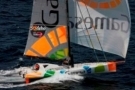
Bonduelle - showing staysail hoisted on Karver furling gear, the stay tensioned at the foot by a line going back to the cockpit and then locked off in the jammer. Further inboard instead of a babystay there is a 2:1 halyard with the top half of a furling swivel attached
Furling gear used on most of the boats is by Facnor or Profurl - the former being a very simple continuous line system that doesn't involve a furling line drum where at stage inevitably the furling line will get tangled. Another manufacturer of furling relatively new on the scene is Karver, a company set up by an ex-Profurl employee, who's smart black furling gear is to be seen on several of the boats.
Sails have also seen considerable development since the last Vendee Globe (read our interview with North Sails France's Bruno Dubois here). In 2000 Ellen MacArthur's Kingfisher was the only boat to go around with moulded sails - a new development of 3DL with a Taffeta outer for protection. Not only do these sails keep their shape better but they are also much lighter than conventional panelled sails - useful for the solo sailor. In this Vendee nine boats have sails from North France and seven from Incidences who use D4 moulded sail technology.
This time round sails carried on board the top boats range from 8-14 in number, although in some instances this includes spare sails. Mike Golding is believed to be taking 13, Alex Thomson says he will take 14. This is substantially fewer than were carried by boats competing in the first two Vendee Globes, says Marc Lefevre, when two complete wardrobes including a spare mainsail might be on board for prudence's sake. This changed for the 1996 Vendee Globe. Prior to that race Christophe Auguin had just sailed (and won) the 1994 BOC Challenge. He had experienced some mainsail problems but they had established what was wrong and fixed it. For the Vendee Auguin went with just one suit.
Below: deck spreader boats can use the spreader as a convenient sheeting point for gennikers as seen her on Bonduelle

With Vendee sail wardrobes there are far fewer crossover points than one finds on crewed boats. Sails can usually handle a much wider range of wind strengths, this is partly to save weight but mainly to preserve the skipper's strength. "I remember doing the Open UAP [Round Europe Race] when La Poste was sailing against Merit," says LeFevre. " La Poste would change sails every 5 knots [change in wind strength]. They were very fast for while but then they changed whereas Merit didn’t change as often and they were off. That was a crewed race. When you are alone you can’t do the job always in good conditions and also you get fatigued."
Back in the mid-1990s there was a move across to Vectran for the running rigging. The whole of Geodis aside from the Dyneema/Spectra mainsheet was decked out with this hi-tech brown cordage for the 1996 Vendee Globe, due to its low stretch and lightweight - it is around 50% the weight of conventional ropes.
Lefevre says the use of Vectran had to be reappraised when some of the Solent sheets on Geodis simply broke in the middle. The cause was the Vectran's inability to handle shock loads due to its low stretch. This situation has been made worse with the advent of moulded sails that are equally unelastic. Several boats are still using Vectran halyards, but generally boats have moved across to Dyneema/Spectra for their other running rigging.
At deck level Lefevre says there has been little change. Boats have now adopted the America's Cup/Volvo athwartships tracks for the headsail fairlead cars, allowing considerably more control over the clew.
In terms of cockpit layout there have been a few changes. The two new Lombards and Virbac have arrangements where halyards and reefing lines feed back from the mast to a central island between the two companionway entrances. On Virbac there is a tunnel through the entire cabintop for this while on the Lombards the lines run through individual holes in the aft end of the cabintop.
The new Ecover is unique in the fleet for having twin wheels like a normal large race boat rather than the traditional twin tiller arrangement where each tiller simply attaches to the top of the rudder stock. The wheels should prove much nicer to use as the tiller arrangements tend to be miserable and uncomfortable to use, but it should be remembered that in all but the most extreme conditions (very light or very heavy) during the Vendee skippers will leave their autopilots in charge of the helming.
Since Ellen MacArthur had a coffee grinder installed in the cockpit of Kingfisher for the last Vendee Globe, so the boys have followed - Mike Golding's Ecover now carries two to make the grinding more efficient and faster.
More photos on the following pages...

Most Read
Most Commented
Comments
Businesses
Pro businesses
-
United Kingdom
-
Italy
-
France
-
Editor's choice
Member blogs
-
 Ned Collier Wakefield: MOD70 round BarbadosWell that was intense. 12 hard fought for seconds for the win. In idyllic conditions, Tony Lawsons MOD ...
 -
 Mini Transat leg 2 reportThe second leg of the Mini Transat started on 31st October, just over a month after ...
 -
Leg 1 reportI’ve been working towards the Mini Transat now for three years. In 2013 I was part ...
Business blogs
-
 The Island Sailing Club in Cowes, Isle of Wight, is delighted that Prince Michael of Kent ...
 -
Peta Stuart-Hunt chats with the 25 year-old British solo sailor Lizzy Foreman before she sets sail ...
-
The 2015 Student Yachting World Cup (SYWoC), an ISAF-recognised event hosted and run by students for ...
Editor's Choice
All time favourites...
-
 Three legs down into Ian Walker’s
 -
 Winning all but two races at
 -
 For the first time in its
Latest Comments
Add a comment - Members log in