
A bubble fit to burst
Friday June 4th 2004, Author: Ian Walker, Location: United Kingdom
Escalating costs discussed in
Part One is bad news for sailing but the good news is that sources of revenue have increased too. In all the big events the relatively recent advent of sponsorship logos on boats and sails has led to new sponsorship and marketing opportunities. It is easy to forget that ISAF (or IYRU as it was then) only relaxed the rule forbidding advertising on boats in the late 1980s. Where fairly Corinthian programs use to be funded by the yacht owners or private donations, professional programs are now more and more reliant on big money sponsorship deals.
For those teams relying on sponsorship to sustain them it is all about trying to deliver a commercial return on any investment in them. This may be measured in media returns, or justified by internal marketing, product testing or by a multitude of other reasons, but the sponsor expects and demands a tangible return. The world sports sponsorship market is increasingly competitive and if sponsors are not satisfied with the potential returns the answer is simple - cease the sponsorship or don’t do it in the first place.
Not all classes rely on sponsorship. Farr 40s are largely funded personally by the owners who also drive the boats. These owners judge it on how much they enjoy the events, how well they do and how much they learn. For many it is an escape from the demands of a very busy working life and I suspect that most love every second of helming and racing their own boat. The Farr 40s undoubtedly has the most competitive big boat racing right now but make no mistake that it is the owners’ game: They pay for it, they manage it and the moment they choose to do so they can stop it! If the competitiveness and cost continues to grow how many owners could become disillusioned with it? Some have already.
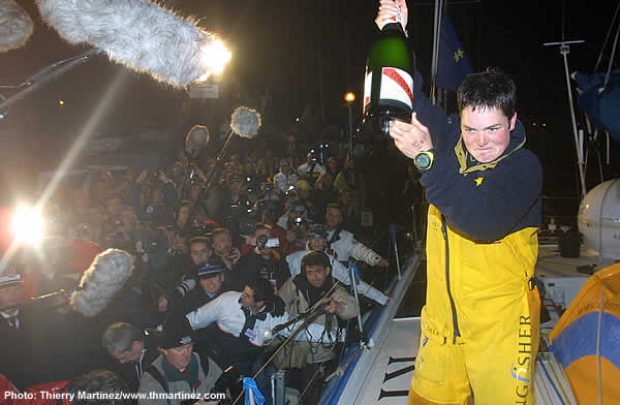
Commercial value is often not as easy to ascertain but in our sport there are some exceptional examples of commercial value both at a low level such as many Olympic sponsorship deals to a higher level such as Kingfisher’s sponsorship of Ellen MacArthur’s Vendee Globe campaign. In the latter case, between the Route du Rhum in 1998 and the completion of the Vendee Kingfisher's return on investment (ie outlay versus advertising value) was in excess of 50:1 and possibly as high as 70:1 (a guestimate including unmonitored markets such as North America). Usually in sports sponsorship 3:1 is considered the average, 5:1 exceptional.
Some America’s Cup sponsors declared themselves more than happy in 2003 and will be renewing deals to the extent that Alinghi are aiming to cover the full costs of their 2007 defence through sponsorship.
The problem with most America's Cup sponsorships in 2003 is that they did not cover the full cost of competition. All of the big teams and indeed many of the smaller ones relied on a substantial level of personal investment especially in the crucial early stages. If the budget required in this new ‘professional era’ far outweighs the value of potential sponsorship then is it really sustainable? Should teams rely on the financial backing of wealthy individuals to ensure the place of their teams on the start line?
If sailing wants to be a professional sport then its challenge is to make the commercial value of any program exceed the cost of carrying it out successfully. For this to happen we need to both cut campaigning costs and provide increased value. That is what they are trying to do at the next America’s Cup.
America’s Cup Management should be applauded for this. They are making every attempt to increase value to the teams and their sponsors in the run up to and during the next. One only hopes that it is a success and that it provides the blueprint for other professional classes to follow. A few examples of the kind of initiatives that should revolutionise the commercial value of sponsoring America’s Cup teams are
- Adding new events to form what could one day become a circuit of AC Class events.
- Choosing a central European venue with excellent accessibility to many multinational companies and their clients
- Choosing a reliable wind and weather venue to increase the spectacle and minimise commercially unfriendly postponements
- Choosing a venue which permits the racing to be close to the shore.
- Creating publicly accessible infrastructure to support the event and its teams,
- Shortening the races and having more than one race per day
- Shortening the whole event so that public interest can be maintained
- Simplifying the management of the event under one body (ACM) to maximise the event’s potential.
Although some of the above initiatives will increase campaigning costs, ACM have tried to reduce costs thanks to the benefits of being able to effectively sell the event to the highest bidder. Examples of cost savings are:
- centrally pooled weather information
- no entry fees for those that enter before 17th December 2004 (there is still a 50,000 Euro Challenger Commission payment and US$25,000 AC copyright fee.
- local tax concessions for syndicates and team members
- Significantly cheaper syndicate bases compared to New Zealand.
- Costs for entering pre-regattas paid for by ACM
Unfortunately the cost savings in no way go far enough. The main problem with the cost is that you need a lot of people to run an AC team, you get through a huge amount of sails and the amount of R&D you can do is limitless. Unless you can restrict any or all of these cost centres you are merely tinkering with the edges. To really cut costs you need to limit team members or salaries, limit sails and masts, limit R&D or somehow restrict the time teams have to spend the money. All of these solutions would be very difficult to enforce but might one day become necessary to sustain the number of teams entering.
I am as excited as anyone about all the new developments in sailing but I am also worried about its sustainability. As with any ‘boom’ period it is often followed by a ‘bust’ if the warnings are not heeded. I believe that the warning signs are there across the sport but most especially in the fully crewed events. Sailing, like Formula One Motor Racing needs strong leadership but unlike Formula One it is not clear who could provide that. In sailing there is no overall organisational body with the authority to dictate any change and so it is probably up to each and every class and event organiser to think about the costs to competitors. I know we live in a free World where market forces are relied on to control things, but sometimes the market needs to be saved from itself.
If you agree with Ian or if you think he is way off the mark, please email your thoughts to us by clicking here .
Most Read
Most Commented
Comments
Businesses

Pro businesses
-
United Kingdom
-
Italy
-
United Kingdom
-
Editor's choice
Member blogs
-
 Ned Collier Wakefield: MOD70 round BarbadosWell that was intense. 12 hard fought for seconds for the win. In idyllic conditions, Tony Lawsons MOD ...
 -
 Mini Transat leg 2 reportThe second leg of the Mini Transat started on 31st October, just over a month after ...
 -
Leg 1 reportI’ve been working towards the Mini Transat now for three years. In 2013 I was part ...
Business blogs
-
 The Island Sailing Club in Cowes, Isle of Wight, is delighted that Prince Michael of Kent ...
 -
Peta Stuart-Hunt chats with the 25 year-old British solo sailor Lizzy Foreman before she sets sail ...
-
The 2015 Student Yachting World Cup (SYWoC), an ISAF-recognised event hosted and run by students for ...
Editor's Choice
All time favourites...
-
 Three legs down into Ian Walker’s
 -
 Winning all but two races at
 -
 For the first time in its
Latest Comments
Add a comment - Members log in