
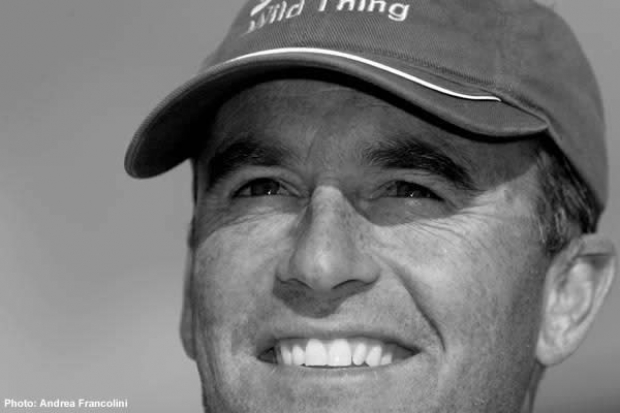
The dogmatic Australian
Friday September 24th 2004, Author: James Boyd, Location: Australasia
He may only have half the budget for his Volvo Ocean 70 campaign, but it would be an unwise man to bet against Grant Wharington making it to the start line of next year's Volvo Ocean Race such is his determination.
Wharington made some impression when he brought his first maxi Wild Thing to Europe for Skandia Cowes Week and the America's Cup 150th anniversary regatta in 2002. He has since built his second maxi Skandia Wild Thing which with it's short single spreader rig, electric winches and a keel that could be canted by a tiny amount relative to Open 60s appeared to be the left field candidate for line honours prior to the start of last year's Rolex Sydney-Hobart race. But in the end Wharington slapped his detractors about the head as his team trounced their Kiwi rival Zana to take the prestigeous line honours trophy.
Over the southern hemisphere winter Skandia Wild Thing has been back in the shed undergoing surgery. Newly fitted is a retractible canard with a trim tab on the back of it, an arrangement similar to that used on many of the 60ft trimarans.
"We think it’s better than having a fixed rudder because you can get rid of the drag going downwind and you can also make it into an asymmetric foil when you’re going upwind. We think it’s a goer," says Wharington. At present Skandia Wild Thing's keel cants by just 15 degrees and previously this would see them making 7 degrees of leeway upwind.
"We thought that was a bit much and with the changes we are doing next year when we will be canting to 40 degrees, it was like a stepping stone anyway because then we'd definitely have to have something else then," he continues. "So we thought we’ll put it in now, it might not be that great with just 15 degrees [of keel canting angle] and the extra drag increase might outweigh the advantage of having the canard, but it turns out to be pretty good. We’re very impressed with it."
Also new is a bowsprit allowing her to fly larger asymmetric kites - the new sail is a massive 680sqm affair compared to 580 sqm before - and the idea has been to tailor the boat for whatever type of regatta she is taking part in. For longer distance races where more reaching conditions are expected they have upped their biggest rated headsail to 290sqm - a jib top on a furler - but for regattas like Hamilton Island where they sail windward-leewards, the jib top is replaced by their largest conventional jib at 175sqm and their 670sqm spinnaker.
Now, Wharington reckons they have pretty much all corners of their performance spectrum plugged. "Probably the only area where we might be vulnerable against Alfa Romeo or a maxZ86 is light air upwind because we don’t have a really huge rig. But we are very narrow and have low wetted surface area so the boat heels quite quickly. If you are doing a race in 5 knots of wind we’d probably struggle against those guys, because they have got big sail plans. But having said that we don’t have to reef that early. We can hold our big jib up to 18 true. The boat is very easily driven."
Remarkably Wharington says all these modifications have been done within the new rating limit of 1.1615 for this year's Rolex Sydney-Hobart race. "They raised the limit a little bit from 1.610 [from last year's race]. We were 1.607, so we still had a bit of space up our sleeve. We were able to put the bowsprit on and the canard and everything and still come in under the limit."
The boat recently won the Hahn Premium Race Week up at Hamilton Island against Zana (now renamed Konica/Minolta) and next month is to be taking part in the China Coast Cup followed by the inaugural Hong Kong-Vietnam race, before returning to Sydney for the annual Boxing Day run south.
After the Rolex Sydney-Hobart and Skandia Geelong Week, the boat will go back into the shed to have her keel fully turbos. Aside from the increase in canting angle they plan to lose 4 tonnes from the bulb and gain 0.5m in draft. "So when we are in Cowes next year for 150 years of Skandia, we’ll be pretty suped up. We are going to be the flagship at Cowes Week." Aside from Skandia Cowes Week Wharington says that the program for the maxi will include the Gotland Rund, Round the Island race, the Rolex Fastnet Race before heading down to the Med for the Maxi Yacht Rolex Cup in Sardinia.
But the main reason for our interview with Wharington is to find out about his plans for the Volvo Ocean Race.
The build of the Australia Volvo Ocean 70 is to commence on 1 October and one expects it to follow similar lines to that of Wharington's new maxi- a home grown affair from his native Mornington on the eastern shore of Melbourne's Port Philip Bay. The VO70, like Skandia Wild Thing, is to be designed by local architect Don Jones, who will be responsible for everything - tank testing, appendages, CFD work (Jones is trained as an engineer - read our interview with him here). The only thing Jones isn't working on, says Wharington, is the rig.
For Wharington 2005 will be a rather busy time between skippering the maxi and working up the VO70, but he has the timing worked out: the VO70 launching in May will coincide with the maxi being shipped to Europe. They will have two months sailing in the new boat before heading to Europe in July to put the maxi back together and sail her to Sweden and carry out her European program as the VO70 is shipped to Europe. After the Maxi Worlds, they'll jump on the VO70. Simple, if ambitious.
Wharington expects all the new Volvo Ocean 70s to be at max when it comes to length, beam and sail area. "I don’t think anyone will go narrow with these boats. They are all going to be maximum beam, because they are so overpowered with massive sail plans."
To go with the canting keel he clearly likes the possibility of having a retractible canard/daggerboard forward with a trim tab (as does Mike Sanderson), but this is illegal - under the VO70 rules you can have a canard which lifts or has a trim tab, but not both (something which the race organisers would do well to review for the 2009 race). It seems the only solution to accompany the canting keel is to have twin asymmetric daggerboards as most Open 60s have.
On the basis that the boats will have the maximum allowable beam, Wharington believes that all the VO70s will have twin rudders. "Two rudders are smaller than one and about the same weight or even a bit lighter. Once you add all the steering gear it is probably about the same weight, but it is a bit smaller [the total rudder area and the drag] and it gives you the benefit that if you hit something you still have one rudder left and if you put them round enough when the boat is heeled you can get at least 2/3 of one of the rudders out of the water." Again all very Open 60 thinking.
Wharington also leads the pro-headsail furler camp. "It’s fantastic. We’ve used it on the big boat and we’ll definitely use it on the 70," he says. "At the end of the day you don’t have to change the sails faster than the next guy, you’ve got to make sure you don’t get fatigued and you don’t drop sails in the water and you don’t damage gear and you don’t damage people. There’s more to it than just the hard and fast ‘got to have a Tuff Luff and do slick changes'. It’s okay in a perfect world, but I don’t think it is a reality when you’ve got nine people and big sails and lots of changes going on.
"I think that a lot of people learned lessons from illbruck last time: people would do lots and lots of changes and dart off in different directions and try to get an edge and illbruck would just stick to their game plan knowing their sails and go straight down the track and the other guys would wear themselves out or break something and they’d come back on track and be five miles behind. They might shoot off and get a short gain, but at the end of the leg illbruck would be ahead. So it is about knowing your boat, your people and your gear."
Crew-wise we can expect to see many of the Skandia Wild Thing crew ending up on board the Volvo boat. This includes Barney Walker, navigator Will Oxley plus the likes of Andrew Henderson, Graham Taylor and Adam Hawkins. A man with valuable Open 60 experience who may also join the team following the Vendee Globe is one Nick Moloney.
The big worry with the Australian campaign at present is funding. Skandia, the obvious choice for Wharington's campaign seem loath to get into the big game just yet (as their marketing head Andre Oszmann mentioned in our interview with him) and at present Wharington says he has enough budget to get to the start line, but not enough to get round.
"Nothing is done until it is done, but we’ve just got to bide our time and get on with the build. We are hoping to get money out of Australia, especially with the stop there. It’s got to be good for a lot of Australian companies, but it’s just a case of getting them to commit to it. We’re hoping that once we get the boat in the water and sailing and the hype starts building with the stopover and everything we’ll get some more people on board." Otherwise the major funding must come from overseas.
The money to date has come partly from minor corporate backing, but from having already sold the boat after the race.
Most Read
Most Commented
Comments
Businesses


Pro businesses
-
France
-
Italy
-
Italy
-
Editor's choice
Member blogs
-
 Ned Collier Wakefield: MOD70 round BarbadosWell that was intense. 12 hard fought for seconds for the win. In idyllic conditions, Tony Lawsons MOD ...
 -
 Mini Transat leg 2 reportThe second leg of the Mini Transat started on 31st October, just over a month after ...
 -
Leg 1 reportI’ve been working towards the Mini Transat now for three years. In 2013 I was part ...
Business blogs
-
 The Island Sailing Club in Cowes, Isle of Wight, is delighted that Prince Michael of Kent ...
 -
Peta Stuart-Hunt chats with the 25 year-old British solo sailor Lizzy Foreman before she sets sail ...
-
The 2015 Student Yachting World Cup (SYWoC), an ISAF-recognised event hosted and run by students for ...
Editor's Choice
All time favourites...
-
 Three legs down into Ian Walker’s
 -
 Winning all but two races at
 -
 For the first time in its
Latest Comments
Add a comment - Members log in