
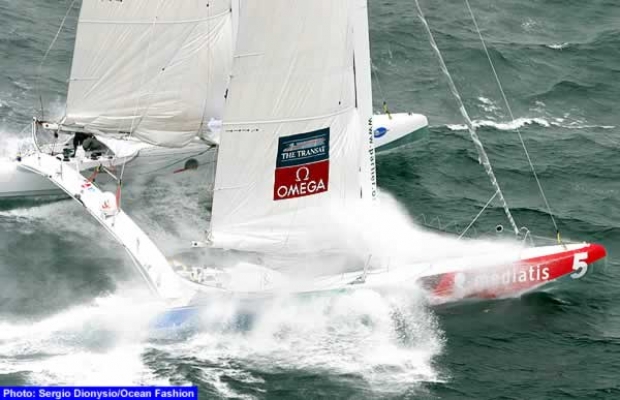
36.6 knots for Parlier
Monday June 7th 2004, Author: James Boyd, Location: France
See the video of Parlier's new catamaran
here
.
The most radical boat currently taking part in The Transat is Yves Parlier's 60ft double wingmasted, seaplane-hulled catamaran, Médiatis Région Aquitaine.
We wrote about this extraordinary boat extensively following her launch in February (see 'Is it a Boat? Is it a Plane' Pt1 and Pt2 or search (above right) under 'Parlier'). Since then Parlier and his team have been busy sea trialling and developing their innovative machine.
Speaking to Parlier's team prior to the start the conclusion was that if there is one race Médiatis Région Aquitaine is not suited to do it is The Transat. At present the boat is neither pleasant nor efficient upwind, but of course Parlier is Parlier and most mortals who dismast in the Indian Ocean in a singlehanded non-stop round the world do not pull into New Zealand, build their own oven to repair their severed carbon spar and then successfully carry on half way around the world.
Prior to the start Parlier had sailed the boat on his singlehanded 750 mile qualifier and had been out on numerous occasions with his crew around the Bay of Biscay. During his solo qualifier Parlier says the boat hit 32 knots and maintained a 25 knot average for two hours. At the beginning of April the boat was taken out of the water to finish off some of the construction work in her long and structurally complex cross beams. She was relaunched in May and Parlier says they then spent a lot of time trying to get their sophisticated autopilot system working ready to complete in The Transat. In the event the pilot system was to give the French skipper problems on start day of The Transat when he was forced to return to Plymouth Yacht Haven prior to the gun to make repairs.
Parlier says his top speed in the boat to date has been a lively 36.6 knots. This was in 18-21 knots of true wind speed but with an awkward cross seas - so conditions were far from ideal (the crew reckon ideal wind conditions for the boat are 30 knots from 130deg true).
Designer Loic Goepfert was on board at the time. "We were under one full main and one with a reef and the gennaker. The boat was accelerating and accelerating so we bore away to leave the apparent wind angle steady but at one point we couldn’t bear away any more so the genniker was too close to the wind and ws at the limit. On the same trajectory but with no genniker, two mains and maybe 30 knots of wind we could easily reach 40 or 45 knots."
While Parlier's performance at present in The Transat has been lacklustre, the boat has shown at least a similar speed at times to the 60ft trimarans. This morning for example she averaged 19.5 knots for four hours and was the fastest boat in fleet (admittedly she is now sailing in different weather to the frontrunners).
As previously written, the boat has planing hulls rather a conventional displacement hull and thus the behaviour of the boat through the water is very different. Like a powerboat as the speed moves into the 20 knot range, so the catamaran's bows rear up as they overtake the bow wave. Once up on the plane (as shown in the video) the sterns sit down and the boat starts to skim across the waves with a motion more ressembling a sailboard than a conventional multihull.
In waves when planing the catamaran buries her bows less than the 60ft trimarans do and sees less deceleration as a result, but has a tendency to bounce around the waves. This is not a pitching problem, but one of the boat's planing ability.
While catamarans are notorious for pitching badly designer Guillaume Verdier says that they spent a lot of time addressing this with Parlier's catamaran. "The trimarans pitch more than we do. We worked a lot to reduce the pitching moment, by reducing mast height, to have the correct angle with the bows and planing surfaces, etc. It would have been impossible to have the boat planing with a large pitching moment, so the whole point was reduce pitching while having a large driving force."
Downwind Parlier says the handling is superb. "In the water the boat feels very safe because we can go down the waves we want. It is very dynamic to steer. You can steer through the waves."
Loick Goepfert confirms this: "It is really a downwind boat. Sailing this boat downwind, it doesn’t want to capsize or pitchpole with the low centre of effort. The boat is really stable and sails very fast. You don’t feel any drag. You feel the boat just wants to go faster. It is a real pleasure downwind.
"The motion is like a dinghy except on a dinghy when you don’t feel safe as some small change can make you capsize. On this you can move really fast and place the boat in the water but with the low centre of effort of the sail, it feels really stable and you have got the feeling that nothing can stop you or slow the boat down. The boat really wants to accelerate. You don’t feel any limits like you do with a classic hull when the hull starts to go into the water like a submarine. On this boat when you accelerate the leeward hull is lifting and you don’t feel anything is dragging. You feel like it is easy and the boat can accelerate and nothing will stop it..."
Currently the boat planes at around 25-26 knots of boats, although the less pressed weather hull planes before this.
Upwind it is a different story. The V-shaped hulls have a tendency to slam and due to the rig configuration and the positioning of the daggerboard the boat showed significant lee helm during her trials. Prior to The Transat the shore team alleviated this problem to some extent by removing rake from the masts. Helm issues such as these are not good for a singlehanded race because it demands more power from the autopilot.
The motion of the boat upwind is extraordinary. "If you are trying to sleep near the daggerboard you can move from your bed maybe 50cm when the boat is slamming. The motion is incredible," says Loic Goepfert. Part of the motion problem is that as the boat gains speed upwind it wants to plan.
Sailing fast upwind in 35 knots on the sea trials they broke one of the PBO backstays. This doesn't surprise Guillaume Verdier who says that inevitably with the catamaran having a beam of 15m will experience signficant deflections in the crossbeams and thus does not make them a good place to crank up runners. Fortunately the backstays are not essential to keeping the rig up as the mainsheet already has an 8 tonne loading.
Taking part in The Transat, renowned as an upwind race, as well as being the first race for Médiatis Région Aquitaine was a very big call for Parlier. Prior to the start the skipper admitted he would be happy if the boat simply made it to the other side.
Watching the video of the boat at the start gives an impression of just how wet she is even sailing in the relatively protected waters off Plymouth. How awful it must have been on the boat sailing in 45 knots of wind in the first North Atlantic gale The Transat multihulls encountered is hard to imagine.
Sailing into the depression Parlier was unable to make the fullest benefit of the wind shift that race leaders such as Michel Desjoyeaux handled so elegantly and for a long while he was clearly simply heading for safety on a course east of south. While the boat has a genniker and a small jib, most of the time the boat is sailed under her two mainsails alone. To reef they lose the windward mainsail first. In the gale Parlier was sailing under bare poles alone.
The boat clearly has a long way to go in her development. From an early stage the designers admitted that compared to the 60ft trimarans the boat is faster in light conditions due to her low wetted surface area, slower in medium conditions but has the potential to be much faster when planing.
Parlier is keen to improve the boats all round ability, but particularly to lower the boat speed at which they get on the plane. He thinks that one way of achieving this is by being able to alter the pitch of the rudder T-foils on the fly. "At around 27 knots it starts to plane, but we hope it will be more like 18-23 knots when we have modified the T-foils," he says.
Following The Transat Médiatis Région Aquitaine will head up to Canada to take part in the fully crewed Quebec-St Malo race. This is the kind of downhill sleigh ride that should give the crew the opportunity to show the boat's real potential. Otherwise her forte will be picking her favoured weather conditions and going for records.
Most Read
Most Commented
Comments
Businesses

Pro businesses
-
France
-
-
United Kingdom
-
Netherlands
Editor's choice
Member blogs
-
 Ned Collier Wakefield: MOD70 round BarbadosWell that was intense. 12 hard fought for seconds for the win. In idyllic conditions, Tony Lawsons MOD ...
 -
 Mini Transat leg 2 reportThe second leg of the Mini Transat started on 31st October, just over a month after ...
 -
Leg 1 reportI’ve been working towards the Mini Transat now for three years. In 2013 I was part ...
Business blogs
-
 The Island Sailing Club in Cowes, Isle of Wight, is delighted that Prince Michael of Kent ...
 -
Peta Stuart-Hunt chats with the 25 year-old British solo sailor Lizzy Foreman before she sets sail ...
-
The 2015 Student Yachting World Cup (SYWoC), an ISAF-recognised event hosted and run by students for ...
Editor's Choice
All time favourites...
-
 Three legs down into Ian Walker’s
 -
 Winning all but two races at
 -
 For the first time in its
Latest Comments
Add a comment - Members log in