
Boat or a plane? Part 2
Friday February 20th 2004, Author: James Boyd, Location: France
This article continues from
part one
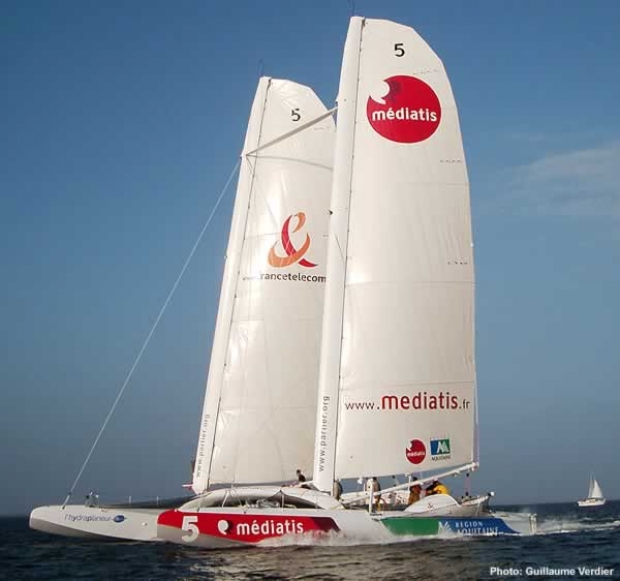
When thedailysail visited Arcachon last week Yves Parlier and his crew were all smiles, Médiatis Région Aquitaine having just completed her maiden voyage on the flat waters of the Bassin d'Arcachon logging 21 knots in the process. There is nothing like seeing eight years of work come to fruition successfully.
Parlier says her steering was "like a bicycle" ie: highly responsive. However it is so responsive that he says he will have to take care in gybes. Gybing too quickly in the 25ft test catamaran the last time he sailed her caused them to capsize as they didn't cross the boat fast enough.
Seeing the boat in its full carbon fibre glory, it is certainly very wide and the hull shape takes some getting used to. Aside from the design of the hulls we would think the design and engineering of the cross beams was probably the hardest part of creating this boat and they are inevitably quite bulky and thus come with a high degree of drag - not good on boat that should be capable of 40+ knots.
Designer Guillaume Verdier, formerly part of Groupe Finot where he worked on the Sodebo and PRB Open 60s, was in charge of structuring Médiatis Région Aquitaine and showed the greatest relief on his face after their maiden voyage. He will be paying careful attention to the information logged by the Insensys fibre optic strain guage matrix set up on board to ensure that the beams - which he says could see as much as 30 tonnes of shear force - don't go the same way as Team Philips' bow. Guages are located in 37 strategic places around the boat linked by a single fibre optic cable.
"We don't have huge bending moments in the middle of the beam, because we don't have the masts there," says Verdier. "The main load is a wrinkling load. You have maximum bending moment nearer the hull. It was really complex..." The beams each have 14 bulkheads in them and the outer and inner carbon fibre laminates have skin links to reduce any delamination spreading in the event of a core failure.
The boat was built by a new company Chantier Naval de Larros - a partnership between Thierry Eluere, Yves Parlier's company Ocea and motor yacht builders Guy Couach. A majority is carbon/Nomex although foam has been used in slamming areas such as beneath the beams.
The wingmasts at 24m off the water are a lot shorter than a 30m ORMA 60ft tri rig, but then there are two of them. There is little special about the masts except that they are using halyard locks and due to the cross bar/triatic joining the tops of the two rigs mast rotation is limited to 70deg. The mast spanner extends forwards on both of the rigs but oddly there are only controls pulling each spanner in one direction - inboard. Because the mainsails are small they only have two reefs in each.
The cockpits are quite small and shallow but there is a good helming position and oddly you get a view of the leeward bow looking beneath the forward mast beam. Sail controls are duplicated in each cockpit and are all close to the steering position. As we mentioned yesterday the two headsails are flown off the leeward rig and the sheeting for the genniker comes off the end of the mainsheet track.
At the forward end of each cockpit there is access to the hull. Clambering below is relatively easy but when we were on board the interiors were not finished and there was not a lot to see. Needless to the say the interior is cramped and it is decidedly a case of sitting headroom only.
With such slender hulls pitching could be a problem, however to counter this there are overhangs at the bow and stern and Parlier points out that the short rigs should help alleviate this. There are also T-foils on each rudder the pitch of which can be altered by +/- 3 degrees. At present the pitch is changed prior to going sailing, but in a future evolution they expect to add a hydraulic system so the pitch can be changed while at sea. Currently there are no hydraulic systems on board at all.
Her designers are reluctant to guess what the boat's top speed might be, but top speed is certainly where her potential lies.
The drag v speed curve for her seaplane hull is very unlike that of conventional hull. It is faster in light conditions due to its narrow waterline and transoms clear of the water (it is expected that some water ballast will have to be taken on forward to help keep the transoms out). At 8 knots of boat speed and above a conventional hull has as much as 10% less drag but the seaplane hull wins out again from 20-24 knots and above and it is in this region that the boat should excel. While drag continues to increase exponentially for boats with conventional hulls for a seaplane hull the drag curve levels out once it is planing - effectively you can go faster and faster without increasing drag. "After 24 knots really the curves separate very quickly," says designer Loic Goepfert. "At 40 knots we've got four times less drag than a classic hull. So it is quite promising." Indeed.
When the boat is planing in theory the overall drag of the boat will increase only minimally - not by a factor of two - when both hulls are in the water (the weight of the boat is distributed over four planing surfaces rather than two). Despite this Parlier still expects the optimum performance to be achieved while just flying the weather hull - like a conventional cat. The only exception may be sailing downwind when it could be faster if both hulls are in the water planing.
Being a very wide catamaran flying a hull will require considerable effort (conversely on the new Orange, for example, overall beam was kept modest so the boat can fly her weather hull in less wind). To regulate hull flying on Parlier's cat in stronger conditions three water ballast tanks are fitted in each hull - forward, midships and aft - each with 500lt capacity. The forward tank will be used upwind, the midships one reaching, the aft downwind.
An unusual characteristic of this hull shape is that it will be easier to get her up on the plane if there are slight waves. "During the towing tank test we discovered that a small amount of waves is better," says Loick Goepfert. "Because we have the step we need some air to get inside to allow the step to release." It is known that on occasions seaplanes cannot take off if the water is too flat.
Using water ballast to alter fore and aft trim will also play an important factor in how quickly the boat gets up on and stays on the plane. The designers expect getting this to be a similar experience to that of a power boat where first you have to get over a hump before the bow lowers and you take off. "Trim will be really important," says Loick Goepfert. "It is exactly like a motorboat which should start flat. Then the speed is growing and then we need to go up to 8 degrees and then when we start lifting we should again go down to 3.5 degrees." Ultimately the boat will end up skimming across the water on the two planing surfaces she has on each hull.
With the big flair forward and low freeboard the boat is likely to be very wet. The narrow bow is expected to be quick through waves in a semi-wave piercing kind of way. Guillaume Verdier says the boat is engineered so that it is capable of going through 1.6m high waves at 40 knots (that should be an exciting ride...)
Parlier doesn't expect his catamaran to be a trimaran killer - not immediately at least. "I think this kind of boat will be good in some conditions but trimarans are better in other conditions," he says. "Maybe it is less versatile than a trimaran. In a race where there are different conditions it is difficult to win today. We have to think about progress but at the moment at low speed it is better to have a conventional Archimedian boat."
Her performance will be such that she is not expected to excel in races where they are a variety of wind strengths and angles. However the design team are currently carrying out a study involving developments of the step that will improve its performance at low speed, enabling boats with this hull shape to get on the plane in lower wind strengths.
Parlier thinks there is great potential to use the seaplane hull shape on a trimaran - although for this he would recommend a conventional single mast configuration.
With the two rigs side-by-side there is the potential for the weather rig to blanket the leeward one. Parlier doesn't view this as a particular problem as most of the time they will be sailing at speeds greater than the wind and so the apparent wind will always be ahead of the beam. If there is a lot of wind then they will only be using one mainsail in any case.
Parlier believes that ultimately the boat will end up in a 'race' configuration with more headsails and a 'record' configuration when they might rely only on one of the rigs and can ensure that they sail only in strong winds on one tack.
From here Parlier plans to continue his test program and a slow work up of the boat. Initially this will take place with in the Bassin d'Arcachon, his local harbour and an ideal location due to its flat water. He may attempt a record over a short two mile course within the Bassin and is also considering setting a new record along the length of the Aquitaine coast.
There is a possibly of him taking the cat up to the first ORMA Grand Prix of the season in La Trinite if the test program allows, but the first event he is committed to doing is the singlehanded Transat. "I think as this will be my first race, the objective is to cross the Atlantic," says Parlier. "And if I can get to Boston without breaking the boat - it will be very good."
As a singlehander he thinks Médiatis Région Aquitaine will have pros and cons versus a 60ft trimaran. The sails are smaller and therefore easier to handle and the boat will be easier to tack or gybe. However as a catamaran, even a beamy catamaran with water ballast, Parlier thinks that controlling her desire to fly a hull will be harder and he will have to have a faster reaction time than if he were on a tri.
Fortunately another weapon in the Parlier armoury is the special autopilot system he has developed. PC-based, the Windsat - IXL is not an auto-learning type device but rather has the ability to control the pilot based on large number of rules. The pilot was perfected on his Open 60 and is currently being developed for multihulls (it is being used on Gitana and Banque Populaire). The advantage of the pilot, Parlier says, is that it can steer the very best VMG upwind and downwind and also can be programmed to make sailing downwind safe.
"In the Vendee Globe or Atlantic [singlehanded] it is not important to stick to the course - it is better to go to the best speed and to ensure that the boat doesn’t tack or gybe," he says. He points out that on some occasions it is better that the boat bears away or luffs up in gusts but which depends obviously on the point of sail and can be very different on multihulls compared to conventional boats. However whatever the desired reaction it can be programmed into the computer creating rules relating to wind speed and direction, heel angle, boat speed and course, etc. For fast boats such as Open 60 and multihulls even more so, Parlier says it is essential to have some form of inertia monitor to measure the boat's acceleration or decelation, but they have yet to finish developing this for their system.
Parlier plans to enter the return race from the Transat - the fully crewed Quebec-St Malo. Upon his return to Europe he then expects to make some more attempts on offshore passage records such as cross-channel, cross-Mediterranean and ultimately trans-Atlantic and trans-Pacific. Round the world, Parlier confirms, is not on the cards.
The future may also see him using the boat to make an attempt on the WSSRC short course speed record over 500m. "I think we have to change the boat for this competition," he says. "Maybe we will have a solid sail. Maybe we will add a fin to profile the crossarm and take off a lot of things. I think if someone goes more than 50 knots it will start to be difficult and you will start to get cavitation problems."
So - will it work? The performance profile of the boat seems to be lacking compared to a 60ft trimaran in moderate conditions but in big conditions Médiatis Région Aquitaine could do a horizon job on the ORMA fleet. The main issue will be whether or not the structure holds together when it is pushed harder - if the beams break mid-Atlantic even the ingenious Parlier will have trouble saving it. What it certain is that the team could have done little more in terms of their research for this boat and Parlier, one of the smartest sailors in France, is not known for sailing slow boats.
More photos on the following pages
Most Read
Most Commented
Comments
Businesses

Pro businesses
-
United Kingdom
-
-
United Kingdom
-
France
Editor's choice
Member blogs
-
 Ned Collier Wakefield: MOD70 round BarbadosWell that was intense. 12 hard fought for seconds for the win. In idyllic conditions, Tony Lawsons MOD ...
 -
 Mini Transat leg 2 reportThe second leg of the Mini Transat started on 31st October, just over a month after ...
 -
Leg 1 reportI’ve been working towards the Mini Transat now for three years. In 2013 I was part ...
Business blogs
-
 The Island Sailing Club in Cowes, Isle of Wight, is delighted that Prince Michael of Kent ...
 -
Peta Stuart-Hunt chats with the 25 year-old British solo sailor Lizzy Foreman before she sets sail ...
-
The 2015 Student Yachting World Cup (SYWoC), an ISAF-recognised event hosted and run by students for ...
Editor's Choice
All time favourites...
-
 Three legs down into Ian Walker’s
 -
 Winning all but two races at
 -
 For the first time in its
Latest Comments
Add a comment - Members log in