
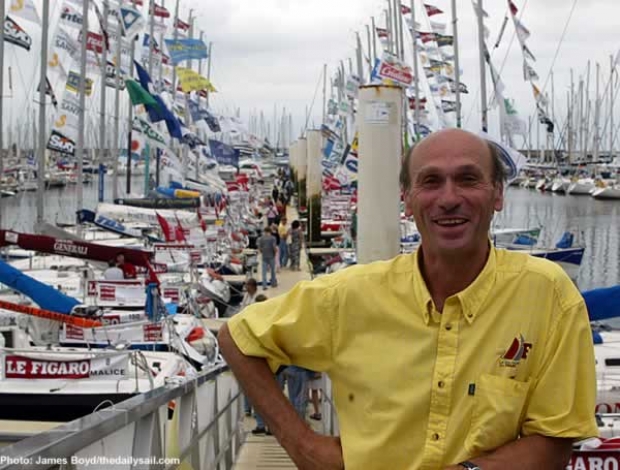
The new Race Director of the Vendee Globe - Denis Horeau
What will become of the Vendee Globe?
Thursday May 20th 2004, Author: James Boyd, Location: France
It has been a turbulent year for the Vendee Globe and for its creator, Philippe Jeantot.
Having won the first two BOC Challenges (now the Five Oceans), singlehanded around the world with stops, Jeantot originally conceived the non-stop Vendee Globe Challenge back in the late 1980s as the ultimate singlehanded offshore race. The Frenchman put the pieces in place for the inaugural event and has run it every four years since, each race feeling like it is a historic occasion. The Vendee Globe is now considered one of the pinnacles within our sport alongside the Olympics, America's Cup and Volvo Ocean Race
However over the last 12 months control of the race has been prised away from Jeantot. The storm began in the spring of 2003 when the race organiser was found guilty of owing almost 3 million Euros in unpaid taxes, both personal and that of one of his companies, Sail COM. Jeantot was given a two year suspended sentence and a fine of 15,000 Euros while the race, or more specifically the Vendee Globe brand, was put up for sale by the law court of La Roche sur Yon (Vendée).
At this time the town of Les Sables d’Olonne, where the race has always started and finished, and the council of the Vendée region where Les Sables d'Olonne is situated went into action assuring competitors and public alike that they would do everything in their power to make sure that the fifth Vendee Globe would continue as normal. “It will be up to the law court to decide, but we’re ready to buy the race”, insisted Louis Guedon, the mayor of Les Sables d’Olonne on the day of the breaking news.
It took nearly a year to sort out how this transfer of ownership would take place with many hearings before the 'Tribunal de commerce' before the event was finally sold to SEM Vendée, a consortium comprising the Vendee Council as the major stakeholder, the town of Les Sables d’Olonne, the Pays de la Loire council and around 30 local companies.
SEM Vendee paid 2 millions Euros for the race, a price Jeantot believed too low. The former owner and Race Director complained that the whole thing was “a masquerade, which betrays the spirit of the race”, to which, Philippe De Villiers, head of the Vendee Council retorted: “My friendship for Philippe Jeantot is stronger than his angriness. We know what we owe Mister Jeantot for creating such a wonderful race, but I cannot pay the debts of someone who doesn’t pay his taxes.”
Roland Jourdain, skipper of Sill, echoed the sentiments of many of the skippers hoping to take part in November's event. “We remain endebted to Philippe Jeantot for having created the Vendee Globe, but the crisis had to come to an end.”
At the end of March the new owners of the Vendee Globe announced the appointment of a new Race Director in Denis Horeau. There are few people better qualified for the job. Horeau was Race Director of the first Vendee Globe when Jeantot was competing and has since run and developed the highly successful Solitaire du Figaro.
Due to the protracted court proceedings little had been done in terms of the organisation of the 2004-5 Vendee Globe and Horeau says he has had to start from scratch. "So far we have to build everything," he says. "Even the pre-entries have no value at all. So we are starting from a blank page."
Horeau's first job has been in writing a new Notice of Race encompassing his interests as Race Director, those of the skippers and the race's new owners. In the event there appear to be few changes that will affect entries.
There was a rumour that Open 50s might be allowed to compete but this may have been wishful thinking on the part of some owners. They had already been banned from the Vendee Globe under the previous regime, despite a number of new boats being built specifically to take part in it.
Horeau says that even if he had been given the job more than eight months prior to the start of the race he would not have allowed the 50s to take part.
"The problem is that you cannot begin your career on a 50 in the Vendee Globe. This was my feeling 15 years ago when we ran the first edition of the race," he maintains. "The Vendee Globe is the top of your career, it is the end of it, it is the Everest. We don’t want people to turn up with their 50, think they can be on TV and known for sailing in the Vendee Globe. That cannot work. If you want to sail the Figaro, then you sail a Figaro and at the end of the day you will be in the Vendee Globe with a 60. That is very important." This is a view that many Open 60 skippers such as Giovanni Soldini and Isabelle Autissier have expressed in the past.
The amateur element among the 50s, he says, can bring added risk to the race, although he acknowledges that there are notable exceptions like Pete Goss, who carried out the incredible rescue of Raphael Dinelli in the 1996-7 race and ocean racing veteran and journalist Patrice Carpentier who raced Goss' boat around four years ago.
Horeau also feels that having more than one class on the start line of the Vendee Globe confuses the race. "In the short term it will make the race less clear than if you just have the 60s. In the long term it will not help the 50s because the 50s should have their own organisation, their class, their own races." At present the Open 50s are represented by IMOCA, and already a number of events have been held purely for them such as last year's Saguenay-St.Pierre-Vendée transatlantic race.
There is of course a strong counter-argument that many of the modern Open 50s are more professional than the poorer Open 60 campaigns, Brad van Liew's Tommy Freedom America campaign in the last Around Alone being a good example.
The qualifications for the Vendee Globe remain much the same. Skippers must sail one major oceanic race on a boat and carry out a trans-oceanic qualification passage on board the actual boat they will be sailing in the Vendee Globe. The only difference says Horeau is that now the qualification passage can now be in a race, such as The Transat. Previous competitors in the Vendee Globe are waived the oceanic race part of their qualification.
Horeau's job in writing the Notice of Race has been made easier as many of the safety rules for the race form part of the IMOCA class rules. Since the disasters of the 1990s when there was a spate of Open 60s that inverted and failed to right - during one incident in the 1996-7 Vendee Globe Canadian skipper Gerry Roufs was lost - the Open 60 class have got their house in order and the boats now have stringent stability requirements and carry a complete armoury of safety gear.
The present entry list on the Vendee Globe website shows 29 entries, but many of these are known not to be taking part. Horeau says that previously the maximum number of entries was limited to 20 boats, but now there is no limit. He expects 15 to 17 boats to be taking part. "If you consider it is the end of your career, you shouldn’t expect to have 25 or 30 boats."
The entry list as we see it at present is as follows:
| Skipper |
Nat
|
Designer |
| Dick Jean-Pierre |
Fr
|
Farr Yacht Design |
| Golding Mike |
GB
|
Owen Clarke |
| Hedrich Charles |
Fr
|
Groupe Finot |
| Humphreys Conrad |
GB
|
Groupe Finot |
| Josse Sebastien |
Fr
|
Groupe Finot |
| Jourdain Roland |
Fr
|
Lombard |
| Laurent Herve |
Fr
|
Groupe Finot |
| Le Cam Jean |
Fr
|
Lombard |
| Liardet Anne |
Fr
|
Briand / Lombard |
| Leibovici Karen |
Fr
|
Harle Mortain |
| Moloney Nick |
Aus
|
Kingfisher Design Group |
| Riou Vincent |
Fr
|
Groupe Finot |
| Sedlacek Norbert |
Austria
|
Joubert Nivelt |
| Stamm Bernard |
Swi
|
Pierre Rolland |
| Thiercelin Marc |
Fr
|
Lombard |
| Thomson Alex |
GB
|
Lombard |
| Wavre Dominique |
Swi
|
Groupe Finot |
Late omission: Around Alone competitor Bruce Schwab is also entered in the Vendee Globe aboard Ocean Planet.
Due to the qualification procedure the only last minute competitors would be those who have previously competed in the Vendee Globe.
Other changes to the race include all TV footage shot by the organiser's TV production company or by the skippers on board during the race being available free of charge. Prize money for the event has been bumped up and now stands at 475,000 Euros (before it was around 300,000).
Horeau feels that the significant development with the Vendee Globe is that it is no longer a privately run affair. "It is going to be much more public than it was before. It is a real part of the 'common wealth' in the mind of Philippe de Villiers and that is the way it should be. It will make a big difference."
From the race organisation side Horeau says he will be running a three man watch system with fully bi-lingual staff. In addition they have recruited Australian veteran singlehander David Adams to monitor the boat's progress through the Southern Ocean. If competitors experience any problems at this stage of the race then it will be Adams who acts as liaison with the local rescue authorities.
The race is also certain to be more competitive this time. Four new boats have been built for the race and at least eight more are still capable of winning. In past events we have seen the competition for first place being fought later and later into the race. Last time Michel Desjoueaux got ahead in the Indian Ocean but was almost caught again by Ellen MacArthur sailing back up the Atlantic.
Horeau feels the race has always been competitive. "In the first race in 1989 Titouan Lamazou went there to win, even though he did not have the best boat. Charente Maritime was the best boat, but Titouan wanted to win the race more than anyone. He was a very strong competitor. This year you have Karen Leibovici and there is the same difference between Karen and Mike Golding as we had in the first race between Jean-Francois Coste and Tituoan Lamazou. Maybe the difference was less in 1989."
Horeau says that one of the reasons there is so much interest in the Vendee Globe is that it is not just a competitive story. "There are three faces to the event. The first is the sport - it is a sporting event. You will have one winner. Michel Desjoyeaux won the event last time on the sporting side. He is the king. The heart of race is the second face. Last time people fell in love with Ellen. Ellen won the Vendee Globe of the heart. The third face is the adventure. In the last race Yves Parlier was Robinson Crusoe."
As ever 'outside assistance' is banned from the Vendee Globe but this remains a slightly grey area. Skipper are forbidden from using the services of a shore-based weather router, yet if for example their generator or water maker or autopilot breaks down and they are at a loss as to how to fix it they are allowed to call the manufacturer.
Horeau tries to define the rule as skippers not being allowed to receive any outside help on a regular basis. Thus if the skipper has a medical emergency then he can call the race's doctor or his own doctor. Safety is the paramount concern thus if there was a problem with a boat in the Southern Ocean and bad weather was forecast then a skipper would be allowed to call a router for advice.
Another potential problem is with the internet. In the last Volvo Ocean Race for example each boat nominated ten websites they would like to access during each leg. These were then pooled and navigators were limited to accessing only these sites from on board.
Horeau says that even this system isn't infallable. "My feeling is that someone who wants to cheat will do it. We will not be able to control everything. We will very much insist that we don't want people to be routed. Everyone - shore crew, sponsors, family, etc - will sign a document saying that they won't cheat and the skipper will be responsible for the signatures of these people."
He says they are working on a Volvo-style proxy server solution too, but ultimately it is impossible to police fully. "You can provide everyone with the equipment, you can do everything not to have problems but what if someone has an Iridium phone? For the Figaro you are not allowed to have a cellular phone, but shall I go into everyone's personal equipment? Shall I strip search the skippers? No."
Horeau will remain Race Director of the Solitaire du Figaro for this year, but he says this will be his last year in this role. The race, which is the effective World Championship of singlehanded offshore racing is going from strength to strength. This year there is the odd scenario that the race has 80 skippers signed up for it, yet only around 75-77 of the new Beneteau Figaro one designs exist...
These numbers are the best the race has ever seen. Horeau maintains that if you keep costs down and numbers of entries up then you have very good sport and the competition will be at the highest level. It helps that he has been uncompromising in the way he has run the event. Unlike the Open 60 class, the Beneteau Figaro is a one design and racing is on a level playing field. Even the rock stars such as Michel Desjoyeaux and Alain Gautier who have been sailing in the class for the last two decades must complete their qualifiers. "If you take this approach on the sporting side people begin to believe and trust in you," Horeau says.
The new boat has attracted back many of the old faces. 1993 winner Solitaire du Figaro Dominique Vittet is returning this year for example. "It is relatively cheap and you have a lot of fun. Last year Loick Peyron came back and was saying how easy it was. 'How many rooms do I need?' Just one for you and Christine [his wife] and one for the helper. 'How many cars and Zodiacs do I need?' Only one... For him it was like a holiday having fin in Spain and Ireland, but with good sport."
While Horeau's departure will be a sad loss for the Figaro class, at least the Vendee Globe, it seems, is in safe hands.
Most Read
Most Commented
Comments
Businesses

Pro businesses
Editor's choice
Member blogs
-
 Ned Collier Wakefield: MOD70 round BarbadosWell that was intense. 12 hard fought for seconds for the win. In idyllic conditions, Tony Lawsons MOD ...
 -
 Mini Transat leg 2 reportThe second leg of the Mini Transat started on 31st October, just over a month after ...
 -
Leg 1 reportI’ve been working towards the Mini Transat now for three years. In 2013 I was part ...
Business blogs
-
 The Island Sailing Club in Cowes, Isle of Wight, is delighted that Prince Michael of Kent ...
 -
Peta Stuart-Hunt chats with the 25 year-old British solo sailor Lizzy Foreman before she sets sail ...
-
The 2015 Student Yachting World Cup (SYWoC), an ISAF-recognised event hosted and run by students for ...
Editor's Choice
All time favourites...
-
 Three legs down into Ian Walker’s
 -
 Winning all but two races at
 -
 For the first time in its
Latest Comments
Add a comment - Members log in