
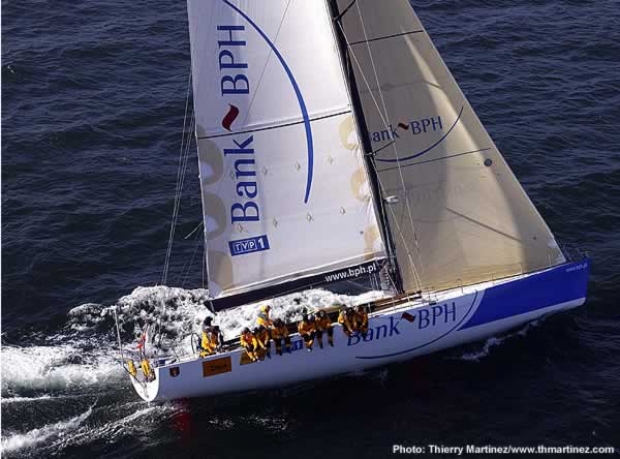
The Assa Abloy training boat in her new livery
First time challenge
Tuesday February 17th 2004, Author: James Boyd, Location: Transoceanic
Whether 'racing a ghost' is preferable or not to racing another yacht, there is no denying that currently the offshore sailing world is going records crazy - particularly non-stop around the world.
We have Jean Luc van-den-Heede who is on the home straight of his arduous singlehanded west-about voyage. Steve Fossett and his team on the world's largest racing catamaran, Cheyenne, are eating up the miles in the South Atlantic on their east-about bid. Olivier de Kersauson will be setting out again on board his maxi-trimaran Geronimo once repairs to his gennikers are complete and Bruno Peyron and his team on Orange II will be off on Wednesday this week.
But that is not all...
Currently in their final throws of preparation in the Figaro class' stronghold of Port la Foret in Brittany is a Volvo Ocean 60 that is to set out imminently in a bid to become the first monohull (to our knowledge at least) to attempt a eastabout non-stop lap of our planet non-stop fully crewed.
The project - a slight case of getting in their before the mighty Mari Cha IV makes their Jules Verne Trophy attempt next winter - is the brainchild of Roman Paszke. One of Poland's leading sailors, Paszke has a strong background in the Admiral's Cup - he first sailed as a navigator aboard Nautilus in 1979 and won aboard his own MK Cafe as part of the American team in 1997. Following this he bought the maxi catamaran Commodore Explorer (the former Transatlantic record holder Jet Services V) from Bruno Peyron and campaigned her in The Race as Warta Polpharma. Their progress in The Race came to a disappointing conclusion when returning up the Atlantic the boat suffered damage to her port hull and the Poles were forced to retire to Brazil.
Since then Paszke has set himself up running racing events in Poland, in a variety of boats, including two Formula 40 catamarans, mainly for corporate clients. His clients include the Polish division of Volkswagen and cellular phone company Idea. Paszke was planning to take part in the second running of The Race, but following its cancellation he, with his latest sponsor, Poland's BPH Bank instead opted to embark on this unique roud the world record attempt. BPH Bank, for those interested in such things, are using this record attempt to promote their new logo.
For Paszke and his team, time has been of the essence. It was only before Christmas that they took possession of the two identical Assa Abloy Volvo Ocean 60s. They will be sailing the Assa training boat around the world, while the race boat is now out of the water in Warsaw's old town where BPH Bank are using it to promote the round the world voyage (and their new logo).
In less than two months, they have delivered the boats from Sweden to Paszke's native Gdansk where they have undergone a rapid refit and health check before being rebranded as Bank BPH. The training boat was then sailed from Gdansk to France. For their brief training period Paszke and his crew have had the benefit of the vast experience of Magnus Olsson who sailed the boat in the last Volvo.
Obviously Assa Abloy was designed for the Volvo Ocean Race and built to be raced at full tilt through the Southern Ocean. However it was designed for a round the world voyage with stopovers and so Paszke has had to reappraise the VOR approach.
"We prepared special things for racing round the world with no stopovers and with a full crew, but not like the Volvo," Paszke told thedailysail. "In the Volvo the boats have 12 people. We are sailing with 10. Unfortunately it is not possible sailing with any less because the racing monohulls need more people with different watches and different conditions [than multihulls]. For example if you are sailing only in trade winds, it is okay to sail with six or eight people but in the Southern Ocean it needs more attention and more power."
Not surprising the challenge for Paszke has been keeping weight down to the minimum. In the Volvo Ocean Race the longest leg was less than a month. On this they could be at sea for more than 90 days.
First to go was the bulky Inmarsat B terminal. This has been replaced with Inmarsat's more modern Fleet 77. The big satcoms units are the most power hungry electronics on board, but the Fleet 77 uses roughly three times less power than the B and as a result they will now be able to carry considerably less fuel - albeit still 700 litres. In addition to this they will take a wind generator for additional and back-up charging.
While the Volvo Ocean Race is a round the world course as is this non-stop attempt and it would be tempting to think changes to the substantial sail inventory would not be needed, Paszke points out that the course isn't the same - they won't encounter land nearly as much and there are some sails which they don't need.
Paszke worked with the gentlemen of North Sails Denmark on the new wardrobe which included a new mainsail. "We paid special attention to building it for long distance," says Paszke. "It is 3DL, but it is a little bit heavier and of course a nice shape, like all the sails from North, but we are carrying maybe two or three less than they would on the Volvo. We expect more reaching and downwind than they get in the Volvo."
The 10 crew are all Polish including the six who sailed with Paszke on The Race in 2001. Crew kit is being limited to 28-30kg and Paszke says they have been working with Musto to ensure that the crew not only have the best kit for the job, but it is lightweight.
On board they carry two watermakers, the primary one produces 3.5 gallons per hour, the smaller reserve one 1 gallon/hour. Food will of course be freeze dried and they have been working with a dietician from the Sports Institute in Gdansk to ensure that they receive the optimum nutrition. The freeze dried has been specially prepared for their voyage by leading Polish manufacturer Lyovit - and they will be taking almost half a tonne of it! This is based on a 95 day circumnavigation.
While there is no record currently in the World Sailing Speed Record Council's book for a non-stop round the world voyage by a fully crew monohull, the only benchmark Paszke and his team can use is the 93 day 4 hour time Michel Desjoyeaux set for a singlehanded monohull non-stop circumnavigation in the last Vendee Globe. (Thinking about this it would be an interesting exercise to see if an Open 60 with three or four crew would be faster non-stop around the world than a Volvo boat would be with 10 or more. Although the offshore calendar is already over crowded, the prospect of a short-handed (but not singlehanded) non-stop monohull round the world event would make for an interesting race. How about it someone?)
Paszke says that their aim is to make the voyage in 90 days. "That is our target but the weather in the Southern Ocean you can’t predict, but we are ready to take on every weather condition. The strength of the boat and the crew are good. I am optimistic."
Weather conditions are ideal for a departure tomorrow. "On Wednesday we have a very good weather window, then I expect it will take us four or five days to the Canaries and we will be in a very good positions to catch the Trade Winds," says Paszke. "For the beginning it is very good. It is untypical weather in Biscay because there are easterly winds, not too strong but enough to give us a good average speed."
Bruno Peyron and his new maxi-cat Orange II are due to set off at the same time. While Orange II will be leaving from the Jules Verne Trophy start line between Ushant and the Lizard, BPH Bank unusually will be leaving from a line off Benodet slightly further south. "We don’t want to go on the Vendee Globe route [from Les Sables d'Olonne] and our sponsor decided to go from Benodet," explains Paszke. "It is a very nice place. We applied for the record. It is going to be a new route. It will be the BPH Bank route. We will call it the Bank BPH Trophy."
During the voyage they will be working once again with German meteorologist Meeno Schrader, who has become known recently as the router for Ellen MacArthur and the Offshore Challenges Sailing Team. "He was our first router when we sailed around the world before," says Paszke. "He is our 11th crewmember. He is a really good guy and a great meteorologist. We have a good connection. We are very lucky to be working with him. Everything should be okay because we have his umbrella under us." Over us?
Following their round the world voyage Bank BPH will return to Poland for some corporate and media work before heading for the Mediterranean where it will be used by the Polish Olympic team during the Games in Athens.
Personally Paszke's ambition still lies in more than one hull and on his return he expects to charter an 60ft trimaran from France to campaign on the ever expanding Nokia Oops Cup circuit around the Baltic. Although his hometown of Gdansk are very interested in supporting this and on 11 July are to host the final event in the 2004 Nokia Oops Cup, Paszke says there is a possibly his team may not be just Polish. He points out his Admiral's Cup team in 1997 which was a Polish-American joint venture.
He would also like to campaign a trimaran on the ORMA circuit and admits his ultimate ambition aside from successfully sailing around the world is the short handed events for the 60ft tris such as the Transat, the Route du Rhum and the Transat Jacques Vabre. He acknowledges that racing in the ORMA circuit is more expensive. "Maybe the evolution of ORMA depends upon the sponsors and if the market is not strong, then maybe ORMA will look at reducing the costs. The economy is not brilliant in Europe and it is better if the sailing is cheaper."
Bank BPH will set sail at 0930 on Wednesday and thedailysail wishes them fair winds.

Most Read
Most Commented
Comments
Businesses

Pro businesses
Editor's choice
Member blogs
-
 Ned Collier Wakefield: MOD70 round BarbadosWell that was intense. 12 hard fought for seconds for the win. In idyllic conditions, Tony Lawsons MOD ...
 -
 Mini Transat leg 2 reportThe second leg of the Mini Transat started on 31st October, just over a month after ...
 -
Leg 1 reportI’ve been working towards the Mini Transat now for three years. In 2013 I was part ...
Business blogs
-
 The Island Sailing Club in Cowes, Isle of Wight, is delighted that Prince Michael of Kent ...
 -
Peta Stuart-Hunt chats with the 25 year-old British solo sailor Lizzy Foreman before she sets sail ...
-
The 2015 Student Yachting World Cup (SYWoC), an ISAF-recognised event hosted and run by students for ...
Editor's Choice
All time favourites...
-
 Three legs down into Ian Walker’s
 -
 Winning all but two races at
 -
 For the first time in its
Latest Comments
Add a comment - Members log in