
Success!
Wednesday December 8th 2004, Author: James Boyd, Location: Australasia
Having broken
Hellomoto's starboard rudder following a collision in the Vendee Globe, Conrad Humphreys has made it to Simonstown near Cape Town, South Africa where against all the odds he has managed to get out the old rudder and fit the new. Whereas many of the boats in the Vendee Globe are fitted with kick-up rudders or emergency rudders which clip on to the transom,
Hellomoto doesn't have such a system, instead carrying a complete spare rudder and stock designed so that it can replace either rudder in the event of one breaking. However fitting a highly buoyant rudder and stock, with an all-up weight of 50kg, while the boat is on the water moored to a buoy and with just one person to carry out the entire job is a Herculean task. It maybe not be as impressive as Yves Parlier reconnecting the two parts of his carbon mast off a remote outcrop of New Zealand, but it is not far off.
Conrad Humphreys takes up the story:
"It was an incredible job. I am still in shock really at the fact that we achieved it within a day.
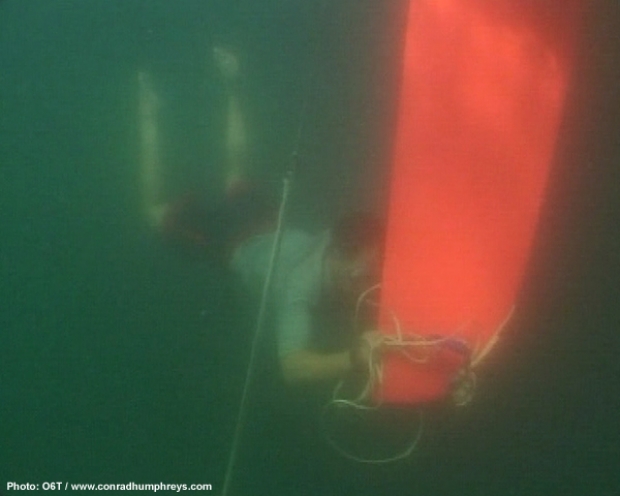
"The first thing I did was I got 75kg of anchor, chain and warp. I put it all together, lashed it all up and attached a snatch block to it and then lifted it over the back of the stern attached to the boom - the boom overhangs the stern. Directly above the rudder, I lowered the weight to the sea bed which was 13m of water. That gave me a purchase on the seabed to that I had something to attach to the damaged rudder blade. I then got in the water and tied the end of the line to the blade around the stock. Obviously I disconnected everything inside the boat.
"I then wound the pulley block up, so I lifted the weight off the seabed, until it was literally 5-6m off the seabed, went back up on deck, took a large mallet and hit the top of the stock as hard as I could. The weight of the 75kg plus the force of the hit knocked the stock and the whole rudder disappeared through both bearings and sunk away to the bottom.
"I am just still amazed because the fit of the rudder stock in the bearings is perfect, so it only takes the stock to move 1mm out and the rudder stock gets stuck in the bearing. I know having taken the rudder out on land before that if you don’t have it perfectly aligned it doesn’t matter how hard you hit it to won’t come out. For it to come out in one go was just extraordinary.

"That was getting it out. I was happy to have got half the job done. The next stage was to recover the stock, and take all the measurements and transfer them to the new ones, things like the autopilot rudder reference units and the quadrants. Once I’d done that I then built a spider’s web around the new blade, so that I had something to attach the weight to. I should tell you at this point that over lunch I had managed to let go of all of the line that had the weight attached to it over the side. The pulley block was lying empty on the boom. I knew at that point that my chances of getting the new rudder in had pretty much evaporated.
"So I had to grab my spare air - I know I have about 10 minutes in a little air canister and hoped that if I followed the line down that I could still catch it before it drifted off. I am an inexperienced diver, but I was pretty nervous about swimming down 13m 45ft with just a small canister of air and no weight belt to control my ascent. But I had no choice, so I disappeared. Luckily I found the weight and the line was just - there was literally 1ft left through the pulley block - I grabbed the loose tail and swam back up to the surface using the line to control my ascent. I got to within 1m of the surface and the line went tight and I realised that the boat had drifted off and pulled the other end tight so I couldn’t get above the surface of the water. I don’t know how much air I had left, but just waited hoping for the boat to drift back the other way and eventually it did and it allowed me to break the surface and quickly get tie the dead end on to the back of the boat. So that was pretty nerve wracking, but I had recovered the kit.
"So back to replacing the rudder. I then tied that end on to the rudder tip. I ran a mouse line through the hole in the bottom of the boat up on to the deck and tied that to the top of the stock and then pushed the whole rudder blade over the side. The problem is that these rudder blades are so buoyant that they just want to float sideways. So I am winding the tip of the rudder down, checking seeing if it was sinking, and it still wasn’t sinking so I kept on winding. I looked down and the rudder was sinking, but it was going down horizontally. And I kept on winding, and gradually I noticed that the rudder was sinking blade first and the stock was sticking up and it had drifted underneath the hole in the bottom of the boat. I carried on winding a little bit more and I saw the stock just appear in the bottom bearing. So I let go of the line holding it down and the whole rudder just floated up through both bearings in one go. I didn’t even have to wiggle it through. It just came up in one. I am still completely gob smacked about it. That was probably the hardest part done. I have just spent most of today connecting all the rods up. I have a slight difficulty because the rudder I have put in is not really a perfect fit because it is designed to be used on either side so it has been difficult to get the alignment correct. I won’t really know until I go sailing if I have got that right."
Getting the rudder to slot in so easily was close to being a miracle. "The bottom bearing is very very strong on this boat. But if you could imagine the worst thing was the stock going through the first bearing and the rudder then turning sideways and it damaging the bottom bearing. I think the key thing was we had a very very good plan. I put a lot of emphasis on the preparation of setting up the boat. We did a lot of other things. We flooded the forward buoyancy ballast tanks to put the nose down, we canted the keel right over so that the rudder was vertical in the water and just spent probably most of a day getting set up for it to give ourselves a fighting chance. I still can’t believe it went in and came out the first time."
Humphreys worked out his plan of attack with his shore manager Joffe Brown. "Four years ago Mike took an emergency rudder and no spare rudder. We sat down and looked at the emergency rudder and to put that on is a very very difficult operation, but it also only means you only can get to a safe port. You can’t carry on with an emergency rudder. So Joffe and I decided together we would see if we could take a spare rudder that would universally fit both sides knowing that it would be almost impossible to fit, but if there was one chance we could fit it you could still be in the race. And I think we just got that one chance."
There are still a number of other major jobs to be carried out on board. The principle one is that the mainsail headboards is chafing on the capshrouds. This will require Humphreys to reshape the headboard. But there is still a distinct possibility that he may climb the rig only to find that the PBO capshroud has chafed through (in fact in the Vendee Globe four years ago Mike Golding got back to Les Sables d'Olonne with a PBO capshroud that had just 15% of the fibre left attached following chafe from a batten pocket). If all is well Humphreys thinks it unlikely that he will leave Simonstown until tomorrow night or possible Friday morning.
Physically after yesterday's excertion he feels utterly shattered. "This morning I woke up and literally I couldn’t even sit up I felt so fatigued. Yesterday was an amazing day and I had a lot of energy. I arrived in the early hours of the morning and set straight to putting that rudder in. I went to sleep at 10pm last night to try and get as much sleep before sunrise here at 5am. I woke up at 6am feeling more tired than I have in the entire race. My whole body felt completely and utterly shattered. It took me a couple of hours this morning just to get going. I have got to climb the rig later today. So my body today has definitely said have a quiet day, have a rest and don’t attempt anything too much. That is the first time I have felt like this in the race. Yesterday I was in the water six or seven time, quite a lot of swimming and having achieved that your body just lets go and you have got to rest at some point. I have still got a lot to do and that makes me feel a little nervous because climbing the rig - I still have 4-5 hours to spend up the rig and there is still a lot to do before I leave."
The whole operation took just six hours - an extremely fine effort on the part of the Hellomoto skipper in our opinion.
Quicktime video clips of Conrad shortly after the rudder damage occurred (to download Quicktime - click here ):
In this clip Conrad describes what happened - click here
See the broken rudder being towed through the water - click here
Conrad, gutted, acknowledges that he must go to Cape Town - click here
Most Read
Most Commented
Comments
Businesses
Pro businesses
-
United Kingdom
-
France
-
France
-
United Kingdom
Editor's choice
Member blogs
-
 Ned Collier Wakefield: MOD70 round BarbadosWell that was intense. 12 hard fought for seconds for the win. In idyllic conditions, Tony Lawsons MOD ...
 -
 Mini Transat leg 2 reportThe second leg of the Mini Transat started on 31st October, just over a month after ...
 -
Leg 1 reportI’ve been working towards the Mini Transat now for three years. In 2013 I was part ...
Business blogs
-
 The Island Sailing Club in Cowes, Isle of Wight, is delighted that Prince Michael of Kent ...
 -
Peta Stuart-Hunt chats with the 25 year-old British solo sailor Lizzy Foreman before she sets sail ...
-
The 2015 Student Yachting World Cup (SYWoC), an ISAF-recognised event hosted and run by students for ...
Editor's Choice
All time favourites...
-
 Three legs down into Ian Walker’s
 -
 Winning all but two races at
 -
 For the first time in its
Latest Comments
Add a comment - Members log in