
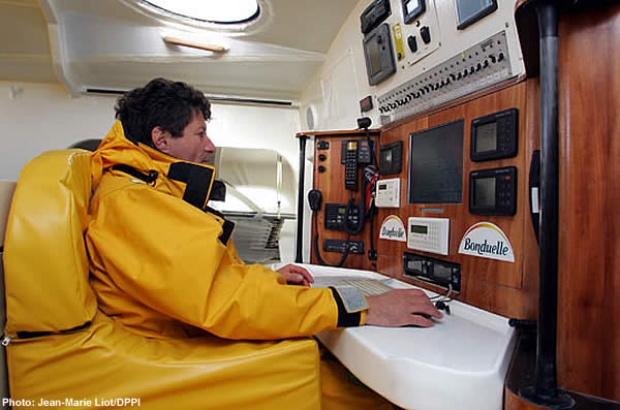
Jean le Cam at the chart table on Bonduelle
Vital tool
Tuesday November 16th 2004, Author: James Boyd, Location: United Kingdom
Technology has come a long way since the first Vendee Globes when skippers would regularly take 10 or more autopilots around the world with them just to make sure they had enough functioning units to get them home.
Today there has been a wholescale improvement in reliability. Most of the Open 60s taking part in the Vendee Globe carry just two independent autopilot systems and some spare parts, so that if one breaks the skipper can immediately switch over to the other.
Prior to the last Vendee Globe there was a significant leap in pilot technology that allowed boats to be steered efficiently to true wind angle. Open 60s are lightweight boats prone to bursts of acceleration that can throw the apparent wind angle, thus making the typical 'wind' mode found on cheaper autopilots all but useless in anything but the most stable conditions.
Calculating true wind angle on the fly and then using that as the reference for the pilot tends to be processor hungry and through trial and error on round the world races hooking up a very fast and accurate electronic compass system to the pilot system was found to be essential to prevent the boat spinning out or accidentally gybing through the pilot being too slow to react. Simple fluxgate compasses have proved themselves to be prone to error when they heel and so in the early Vendee Globes a few of the richer Open 60 campaigns fitted their boats with £15,000-worth of full-on commercial spec gyrocompasses. Today most boats are fitted with quasi-gyro compasses such as the KVH GyroTrac that is about a quarter of the price and one tenth the weight of a commercial unit.
In the Vendee Globe almost half the fleet are fitted with French NKE Gyropilots that include a basic wireless remote. Seven of the boats including race leader Bonduelle, Ecover, Skandia and VMI are using B&G gear and five of these are also using B&G's latest piece of technology, the RemoteVision.
 RemoteVision is a handheld bluetooth wireless instrument and pilot controller that B&G launched in September. The unit has dedicated port and starboard dodge button for the autopilot and an on/off button and controls that otherwise ressemble those of a Sony Ericsson phone. Unlike the NKE remote the unit comes with a full function display enabling the skipper to call up any item of data being output from any B&G instrument hooked up to the network.
With the bluetooth base station mounted down below the range of the handheld unit is 100m. B&G's George Pollard puts forward this scenario: "In the last Vendee when Ellen was up her mast, the boat gybed seven times and it was a real nightmare." If she had gone aloft with the RemoteVision then she would have been able to prevent Kingfisher from gybing.
While this scenario is obviously rare, what is very much more likely is that skippers will sleep during the Vendee Globe, be it at their bunk, at the chart table or on deck clutching their RemoteVision so that they can manoeuvre the boat in an instant. For this exact purpose the unit is also fitted with a built-in alarm so that, for example, if the boat is steering to true wind angle and there is a significant shift, the unit will wake the skipper.
Aside from the pilot functions either four or seven lines of data can be displayed on the unit and the user can also bring up graphic displays. For example while at the helm the skipper could look at a graph showing trends in wind angle or pressure over the last 10 minutes or 24 hours.
For use on deck, the RemoteVision comes with a built-in handbearing compass (as displayed above), that unlike some older fluxgate models doesn't have to be held horizontal to give an accurate reading. It also has a built-in LED torch.
The unit is waterproof to IP68 (ie it can withstand being submersed up to 1m for 30 minutes). Sadly due to its 100m range it is unlikely that if a skipper fell overboard they would be quick enough on the draw to use the RemoteVision as an aid to steer the boat back to them. It runs off AA-sized batteries that will power it for 60 hours non-stop, although it has an intelligent sleep mode to conserve power. Like a mobile phone the unit also has a key lock feature.
As with other BlueTooth devices the unit has its own unique ID number so that Mike Golding, for example, wouldn't have been able to steer Bonduelle at the start of the Vendee Globe.
Aside from the RemoteVision B&G last year updated the insides of their Hercules Pilot, being used on the Vendee. This now features a new microprocessor platform and a gyrocompass input. It also has new software that includes several 'smart' features such as better crash gybe protection as well as allowing a range of true wind angles to be set that the pilot will keep the boat within. The pilot also has an intelligent sensitivity control that is smart enough to realise if there is a gust or a big wave to apply maximum drive to the rams.
The result is a pilot that compared to older models should use less power and can operate in almost all wind conditions with the exception of when it is very light. According to George Pollard the new pilot successfully steered Kingfisher and Ecover in 60-70 knot winds during the Route du Rhum two years ago. On B&Q/Castorama, the speed record to date is held not by Ellen but by the Hercules, as was also the case on Francis Joyon's maxi-trimaran IDEC when he sailed singlehanded non-stop around the world earlier this year.
Most Read
Most Commented
Comments
Businesses

Pro businesses
-
United Kingdom
-
-
-
France
Editor's choice
Member blogs
-
 Ned Collier Wakefield: MOD70 round BarbadosWell that was intense. 12 hard fought for seconds for the win. In idyllic conditions, Tony Lawsons MOD ...
 -
 Mini Transat leg 2 reportThe second leg of the Mini Transat started on 31st October, just over a month after ...
 -
Leg 1 reportI’ve been working towards the Mini Transat now for three years. In 2013 I was part ...
Business blogs
-
 The Island Sailing Club in Cowes, Isle of Wight, is delighted that Prince Michael of Kent ...
 -
Peta Stuart-Hunt chats with the 25 year-old British solo sailor Lizzy Foreman before she sets sail ...
-
The 2015 Student Yachting World Cup (SYWoC), an ISAF-recognised event hosted and run by students for ...
Editor's Choice
All time favourites...
-
 Three legs down into Ian Walker’s
 -
 Winning all but two races at
 -
 For the first time in its
Latest Comments
Add a comment - Members log in