
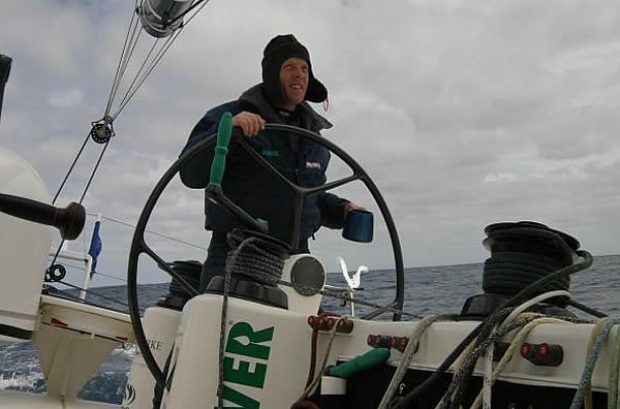
Golding in the Southern Ocean
Sunday December 12th 2004, Author: James Boyd, Location: none selected
Heading west when the east was paying to the north of Cape Verde Islands just three days into the Vendee Globe, Mike Golding on
Ecover has been paying for this error ever since as he has suffered from repeated doses of the rich ahead of him getting richer. While the weather cards seem to have fallen nicely for the two leaders so Golding has been able to do little while
PRB and
Bonduelle have slowly carved out an impressive lead.
By the Equator Ecover was 82 miles astern. As the front duo were first to break out of the light winds in the South Atlantic so their lead extended to 200+ miles and they then benefitted from being first to get into the strong westerlies of the Southern Ocean quickly increasing their lead to 500 miles over Golding.
Into the south and the relative position of the leaders to the 'chasing pack', which since the retirement of Alex Thomson's Hugo Boss have comprised Roland Jourdain's Sill et Veolia, Sebastien Josse's VMI with Golding's Ecover in fifth, has been concertinaing back and forth. The separation is such that the leaders have been sailing in different weather to the chasing pack and there are times when one benefits from the conditions while the other doesn't before the tables turn back again.
Fortunately the last days have seen the tables finally turn in favour of the chasing pack. The worst occasion, on 5 December, Golding was 800 miles astern of the leaders. Remarkably over the course of the week since then Golding has halved PRB's advantage and now believes that he can half this again over the next few days.
Aside from being astern, Ecover is still in good shape. The only handicap has been the demise of the Fleet 77 satcom unit which Golding uses to beam back broadcast quality images from on board, but which from a boat performance standpoint he also uses to surf the web. Without it Golding has been forced to resort to the snail's pace data transfer of his Iridium and accept downloading smaller weather files. Mind you Jean le Cam on second placed Bonduelle is in the same predicament...
"So far I am doing well - the boat is in stunning condition," says Golding. "Things are getting tired. I am starting to see signs of wear. The winches are tiring and the steering if a bit shakey, but the basic boat itself and the sails are in good condition."
Golding is one of the most experienced singlehanded skippers taking part in the Vendee Globe and knows what he must do to come out of this race with a good result. The principle issue is one of pushing hard without pushing so hard that the boat breaks a la Alex Thomson.
Just as is the case with the use of gennikers in the trimaran fleet, so Golding says there is an unwritten truce between Open 60 sailors that they don't use the powerful Code sails (Code 5 and Code 0) at night. "It is just too hard and the risk is very high. The problem with Code sails down here is just the sea state. You leap off a wave and you are going to break something for sure. The bowsprit breakage further back in the fleet [on Marc Thiercelin's Pro Form] is testimony to that."
As ever the ability to push hard is mainly sea state rather than wind speed related. On Friday night when Golding was trying to make up some ground while the wind strength was good Ecover was sailing in 6-10m waves. Pushing too hard in 35-40 knot winds with this severe sea state on a pitch black night Ecover span out and Golding found himself over on his ear with the boat side on to the waves. Similarly on Saturday night the boat again rounded up when blasting down one wave the autopilot ram froze, which Golding again attributes to pushing too hard.
Golding describes Friday night's scenaro: "Suddenly you go 90 degrees to the breeze, you’ve got way too much sail and so consequently the boat is really overpressed and the rudder stalls out and it is not easy for the boat to come back whether you are steering or the pilot is. During that wipe-out I blew the vang off, grabbed the helm and I was having real trouble trying to understand where I was in the wave sequence, because it was pitch black. The only instrument that is worth anything in those conditions is the Windex and it is really hard to look up and steering. And the chances of doing a double gybe are pretty high, because you’ve got full lock to come down and when the rudder does reconnect it does so with some vengeance and the boat is off at 20-25 knots and you’ve got to hold otherwise you are into a gybe. So it’s all pretty hairy stuff."
After this incident Golding chose to change down a gear and in fact the boat was going equally fast just sailing in a less dramatic manner.
"What you are trying to do is to stay on the surfs for longer with big sails, but in reality these waves were so big and in the wrong sequence to be able to do that," Golding admitted. "There was a point in the night [Friday night] when I changed from Solent to staysail and I had the boat sailing at a very deep angle on pilot quite comfortably and I got the Solent away. The big game is to get it away without wrecking it, without flogging it, so it is a delicate balance of being downwind and not having it snap through the rig.
"So I got it away and I was just tidying up and getting ready to put the staysail up and I was looking at my speed and I was doing 17 knots straight down the line and the boat was going really easily. I was thinking 'maybe, I don’t need the staysail?' But it is so unconventional going along with one sail, I decided to go with convention and it got all complicated again. I thought the boat would screw up with just the main up, but it was lovely and steady. I don’t know how long it would have lasted." Una-rigged Open 60s - worth thinking about for the future...
Golding says that he has never known Open 60s to wipe out in this manner and feels this is indicative of the front runners pushing their boats harder than they ever have in the past. "I just think everyone is looking at what everyone else is doing and just trying to push a little harder. People are just able to get closer to the edge, because the gear is better, the prep is better, and the pilots are better. In fact it is nearly all controlled by the pilot - if the pilot is no good you can’t push. I’m sure that all the gear from every equipment supplier has developed. I know our pilot system is better than its ever been. Good news for B&G, exceptional news for us..."
Certainly this is the fastest and most competitive Vendee Globe ever. At present, five weeks into the race and Vincent Riou on PRB is 750 miles to the west of the longitude of Austalia's Cape Leeuwin and has Jean le Cam and Bonduelle breathing down his neck just 50 miles astern. Five weeks into the Vendee Globe four years ago, PRB was also leading, but with Michel Desjoyeaux at the wheel, and had just passed the Crozet Islands 2,400 miles from the longitude of Cape Leeuwin. Effectively PRB is at present 1,650 miles or 4.7 days ahead of her 2000 pace, which would see her lying in ninth place in this Vendee Globe...
Another observation is just how competitive the boats are. This is impressive considering that the boats are 'Open' class and substantially different in not only their design but their vintage. Throughout the fleet there are new boats racing four year old boats whether it is PRB up against the new Bonduelle at the front, the new Ecover and Sill versus VMI that raced four years ago as Thomas Coville's Sodebo or Virbac-Paprec being led by the last generation Temenos in the mid-fleet.
"Anyone who thinks there is a speed difference between new and old boats had better think again," says Golding. "I think the new boats are better, but I think the old boats have been really well developed. It is extraordinary how well the boats are going. It is really good news for the class. It just does show you that you can get into the class without having to build a brand new boat."
Particularly impressive is the performance of Sebastien Josse's VMI which of the five leaders is the only boat to use water ballast rather than the supposedly faster swing keel. "It is extraordinary," says Golding. "I think they will suffer a bit on the way back up which is where the swing keel boats are going to get better… what my task is to still be within striking distance at Cape Horn."
Back on board Ecover and one of the interesting issues is what happens at night. Over the weekend with the big waves running Golding has left his pilot in charge simply, he says, because it gets less disorientated than a human does. In theory it might be possible to use night vision gear to steer in these conditions at night. Golding says he does carry a night scope, but he uses it for tactical boat on boat work and in much gentler conditions.
In fact being alone on board singlehanded racing on the minimum of sleep it is easy to get disorientated generally. "You get 100% disorientated and a little messed up by the fact that I still run GMT on board from a navigation point of view," agrees Golding. "All around me the world is shifting and now it is early afternoon for me in terms of the sun, but it is all a bit of a mess up really and it is going to get worse before it gets better. I have always tended to run GMT, because with the navigation it gives less chance of an error particularly when you are dealing with weather files that are date stamped. The only thing that is slightly confusing about that is that you look at the time on the weather file and you tend to think of a certain time of the day. You forget it might be dark."
With sleep caught in sporadic bursts, although perhaps slightly longer than he anticipated his ears having tuned out the 125dB car alarm he uses to wake himself up, Golding says that meal times are crucial to anchoring his rhythm on board.
"There are two focal points - breakfast and dinner. Breakfast is sun up and dinner is sun down. It is a pretty simple existence. There are some benefits to that. If I get hungry I just eat - I am not locked into it.
"The rule on the boat is that you do things before you need to do them, particularly with sail changes. If you are thinking about it, you do it. If you are cold you make sure you wrap up warm, if you are hungry you eat and if you are tired you sleep. And all those things are basic look-after-yourself strategy.
"Then you have a problem, such as we had this morning [with the pilot]. You are working in the back while the boat is absolutely hooning along. You are trying to do not a complex job, but a job that requires a certain amount of concentration - that’s when the real challenge of a race like this starts to take effect. That is the real test if you can keep your focus and still do the job right. Because it is so easy to make things worse. Certainly if I mess around with electronics you can guarantee it is going to get worse!"
Golding says that keeping on top of jobs such as this is vital. Ecover has two autopilots both permanently hooked up to the steering mechanism. If one goes down as it did this morning, it is a simple and fast job just to switch over to the other. Golding says he changed the broken ram as a matter of course and he is now back to two operating pilots.
"It is important that I always have two pilots because if one of the systems goes down I need the ability to switch across. So immediately a pilot fails you, even though you have got another pilot, you can’t afford to sit on your hands and say ‘I'll do it tomorrow’. You’ve got to do it there and then because the next pilot failure, if you have another one, would be catastrophic. You would be absolutely stuffed on the helm. You’d have to get sails down to be able to effect a repair.
"Everything I have done so far [repairwork] has been with the boat motoring along at full speed with only the slightest interruption when I had to do the switch-over. Now I am back to two pilots, fully functioning and I have a ram here which I have put back in the box, but which I will fish out and try and get it to work. I think it may have been a momentary glitch and shutting down the pilot and restarting it may have fixed it. But today I couldn’t afford the risk. Not at this speed."
Another feature of this Vendee Globe has been the addition of more waypoints and in particular waypoint gates. So far the waypoint gate off South Africa and at Heard Island have made no impression on the track of the boats - on both occasions they passed well to the north of them. However the next two gates off Australia, put in as a sop to the Australian rescue authorities following the costly rescues of Isabelle Autissier in the 1994 BOC Challenge and subsequently Tony Bullimore and Thierry Dubois in the 1996 Vendee Globe will have an effect on the course of the boats. The waypoint gates are located so that they keep the boats within rescue range.
"This next one is really having an effect on where we are," says Golding. "There are too many waypoints - there is no question about that. It does feel a little restrictive. The next waypoint beyond this one is also quite restrictive. But it is the same for everyone."
With 14,000 miles to go there is still much to play for and Golding's tactics, as he said before the start of the race, is to be in contact with the leaders. 400 miles or better still is still 'in contact' when you consider that Ellen caught Michel Desjoyeaux at the Equator having been 600 miles astern of him rounding Cape Horn.
With any luck Golding will arrive back in Les Sables d'Olonne in record time with a result he wants and hopefully an MBE awaiting him. "Fat chance of that. I’m not a girl!" Golding retorts.
Most Read
Most Commented
Comments
Businesses

Pro businesses
-
United Kingdom
-
-
United Kingdom
-
France
Editor's choice
Member blogs
-
 Ned Collier Wakefield: MOD70 round BarbadosWell that was intense. 12 hard fought for seconds for the win. In idyllic conditions, Tony Lawsons MOD ...
 -
 Mini Transat leg 2 reportThe second leg of the Mini Transat started on 31st October, just over a month after ...
 -
Leg 1 reportI’ve been working towards the Mini Transat now for three years. In 2013 I was part ...
Business blogs
-
 The Island Sailing Club in Cowes, Isle of Wight, is delighted that Prince Michael of Kent ...
 -
Peta Stuart-Hunt chats with the 25 year-old British solo sailor Lizzy Foreman before she sets sail ...
-
The 2015 Student Yachting World Cup (SYWoC), an ISAF-recognised event hosted and run by students for ...
Editor's Choice
All time favourites...
-
 Three legs down into Ian Walker’s
 -
 Winning all but two races at
 -
 For the first time in its
Latest Comments
Add a comment - Members log in