
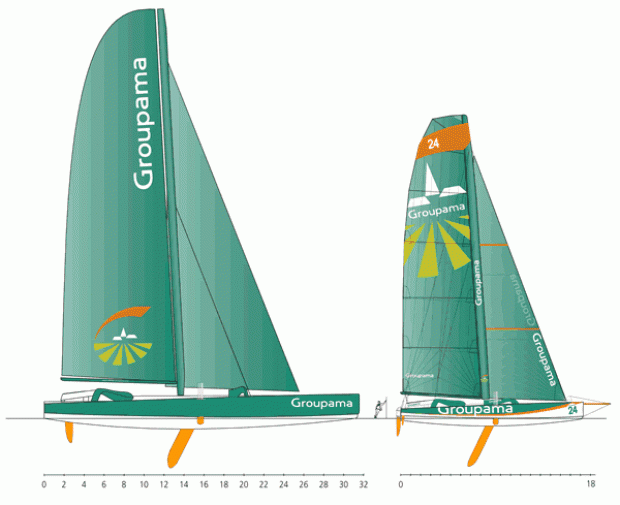
Comparison between the new maxi (left) and Groupama 2
The next big thing
Wednesday December 8th 2004, Author: James Boyd, Location: France
No sooner had the painted dried on Franck Cammas' new 60ft trimaran
Groupama 2 than the 32 year old skipper was announcing outline plans for his third green boat in this series - a 105ft trimaran for ocean record breaking.
Yesterday morning in Paris at the head office of the Groupama insurance company, Cammas and his team revealed more details of Groupama 3. After Olivier de Kersauson's Geronimo, this will be only the second G-Class maxi-trimaran ever to have been built.
In general at 105ft (32m) LOA the boat is shorter than the new generation G-Class multihulls like Geronimo and Orange II that are around 120-125ft LOA. While 60ft trimarans have length and mast height constraints and thus tend to be as beamy as they are long, there are no such limits for the maxi-multihulls and as a result Groupama 3 is considerable less beam for her length at just 22.5m wide. Like Ellen's B&Q Castorama the new boat carries substantially more buoyancy forward than an ORMA 60.
Effectively designed to no rule, the main constrainting parameters of a boat like Groupama 3 are the size of sails the crew can handle and the budget. As a result the challenge is the purest imaginable - simply to find the fastest boat for a given budget.
Designer Vincent Lauriot Prevost, who with partner Marc van Peteghem has drawn all of Cammas' multihulls, says that back in the spring they carried out a VPP comparison of a number of different formats of multihull before making their final decision. These included a 36m catamaran, Geronimo, Geronimo with foils (ie the ORMA 60 style retractable curved foils in the floats) and a 105ft trimaran with foils and a canting mast.
The VPPs were all based on a round the world routing model that the designers had originally had created for them by top French meteorologist and router Pierre Lasnier with added tweaks from Austrian multihull designer Martin Fischer who had helped with the design of Groupama 2. Prevost says they looked at all the different 'virtual' boats trying to establish what were the most valuable elements of each. They concluded that the best round the world boat was one that had to be be seaworthy and hold its own in the Southern Ocean but was primarily optimised for the moderate 10-20 knot winds of the Atlantic.
"It is not important to be the fastest boat in the Southern Ocean because you don’t need to be faster than the meteorological systems," explains Vincent Lauriot Prevost. "If you can sail at the speed of a system you are able to have a very good average performance during this period of the race."
While modern G-Class multihulls are capable of sailing faster than all but the speediest Southern Ocean depressions, Prevost says there is no benefit from outrunning one as this will mean ending up in the trough preceeding the depression where the sea state (much more of speed restricting factor than wind speed on multihulls) will be worse. The ideal scenario is to stay in the NE quadrant of a depression and stay in the relatively flat seas and consistent wind angles to be found there.
"We think in the South if you are able to have an average of 500-550 miles regularly you will be in the tempo of the weather systems," says Prevost. However he adds that having the extra pace in the Atlantic could reap huge rewards enabling Cammas to jump between weather system quickly in a similar to fashion to how Jean le Cam and Vincent Riou did recently passing out of the South Atlantic in the Vendee Globe. "While the speed difference getting out of the high might be 10-15 percent, in the end this lets you gain much more."
The trimaran option was chosen as it showed a performance advantage over the other models tested in most conditions, but in particular light to medium winds (due to its lower wetted surface area) and upwind (surprisingly Prevost says a cat is better upwind than a trimaran when it is on one hull). Trimarans are also easier to tack and manoeuvre. Deep running a catamaran is faster but on this point of sail Groupama 3 will benefit from having lifting foils in her hulls. The routing for the 105ft trimaran, running at 80% efficency and optimum weather conditions showed her sailing around the world in 49 days, compared to 53.5 days for the 120ft catamaran.
So why not a 120ft trimaran? The reason is one of budget. With three hulls instead of two, trimarans are more expensive to build. Thus the price to build a 105ft trimaran is roughly similar to that of a 120ft catamaran.
Beyond this the principle issue has been one of weight. They could have built a longer boat but it would have been heavier. While the laden weight of Orange II and Cheyenne are in the high 20s (tonnes), Geronimo is around 22, Club Med (and her sisterships) 21-22 the new Groupama is expected to weigh in at around 18 tonnes. Cammas' new 60ft trimaran in comparison is 6.5 tonnes.

Aside from saving weight by making the boat smaller the team also managed to par down weight in the structure. "We've tried to have the lightest solution in terms of beams and float and main hull," says Prevost. "This means [for example] that with the mast aft of the front beam the front beam is at the optimum position where the average loads are at the smallest. So we reduced the length of the float in front of the beam, we tried to have the beam with less Veed, etc."
To improve their light to moderate airs upwind performance, for when they return up the South Atlantic for example, the designers have maintained the same Veed aft end and smooth entry lines of the floats as they had on Groupama 2 to improve tacking and foils to help lift the hulls over the waves. The floats have similar buoyancy compared to the all-up weight as a 60ft trimaran - around 240-250%.
Compared to Groupama 2 the new boat will have curved foils and her rig will be a rotating wingmast, but will not cant. Once again this was principally for reasons of cost - there were cheaper ways to get a greater advantage says Prevost. The curved foils better suited the way Cammas wanted to use the boat. Conversely Olivier de Kersauson's Geronimo, has recently undergone some modification work and is now fitted with a wingmast that can be canted up to weather. "Olivier thinks the number of days he can use the foil will not be enough to be efficient compared to a canting mast when there will be many more days," says Prevost. While Groupama III doesn't have this feature, obviously if ever there came the need for more speed they could fit a canting mast mechanism or increase sail area and/or mast height.
Equally indicative of the team feeling that at this stage they don't have to pull out all the stops performance-wise to the same degree as their ORMA 60 is in the testing they carried out on the boat. While Groupama 2 benefitted from tank testing, their maxi was designed in the computer as Prevost says there was no time nor budget for physical testing.
The rig proportions are very similar to an ORMA 60 with a short boom, except that the rig is mounted further aft in the boat (midway between the two crossbeams) with the daggerboard located between the mast step and the forward crossbeam. As on Ellen's B&Q Castorama, the outer forestay is not fixed to the extremity of the bow and as a result there is no need for a bowsprit. While there is no mast height limit (for the ORMA 60s it is 30m) Prevost expects the mainsail to have considerable roach as this allows for a shorter mast reducing the centre of effort.
Compared to Groupama 2, the maxi will be less 'powerful' for her displacement says Prevost. On the 60 footer the ratio of sail area to displacement is roughly 50-55 sqm/tonne whereas on the new boat the figure is around 33-35sqm/tonne. Because of this it is not necessary to have the massive (and heavy) beam of the 60.
The structure is also less extreme than the new 60. Prevost says it is in fact closer to Groupama 1 in terms of avoiding the use of stiff, high modulus carbon. The more flexible structure should make for better reliability and longevity.

Groupama 2 on her first outing at the Fecamps Grand Prix this year
Like Groupama 2, the new boat is fitted with an X-beam configuration with the cockpit enclosed between the aft beam and the curved track for the mainsheet. The layout of the cockpit will also be similar with the winches mounted along the aft beam behind which are the coffee grinders but with the helming position slung off the aft beam (the forward side of the cockpit) right beside the winch positions (rather than up the beam at the extremities of the cockpit). "When three or four people are in the cockpit they should be close to each other and sheltered as well," says Prevost.
While Groupama 3 has clearly benefitted from some of the thinking that went into the team's new 60ft trimaran, it has also benefitted from the designers having created Geronimo. In comparision to de Kersauson's tri, the new boat is lighter, shorter, with more beam and more sail area.
On Orange 2 and B&Q Castorama there has been a move to increase buoyancy in the bows to increase safety and prevent pitchpoling, while also allowing the boat to be driven harder. On Groupama III they have not taken this to such an extreme level although there is increased buoyancy forward but this has come from elongating the bows rather than dramatically increasing freeboard.
Unlike Geronimo which has a single rudder on the centre hull - de Kersauson maintains less appendages is a lighter solution with less chance of collision - Groupama III will have a rudder fitted in each hull like a 60ft trimaran. These rudders will all be fixed (ie non-kick up), but their internal mechanism will be mounted in watertight boxes.
In terms of speed around the world Vincent Lauriot Prevost will not make predictions as the performance is so dependent upon the weather. However he says that the new boat is capable of breaking Cheyenne's 58 day time.
From a sailing perspective Cammas' navigator Franck Proffit, who co-skippered Club Med with Grant Dalton in The Race, reckons that the experience will be very different to the first generation of G-Class catamarans he sailed. " Club Med was very conservative and heavy because the choice was to make a fast boat and to take no risks. The time was very short between building it and The Race and we didn’t have enough time to test the boat. Groupama 3 will be a lot faster than Club Med and lighter. That will be pretty important.
"Also the experience will be different as with Club Med it was an international crew and Grant had no experience at all on multihulls," Proffit continues. "It was hard for the people who knew how these things worked, to explain quickly how to sail it. Here everyone in the Groupama team knows multihulls, we have a lot of experience and that will help a lot."
Proffit acknowledges that the trimaran will be harder than the cat to sail in the Southern Ocean. "We will be conservative. For sure, we want a light boat, but if you make a big long boat it will be heavy and if it is heavy there will be a drawback in light winds. Our view is that in the Southern Ocean you are very 'preservative' [ie you don't take risks or push too hard]. You don’t want to go fast, you run with two or three depressions. If you can average 25 knots of speed that is perfect - you don’t need more. Going faster in this place is not very safe. We will be very safe in the Southern Ocean and very good coming down [the Atlantic] and up after the Southern Ocean."
Aside from the increased buoyancy forward, for driving hard in the south Groupama III will be kept from going 'down the mine' by her foils, her aft water ballast and the volume distribution of her hulls. "I think that the boat will be light to drive," says Proffit. "If the boat is light you can play with the waves and be more in contact with the big waves and the idea of having narrow foils is to have less collisions with waves. Classically I think the Southern Ocean, we will be sailing like Club Med - safe and not pushing too much."
In the Atlantic Proffit says the trimaran will offer better all-round performance and manoeuvrability than a cat. Fewer crew will be needed to sail the boat than Club Med, resulting in further weight savings - both bodies, food and their paraphernalia. Groupama III will sail with 10 or 11 with watches comprising a helmsman and two trimmers. On Club Med they had 13 crew and to reef they needed two watches each of four plus navigator Mike Quilter. The new boat can be reefed by six. This is partly because sail weights are less but also because they will keep the Solent on a roller furler so there will be less lugging around of sails. The Solent on Club Med for example weighed around 300kg.
While the boat is not designed for singlehanded racing and this doesn't feature in her program at present, Proffit sees no reason why Groupama III shouldn't be sailed with just Cammas on board. Compared to Francis Joyon's IDEC the gear is lighter and the cockpit set-up with the helm next to the pedestals is ideal.
At present the target for the boat when it is finally launched in June 2006 are the standard crewed records such as the Jules Verne Trophy, the west-east north Atlantic crossing, the 24 hour record, TransMed, Route of Discovery, etc. However the team would also be keen to race the boat should the opportunity arise.
Compared to the 60ft ORMA circuit Proffit is enthusiastic about the maxi-multihulls as a class because he feels there is a greater opportunity for non-French teams to get involved since they are designed to be sailed with a crew rather than singlehanded and they are the fastest offshore boats on the planet.
Construction of the new boat is now underway at Multiplast in Vannes, which has built all of the G-class multihulls to date with the exception of PlayStation/ Cheyenne. Groupama III is to be ready for Cammas to make an attempt on the Jules Verne Trophy on his return from the Route du Rhum in 2006, a race he is at present favourite to win.
Cost-wise the build for the new boat is 6.9 million Euros (compared to 2.9 million for Groupama 2). The annual budget for running Groupama 2 and 3 in tandem will be 4.5 million Euros. At present the Groupama program is scheduled to run until 2011 - how many other sailing teams anywhere can boast that?

Most Read
Most Commented
Comments
Businesses

Pro businesses
Editor's choice
Member blogs
-
 Ned Collier Wakefield: MOD70 round BarbadosWell that was intense. 12 hard fought for seconds for the win. In idyllic conditions, Tony Lawsons MOD ...
 -
 Mini Transat leg 2 reportThe second leg of the Mini Transat started on 31st October, just over a month after ...
 -
Leg 1 reportI’ve been working towards the Mini Transat now for three years. In 2013 I was part ...
Business blogs
-
 The Island Sailing Club in Cowes, Isle of Wight, is delighted that Prince Michael of Kent ...
 -
Peta Stuart-Hunt chats with the 25 year-old British solo sailor Lizzy Foreman before she sets sail ...
-
The 2015 Student Yachting World Cup (SYWoC), an ISAF-recognised event hosted and run by students for ...
Editor's Choice
All time favourites...
-
 Three legs down into Ian Walker’s
 -
 Winning all but two races at
 -
 For the first time in its
Latest Comments
Add a comment - Members log in