
So near but so far
Friday August 27th 2004, Author: James Boyd, Location: France
So near but so far. Coming within a few minutes of breaking transatlantic records seems to becoming a feature of 2004, with Ellen MacArthur less than an hour outside of Laurent Bourgnon's singlehanded record and on Wednesday afternoon Bruno Peyron and the crew of
Orange II just 30 minutes outside of
PlayStation's time.
Even though the transatlantic record eluded them on this occasion, coming so close demonstrates that Peyron new Orange II has the legs to do so given the right conditions. While PlayStation sailed directly down the great circle the weather mid-Atlantic at the time did not allow Orange II to follow this same shortest route. Peyron says that they were unable to take this route because the wind angle did not allow them to go that way and there was also less wind on this course. As a result they ended up sailing very much further south than they needed to.
However Peyron feels they made the best of the situation and put in the gybe back to north just as the wind was veering. Working with expert meteorologist Roger Badham, Peyron says they timed this gybe to perfection to within five minutes.
While they may have been outside of the outright transatlantic record, Peyron and the crew have the ultimate consolation prize in having broken the 700 nautical mile/day barrier. Back in June 2000 Peyron was with Grant Dalton on board Club Med when they broke the 600 mile barrier taking the 24 hour record at that time from 580 miles to 627 miles. This time round the margin is smaller - from 694.78 miles, a record held by Brian Thompson and the crew of Maiden II (the former Club Med), to 706.2 miles (subject to ratification by the World Sailing Speed Record Council).
At the time of their 700 mile day Peyron says it was all about getting the right wind speed and direction. "We had the right level of wind speed which is around 28-30 knots and then the right angle of course, but the angle moved a lot, so if you check our real course you will see it was not a straight line. It was moving 5degrees to 5 degrees, so we lost probably 10 miles by doing that." Optimum wind conditions on Orange II are around 30 knots with the true wind angle 130-135 degrees off the bow.

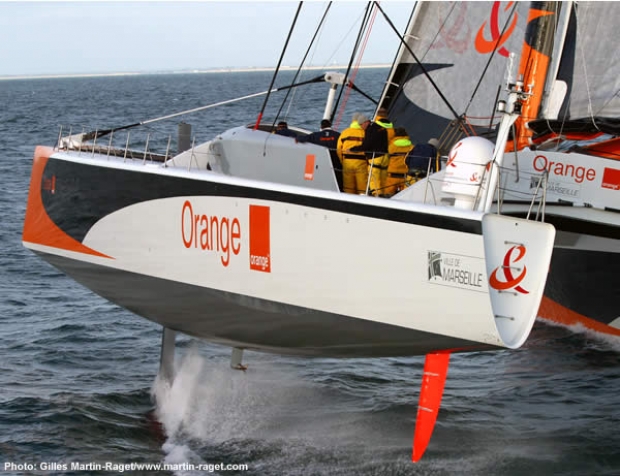
On board the sensation during this 700 mile day was incredible says Peyron. "If you imagine we were pushing the boat so hard. We were in 32 knots of wind under one reef, full genniker and staysail on one hull, flying a hull in 3-5m of wave. It was just amazing." During this time the boat speed topped out at 39 knots and Peyron says that what was remarkable about this was that it wasn't on a surf - it was generated by the boat's brute power.
However sailing along at breakneck speed in the middle of the ocean on a 36m long racing catamaran with one hull out of the water took some getting used to. Presumably it was very stressful? "It is at the beginning, but you get used to it, like a small Hobie cat or a Tornado. I have spent a lot of time in them and it is exactly the same thing. When you lift the hull you can sail at least 5 degrees lower. Of course it is very impressive."
On board they only had 10 crew and so ran two watches of five. "We had to push to the maximum with not very much in terms of human power," says Peyron. "Five guys on deck is enough to control the boat, not to do a manoeuvre. To control the boat you need a guy at the helm, one on the traveller one on the mainsheet and one of the genniker, plus one running if something needs to be done. So it is very concentrated."
Interestingly rather than having on, off and standby watches due to the duration of the record attempt Peyron ran only on and standby watches - no off watch! The standby watch would sleep in the large cockpit cuddly in the weather hull ready to join in when required for manoeuvres. However the movement of the boat at high speed, even downwind was not conducive to a great amount of sleep. "It is very brutal and hard. And the harder you push, the less you can sleep of course," Peyron describes it.
In the hull-flying in big wind conditions Peyron limited the helming to four drivers - Sebastien Audigane, Lionel Lemonchois, Klabbe Nylof and Halvard Mabire.
What was equally remarkable about the voyage is that they broke nothing. "I was the first to be surprised by this," says Peyron. "If you can imagine the pressure from a 40m monster, flying on one hull at 35 knots you can just imagine the load on the bowsprit, pushing through waves. And nothing broke, not one lashing. Nothing."
This afternoon the boat sailed into the bay off west France resort town of La Baule. The Peyron family herald from here, it is where Peyron brought Commodore Explorer after he won the Jules Verne Trophy record for the first time in 1993 and where today he sails dinghy cats with his daughter out of the same club as Yves Loday. Conditions were just right in the bay and the crew were able to lay on a big-cat-at-high-speed demonstration flying a hull for the assembled spectators.
From here Orange II goes to Lorient for a complete check over and then down to her homeport of Marseilles where she will spend 3-4 weeks prior to making an attempt on the Trans-Med record between Marseilles and Carthage in Tunisia - another record currently held by Steve Fossett's PlayStation. Then it will be back up to Lorient to prepare for a fresh attempt on Jules Verne Trophy. And no guessing who has this record at present.
For Peyron the transatlantic record may not have resulted in him getting both the records he wanted but having pushed the *** out of the boat he knows that it is now reliable. This will be reassuring come his next Jules Verne Trophy attempt this winter.
Most Read
Most Commented
Comments
Businesses
Pro businesses
-
United Kingdom
-
-
Netherlands
-
France
Editor's choice
Member blogs
-
 Ned Collier Wakefield: MOD70 round BarbadosWell that was intense. 12 hard fought for seconds for the win. In idyllic conditions, Tony Lawsons MOD ...
 -
 Mini Transat leg 2 reportThe second leg of the Mini Transat started on 31st October, just over a month after ...
 -
Leg 1 reportI’ve been working towards the Mini Transat now for three years. In 2013 I was part ...
Business blogs
-
 The Island Sailing Club in Cowes, Isle of Wight, is delighted that Prince Michael of Kent ...
 -
Peta Stuart-Hunt chats with the 25 year-old British solo sailor Lizzy Foreman before she sets sail ...
-
The 2015 Student Yachting World Cup (SYWoC), an ISAF-recognised event hosted and run by students for ...
Editor's Choice
All time favourites...
-
 Three legs down into Ian Walker’s
 -
 Winning all but two races at
 -
 For the first time in its
Latest Comments
Add a comment - Members log in