
Virtuous circles
Monday September 20th 2004, Author: James Boyd, Location: United Kingdom
While Rolex may sponsor more events than they do, international financial services and long term saving company Skandia has perhaps the most diverse selection of yachting 'properties' (to use some marketing parlance) of any sponsor within our sport.
From their humble beginnings in Stockholm, Skandia now have offices in 20 countries, do business in more than 100 countries and have somewhere in the region of £78 billion in assets and funds under their management. By far their largest market is the UK and next year we can expect big things at Cowes Week, as the company celebrate their 150th anniversary.
Unusually and perhaps the greatest tribute to our sport is that Skandia carry out no corporate advertising in the traditional manner, unlike most of their competitors. Instead their whole marketing drive is focussed on sponsorship, almost all of it pumped into yachting - a commitment to our sport like no other.
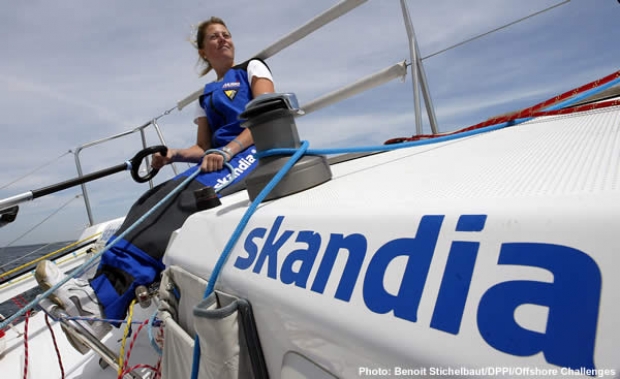
Their portfolio in yachting not only includes a huge presence at Cowes Week, which they have been backing for 10 years now, a similar if more recent role at Geelong Week in Australia as well as backing for Grant Wharington's Rolex Sydney-Hobart winning maxi, individual sailors such as Star sailors Iain Percy and Steve Mitchell plus solo sailors Sam Davies and Nick Moloney, who come November will be setting sail around the world in the Vendee Globe aboard Ellen MacArthur's former Kingfisher Open 60, now renamed Skandia Multimanager.
 The man running this particular show is Andre Oszmann, Skandia Group's Chief Marketing Officer, who is based in Skandia's UK head office in Southampton, but controls the marketing spend across the company internationally.
"The first thing to say is that apart from the obvious things like company awareness, the basic gist of our sponsorship of sailing is to make sailing more accessible and to grow the reach of the sport and generally enrich people’s lives through it," says Oszmann. "That sounds like waffle, but it’s important because it sets the tone of all of our sponsorships: if anything that comes along as a possible opportunity doesn’t fit that brief - it doesn’t help make the sport of sailing more accessible - we won’t touch it."
However there are parallels between sailing and their business too: "There is a large contingent who think that sailing is just for rich people, it’s elitist and you’ve got to be very wealthy to be involved and it is very exclusive as opposed to inclusive. Well, an event like Skandia Cowes Week proves that’s complete rubbish and not true. Our business is often seen also as something a little bit aloof and inaccessible too. We like to think of ourselves as a fairly, open accessible company. Yes, you have to have money and be serious about investing, but we are open and that is a large part of what we are trying to do in linking that to the sailing."
Clearly though the demographics for those who take part at Skandia Cowes Week is way above the average and this is attractive to them. Oszmann says that while they don't expect everyone taking part to become an immediate customer it is a method of helping them gain market share. "We have done some significant research that shows that the yachting fraternity in particular that come to Cowes understand us and are warmed to us. So if an IFA [independent financial adviser] said ‘we recommend you have a pension from Skandia’ they are more likely to buy than not. They understand that what we are trying to do is grow the sport. Everything we are doing is helping the sport they love so that more people understand it and want to be part of it. So it is hopefully a virtuous circle."
Perhaps a more significant part of what Skandia get up to at Cowes Week is that they milk the event in terms of corporate entertainment. As a company Skandia do not sell direct to the public, but rely on intermediaries to do so on their behalf. This year at Cowes Week saw them entertaining some 1,500 intermediaries along with a large number of staff not just from their own office in Southampton, but from their overseas offices as well.
The last 18 months has seen Skandia commitment to sailing grow to its present massive international level. This phase started with the Skandia Set Sail program at Cowes Week and subsequently with their backing of Geelong Week near Melbourne, announced at Cowes Week 2003. This event they now twin with Cowes Week and when the event was held this January, for the first time with their backing, Cowes Week Race Director Stuart Quarrie travelled to Geelong, along with competition winners Iain May's Charlie Fish team. Conversely at Cowes Week this year the main race officers from Geelong travelled to Cowes Week along with the crew of Larica II who sailed a Hunter 707.
"Already it is paying off," says Oszmann. "They have been swapping ideas, so there are going to be some interesting changes to the race management down there [Geelong] as a result. There is also a lot of the shoreside stuff that an event like Cowes Week can learn from Geelong."
Oszmann describes Cowes Week and Geelong Week as the two pillars of their whole yachting sponsorship program and their support has now extended to teams and professional sailors.
"We think that the first type of serious racing people do is in a regatta like Cowes Week. So we have the two main events where we mix sailors like Iain and Steve or Nick with every day sailors." At Cowes Week this year with Percy and Mitchell away in Athens, they instead rolled America's Cup legend John Bertrand into Cowes with Grant Wharington, skipper of their maxi.

"And then we have teams, like the maxi in Australia and the yachting academy on the Bear of Britain," Oszmann continues. "So the next step up is if you get a bit more serious about your racing, you might go and campaign in a team. And then if you get really serious you might go off and do something crazy like Nick or Sam are. And then you have Iain and Steve in the athletes' camp.
"So there’s a natural progression and the people at the top end, if you choose them right, are a great inspiration for people starting out at the event level. And we are always about trying to put something back into the sport. Nick, for example, is really down to earth and there is nothing that is too much trouble if it is about getting more people involved with the sport. So we take a lot of time and effort in picking the right people to sponsor, so they are competitive sailors with got a good chance of doing well, but they have real personality, a real passion for the sport and a real passion for getting more people into it, so the whole thing hopefully goes in a virtuous circle."
In August Skandia announced the extension of their sponsorship of Cowes Week through until 2008. "It will be probably the longest that anyone has sponsored this event and it is showing our long term commitment. Our business is about getting people to commit long term investments to us, so we think that we should reflect that in our investment. A lot of sponsorships end after three years. I think you get the payback if you keep on with it."
So why is it that they aren't involved in any other sports? "We have a few other bits and pieces that we have been doing, but the whole plan is to unwind generally and concentrate on one sport," admits Oszmann. "Firstly I think you get a better bang for your buck. You can get ownership of a sport or a territory within a sport and I think if you have a lot of little things it dissipates. We had a good look at all sports and there is nothing in our view that competes with sailing - not in terms of the type of thing we are trying to do. You can get people to just come and look at it, you can get people out on the water, you can get people out on the water competing. There is a great team spirit which you can build up. It is a bit like Formula 1 and saying come to the Grand Prix and actually get on the race track and race Schumacher. You can’t do that. Equally it is like saying, you have all the hospitality boats out on the water, maybe you don’t want to take part, but you want to follow a player on the pitch."
Oszmann adds that a lot of people who sail are also interested in other sports such as rugby, tennis and golf, so there is little point in sponsoring those. "So it is a much more inclusive sport than any of the others and it has got a fresh, clean image and it is healthy, it is environmentally friendly."
Obviously Skandia's UK headquarters being near the sea helped swing their initial decision to get involved with Cowes Week. "It is hugely helpful because another big aspect is that we engage the staff in this and the proximity makes it really easy. So at Cowes Week we have loads of staff over and we have staff on the SunFasts every day. I’m Commodore of the Skandia Sailing Club which is an internal club, which everyone is automatically a member of and they get a chance to go out with Nick [Moloney] and get them all involved. So the proximity always helps. However Geelong is not near Sydney, so they can’t just pop over. So it is a bonus, not the only reason we’ve done it."
Oszmann won't divulge how much they spend annually on their yachting sponsorships and corporate hospitality, other than it is "in the millions". "What I can say is that we don’t advertise. We put all of our promotional activity above the line into sponsorship and PR. We get a lot of benefit out of the PR we spin off from Cowes Week and we measure the value in terms of advertising value equivalent. So we look at column inches: are there Skandia mentions and in what context? Are the messages getting across? Is there a branded photo? And how much would that cost to place an ad of the same type."
Typically they look to get a 3x return on investment in this respect and usually it has been 3-3.5x. "It varies. You get lucky one-offs like, from a media perspective, winning the Sydney-Hobart. We would have got our return on investment, but winning it, it suddenly goes supernova. So if you get those lucky breaks on the media perspective then it is a bonus."
Grant Wharington is gunning for a Volvo Ocean Race project, so does this mean that we can soon expect to see Skandia branching out into even bigger projects? Not at the moment, says Oszmann. "There’s two aspects to it. One is the sheer amount of money and I think we can get more value the way we are doing this. But secondly it is the connotations. The America's Cup for example is very elitist. It is boys with very big expensive toys. The Volvo is an interesting one, which we are keeping a watching brief on. We have a number of syndicates coming to us. At the moment it doesn’t make sense, but we are interested in the way that is developing. Glenn [Bourke, Volvo Ocean Race CEO] seems to be trying to make it more accessible with the in-port racing. Certainly not this time round, but I would never say never."
If ever there was a positive sponsorship model to wave in front of other potential sponsors of our sport - then this would have to be it...

Most Read
Most Commented
Comments
Businesses
Pro businesses
-
United Kingdom
-
France
-
-
United Kingdom
Editor's choice
Member blogs
-
 Ned Collier Wakefield: MOD70 round BarbadosWell that was intense. 12 hard fought for seconds for the win. In idyllic conditions, Tony Lawsons MOD ...
 -
 Mini Transat leg 2 reportThe second leg of the Mini Transat started on 31st October, just over a month after ...
 -
Leg 1 reportI’ve been working towards the Mini Transat now for three years. In 2013 I was part ...
Business blogs
-
 The Island Sailing Club in Cowes, Isle of Wight, is delighted that Prince Michael of Kent ...
 -
Peta Stuart-Hunt chats with the 25 year-old British solo sailor Lizzy Foreman before she sets sail ...
-
The 2015 Student Yachting World Cup (SYWoC), an ISAF-recognised event hosted and run by students for ...
Editor's Choice
All time favourites...
-
 Three legs down into Ian Walker’s
 -
 Winning all but two races at
 -
 For the first time in its
Latest Comments
Add a comment - Members log in