

THE Man
Wednesday June 9th 2004, Author: James Boyd, Location: Transoceanic
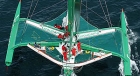
Michel Desjoyeaux entered the history books alongside the likes of Eric Tabarly and Philippe Poupon this evening in Boston when aboard his 60ft trimaran
Geant, he secured victory in the Transat. But unlike his fellow greats, Desjoyeaux' achievement is unique for he is the first person ever to have won the top three events in singlehanded offshore racing.
Quite aside from his two wins in the Solitaire du Figaro, where he currently ranks third in the ultimate pecking order behind Poupon and Jean le Cam who have each won it three times, Desjoyeaux won the Vendee Globe sailing his Open 60 PRB in 2000-1. Two years later he followed this up with a win in the Route du Rhum, when out of 18 starters his new trimaran Geant was one of just three finishers. Now in one of the most competitive solo offshore events we have seen to date, he has won The Transat.
Aside from this solo offshore racing hat trick, Desjoyeaux demolished Francis Joyon's record set in the 2000 race. Crossing the finish line at 21:29:55 GMT, Geant completed the course in 8 days 8 hours 29 minutes 55 seconds. This makes his average speed for the course 13.61 knots, although in terms of his actual distance sailed he maintained an impressive average of 16.41 knots.
Approaching the line in flat water and around 12 knots of breeze, Geant was joined by a handful of press and spectator boats, all attempting to keep up with her. On the water we logged her at around 17 knots and from time to time whenever Desjoyeaux bore away or trimmed the speed would effortlessly hit the 20s on one occasion the main hull clearing the water.
Stepping on to the dock here outside the Boston Harbour Hotel, Desjoyeaux looked slightly salty, with a week's worth of stubble and was generally a little worn but far from exhausted. His white and peppermint green-hulled trimaran looked in exceptional shape aside from a couple of dings in the topsides.
Desjoyeaux's eight day voyage across the North Atlantic was a piece of text book offshore racing. "The start was not very easy to work out because we knew that we would have light winds but at the start there was 25 knots so it was very important to get into the lead as soon as possible," he said.
The key tactical moment came early on, Desjoyeaux believes: "I think where we won the race was in the ridge after the first night, maybe 36 hours after the start, when we were able to cross it in the right place - just two of us. All the fleet was on one line and in the morning just two boats were ahead - Sodebo and me and I was leading. And all the rest of the fleet had no other solution but to follow us and stay with the leaders. Then there were our two boats leading the race, and when we separated was in the second low pressure where we continued to go straight to the centre and Sodebo tried to escape the centre of the low pressure and then we got away from him. That is just my feeling."
Sailing into the low pressure system was an exceptional example of using the weather to the full potential. Desjoyeaux reached directly into the centre of the depression and when the wind shift arrived, reached out the other side. If he'd remained on the great circle or the rhumb line he would have been sailing upwind and he was more than able to compensate for the extra miles sailed by the faster point of sail of the trimaran.
In the event the crossing to Newfoundland was very quick. "With these boats we can make 500 miles a day even alone and when we arrive off Newfoundland, we were five days into the race and there was 1000 miles to go until the finish line…so maybe two days. And then you make the routing process on the computer and you see 3.5 days. So you can hope to cross the Atlantic in seven days, but it must mean the conditions are optimum for such a race."
Due to their tactics sailing into and out of the depression their route to round Cape Race was much further north than normal. At the same time ice reports were showing a large concentration of bergs directly east of Newfoundland with the course of the boats taking them through the middle of this area. Showing great maturity the skippers in the ORMA fleet came to the group decision to self-impose a waypoint to sail around. Desjoyeaux explains the importance of this: "You have to understand that a 1m growler is big enough to completely break your boat. You can't imagine in waves or with fog, when sometime you don’t see the top of the mast 30m up... I can't understand how a singlehanded sailor or even a crewed sailor can be sure not to find a growler particularly in front of three hulls," he said, adding. "I don't like ice. Ice is just for the Pastis in France."
For Desjoyeaux the matter of his record time was not important while he was racing. "When I race I am racing against competitors not against the Omega timer. So the problem is how to keep your lead position or to improve it or not to lose it. The time is something you realise here when you finish not when you are racing. When we are racing we are racing against the competitors and you are trying to do your best with weather systems, not with the time."
One of the most extraordinary aspects of The Transat was how Desjoyeaux went about racing his monster trimaran. The different between racing an Open 60 monohull as he had four years ago and a 60ft trimaran are large, like a race horse and a race horse shot full of amphetamines. Both have a range on conditions where the boat will look after herself to some degree of safety under autopilot, only with the trimaran this window is much much smaller.
 In terms of the rhythm of the race, Desjoyeaux says that he treated like two legs of the Figaro back to back and like the Figaro he got an average three hours sleep each day in catnaps. "I can sleep at the helm, I can sleep when I wait for my cooking, or when I wait for the files to come back from the computers. But it is always for a short time which amounts to three hours a day."
During the entire race he only slept for 30 minutes in his bunk down below. Usually he slept at one of the two helm positions, each half way along the aft beam. On Geant these are protected by a large windscreen to keep the worst of the elements off the skipper. "When it was really cold, I slept under the bubble I have in the middle of the boat."
Because he slept outside so much, Desjoyeaux says the experience was a lot colder than it had even been on the Vendee Globe. "On the Vendee Globe I was never so cold, because in that race you are always inside the boat and you don’t have to be in the wet conditions outside. When you go to trim a sail outside during the Vendee Globe it is just a few minutes, not 12 hours a day outside. This was the coldest sailing I have done. Fortunately it is only three days."
Aside from some excellent preparation of his boat, another key to his success was working with his router Jean-Yves Bernot. Routing is allowed in The Transat only for the ORMA multihulls.
"When the routing is allowed you have to use it, especially with these boats," says Desjoyeaux. "If it is not allowed you don’t use it and you make your own so you go slowly and you lose a lot of time to this. Jean-Yves helped me not only in the way of going across a ridge, or across a low pressure, or around a high pressure he also made me win a lot of time by making the right choice at the right moment. For example when you don't know what you want to do, say you are crossing a system, you will tack just to check if it is not a good moment, if it is not half an hour later you tack back again and try a second time. Each time you do that you lose a lot of energy by trimming the boat and you are not sure about what you do.
"This was the first time I was routed in a singlehanded race and it is a very big help to have someone on the phone who tells you will tack in less than one hour and in half an hour you tack… and that’s it. These boats are very powerful and handling each sail you lose energy and the less energy you lose the better you are." Bernot is special, Desjoyeaux maintains, because he has considerable experience as a sailor aside and hasn't just sat behind his PC like some other routers. He is therefore better able to intepret the forecasts to anticipate the conditions that will actually be seen on the sea.
Desjoyeaux says that he never made a major decision against Bernot's advice. "Each time we agreed about what to do and he has more information that I don't have on board and he made the good decisions for me. If you don’t have complete confidence in your router, you might as well do it yourself."
Impressively Geant is fitted with a Mini M handset in each of the helming positions allowing Desjoyeaux to be on the phone to his router without leaving the helm. However the Mini M stopped working during the race. "While the Mini M was working I was talking to Jean-Yves eight to ten times a day. He also sent me a message on the Standard C, but I didn't read them until the Mini M fell down. Then I did everything by Satcom C and if I didn’t understand something then then I started the Satcom F."
In the ORMA fleet Bernot was also routing Alain Gautier.
During the race Desjoyeaux says he had no problems with the sails or the battens. The Mini M went down and he had a other small problems with the electrics. On one occasion the engine also refused to start. "I tried to start the engine and I thought 'oh shit, it is the Vendee Globe again'. In fact it was just a small plug on the fuel vein that was off and I plugged it in again and it was off."
Desjoyeaux says he thinks that as an event the name of 'The' Transat hits the spot. "I think that this time for the multihulls we were very lucky with the conditions. That’s why we were fast. I think the monohulls were not lucky, but that’s the game."
Geant will be taking part in the Quebec-St Malo later this month as well as the remainder of the ORMA Grand Prix season. However with the top three solo sailing titles on his CV there must be precious little for him to do. Putting this to Desjoyeaux it becomes clear that there is still some unfinished businessed for him...in the Figaro.
More photos on the following pages...

Most Read
Most Commented
Comments
Businesses

Pro businesses
-
-
-
Italy
-
United Kingdom
Editor's choice
Member blogs
-
 Ned Collier Wakefield: MOD70 round BarbadosWell that was intense. 12 hard fought for seconds for the win. In idyllic conditions, Tony Lawsons MOD ...
 -
 Mini Transat leg 2 reportThe second leg of the Mini Transat started on 31st October, just over a month after ...
 -
Leg 1 reportI’ve been working towards the Mini Transat now for three years. In 2013 I was part ...
Business blogs
-
 The Island Sailing Club in Cowes, Isle of Wight, is delighted that Prince Michael of Kent ...
 -
Peta Stuart-Hunt chats with the 25 year-old British solo sailor Lizzy Foreman before she sets sail ...
-
The 2015 Student Yachting World Cup (SYWoC), an ISAF-recognised event hosted and run by students for ...
Editor's Choice
All time favourites...
-
 Three legs down into Ian Walker’s
 -
 Winning all but two races at
 -
 For the first time in its
Latest Comments
Add a comment - Members log in