
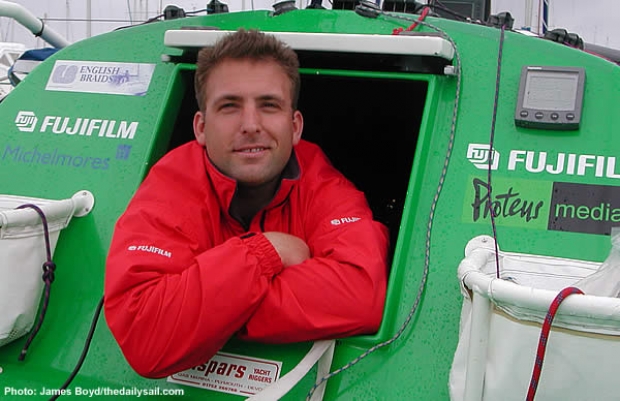
Alex Bennett
Back to basics
Friday July 9th 2004, Author: James Boyd, Location: United Kingdom
Alex Bennett’s solo sailing career was going well - a highly respectable fifth in the 1999 Mini Transat, a crew spot on
Team Philips, which if it wasn’t good for results on the water helped his profile (in the West Country at least the Philips crew were viewed with an awe similar to that of the first astronauts) and then an Open 50 win in the 2001 Transat Jacques Vabre.
The Bennett master plan was to find sponsorship to enter a boat in this year’s Vendee Globe, but disaster struck while delivering his boat back from Brazil after the TJV when problems with the rams for the canting keel mechanism on his Open 50, formerly Pete Goss’ Aqua Quorum, forced him to abandon the boat mid-Atlantic.
Now Bennett is back in the class in which he initially made a name for himself. “The decision was made back in early October,” Bennett recounts. “We were still looking up until then for money for the Vendee with little success. We had a few close calls with funding and they just didn’t materialise into anything. So I started thinking what else is available and the Mini was always something I wanted to go back to because we had a good result in 1999 and I felt we could always do better and even win it with the right tools and preparation time.”
Bennett says he looked at the possibility of taking part in The Transat, but there was too much risk going ahead with a self-funded Open 50 or 60 campaign. “I felt at the end of the day if I didn’t get any decent sponsorship I could get through the Mini and get a good boat on virtually no cash, whereas if I had an Open 60 or an Open 50 doing The Transat it was going to be big bucks all the way. So we made the decision and then it was a case of looking for funding for it and eventually several months of hard work paid off.”
In February this year, Bennett announced the sponsorship of his Mini campaign by Fujifilm UK, the boat painted in the familiar green, similar that of Loick Peyron’s original trimaran of this name (sponsored by Fuji France).
“It came about through a lot of hardwork,” says Bennett of his sponsorship deal. “We did have a door opened to us. You don’t get something like this from cold calling. It was quite comfortable with what they wanted to do marketing-wise and there is also a bit of corporate hospitality which we’re doing both on the Mini for select clients of theirs who can sail and off the Mini as well. Part of the contract is also for me to do talks, which is normal with these things now.”
For his Mini campaign Bennett picked up Reality, originally the highly refined Groupe Finot design of Peter Heppel that aeronautical engineer and America’s Cup hydrodynamist campaigned in the 1999 Mini Transat. Bennett bought her from his former Round Britain crew David Barden, who had intended to race the Mini Transat himself, but found himself unable to do so due to work commitments at his company AllSpars.
“ Reality is a great boat,” says Bennett. “It is one of the best for a number of reasons, but when I started to think about the Mini again I wanted to build a new boat, which was something I always wanted to do. So we started to look at designs and the obvious one was a new Karen Liquid (sailor/designer Sebastien Magnen’s 1997 and 1999 Mini Transat winner), but frankly the work-up time didn’t add up. So we have a very platform that is known to work and be reliable and we’re going to modify it and develop it. And I think that is the best way to go given the fact that we have to qualify this year to be in the game for the Transat next year.”
Bennett is at an advantage in terms of the all-important qualification for the 2005 Mini Transat as he has competed in the race before. As a result he doesn’t have to sail the obligatory 1,000 mile qualifier. However he does have to complete 1,000 miles in Classe Mini racing.
To date this year he has had to pull out of the Mini Select race from Pornichet, came second in the singlehanded Mini Cup, from Dieppe to Douarnannez and had to retire from the Mini Fastnet, when a spreader broke about five hours into the race. “We were lying third out of about 84 at the time going really well,” he recounts. “Luckily we weren’t dismasted. We managed to tack pretty quickly and limped about 40 miles back to Douarnannez. It wasn’t too much of a big deal.”
Tomorrow Bennett will be setting sail in the class’ doublehanded Open Demi-Cle race from Locmiquelic in southern Brittany with his crew Ifor Pedley. If he completes this race he will have covered the mandatory number of race miles qualifying his to be considered for next year’s Mini Transat. He must then file his entry officially in the 2005 Mini Transat at the earliest convenience- the Salon Nautique in Paris in December. Then it will be a case of fingers crossed hoping that he makes it on to the entry list. This is far from assured given the high number demand for places this race.
“It wasn’t as bad when I last did it,” says Bennett of the Mini’s Kafka-esque qualification process. “You had to be organised and have your paperwork filed in and you had to do your qualification but I guess it wasn’t policed so much. The need to be organised and get out there and do the miles in wasn’t as pronounced as it is now. Now it is a very heavy weight on all our shoulders, especially people who are serious and have sponsor commitments as well - it is a big thing and these first races are critical.”
If Bennett does get an entry then he is still obliged to race in one Mini event in the class’ calendar next year in order to sail the Mini Transat. “At the end of the day there’s going to be 70 boats on the start line of the next Mini Transat and you need to make sure you are one of them. That’s why we haven’t build a new boat, because I didn’t think there was time.”
Since acquiring Reality Bennett has fitted a new carbon fibre rig as allowed under the 2004 rules. The new spar is made by AllSpars and is looked after by Barden. “That’s in the early stages of development, but it has a nice section so we’ve got a good datum to start with.”
Aside from this they have ripped out all the old electronics on board and replaced them with Raymarine gear, including two complete pilot systems and a Maxi display head beneath the mast. This year another upgrade in the Mini class rules allows for wind instruments to be used. “I view that as essential to the speed of the boat especially upwind at night when its dark and you can’t see the telltails. Now you lock on to a wind heading and off you go and I think the boats will become faster because of that,” says Bennett.
North Sails UK have been responsible for the new sail wardrobe (Heppel’s original wardrobe was made by North France). “It was a case of building on what Peter had done, bearing in mind that the course of the Mini Transat is different now, so we can have bigger downwind sail area, etc. And that’s what we’ll be doing over the next year - developing the sails for the new route.” Since the 1999 race, the destination of the Mini Transat has moved from Martinique to Salvador de Bahia in Brazil.
The significant development in the sail wardrobe has been the Code 0, masthead and on a furler, that is considerably bigger than the previous equivalent. “It is a light airs upwind sail in about 10 knots apparent, but you can use in say 20 knots reaching off downhill if you don’t want to pop the chute. I think that’s going to be a good all-round sail,” says Bennett. Instead of tacking this sail to the bowsprit, instead it attached to the bottom of a separate A frame at the bow (see photo). “I can set all the downwind sails from the A-frame, although not as efficiently, but it will still work. At the end of the day having done the race before this Mini thing is all about redundancy. It is not about having the fastest boat it is about having the most reliable boat.”
Since their spreader issue in the Mini Fastnet the mast has been repaired. They have also improved the water ballast system. “With the water ballast we can pump in and out a minute quicker than before. A problem with the water ballasted boats is that we are at a disadvantage tacking against swing keelers, so we wanted to change that. Now we’re very happy with the speed of the boat. It is obvious that the boat is one of the fastest boats in the fleet, which is nice as it was always a bit of a question in my mind being a water ballasted boat when most of the top boats were swing keel. I thought water ballast was the way to go for the Transat because of the course and it seems she’s now at no disadvantage all the way around.”
If he and Pedley get a good result in the Demi-Cle then Bennett will bring the boat back to the UK for the rest of the year for training. If he doesn’t finish or fails to do well then the boat will continue Mini season in the Med, as with the demise of the class’ race to the Azores and back (due to lack of sponsorship) there is no other racing for the Minis on the Atlantic side of France.
Generally being back in the Mini, Bennett says, it is as challenging as ever. “I’ve been away from the Minis for four years now and no matter what people say I think they are the hardest boats to sail offshore because they are so small and powered up. They are much harder than Open 50s and 60s where you have it easy – when it’s blowing 40 knots you can walk down below and make a cup of tea with easy. In a Mini when it’s blowing 20 knots it’s like full-on survival mode.”

Most Read
Most Commented
Comments
Businesses

Pro businesses
-
Italy
-
United Kingdom
-
United Kingdom
-
Netherlands
Editor's choice
Member blogs
-
 Ned Collier Wakefield: MOD70 round BarbadosWell that was intense. 12 hard fought for seconds for the win. In idyllic conditions, Tony Lawsons MOD ...
 -
 Mini Transat leg 2 reportThe second leg of the Mini Transat started on 31st October, just over a month after ...
 -
Leg 1 reportI’ve been working towards the Mini Transat now for three years. In 2013 I was part ...
Business blogs
-
 The Island Sailing Club in Cowes, Isle of Wight, is delighted that Prince Michael of Kent ...
 -
Peta Stuart-Hunt chats with the 25 year-old British solo sailor Lizzy Foreman before she sets sail ...
-
The 2015 Student Yachting World Cup (SYWoC), an ISAF-recognised event hosted and run by students for ...
Editor's Choice
All time favourites...
-
 Three legs down into Ian Walker’s
 -
 Winning all but two races at
 -
 For the first time in its
Latest Comments
Add a comment - Members log in