
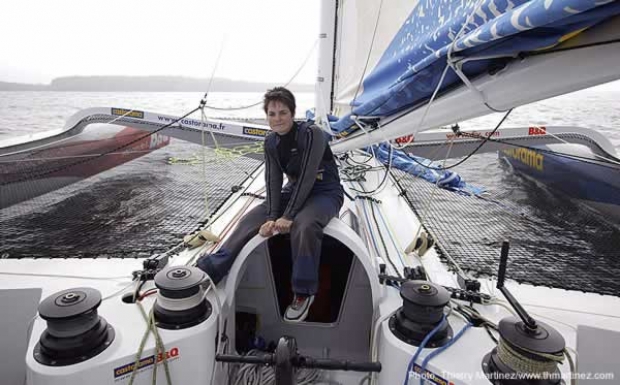
Ellen on her new trimaran
Friday January 9th 2004, Author: James Boyd, Location: Australasia
So at the tender age of 24 amid a blaze of media glory you finish second in the Vendee Globe, one of the pinnacles within our sport alongside the Olympics, America's Cup and Volvo Ocean Race. What next?
If you are in it purely for the competition then you head for one of these other pinnacles hence why we see Dean Barker launching himself into a Finn campaign and conversely Ben Ainslie into an America's Cup campaign.
But this is not entirely the order of the day for the wee lass from Derbyshire. "I am not just motivated by racing," says Ellen MacArthur, a point usually guaranteed to make sports writers wince. "I have always been someone to say when I start a race I’m not there just because I want to win. I’m there because I love it. That is really important to me. When I’m out there I give it my best and you know you’re always going learn. So the motivation is not going out there to win. The motivation is going out there because I love being out there and if you love being out there then you can give more."
Ellen's latest project - to undertake a campaign of singlehanded record breaking aboard her new purpose-built Castorama B&Q trimaran - was conjured up during conversations with her long term friend, confidente and eventual designer Nigel Irens. "You finish the Vendee and like everyone, I think, you go through this process of trying to decide what the future is and it is not easy. You go through a period of trying to work things out and making your mind up. I did a lot of thinking and I remember speaking to Nigel about different things and it was during a conversation with Nigel that this came about and I guess I was following my heart in many ways. I remember sitting there in the library reading about Chichester going off and doing his voyage. And this is the same kind of thing - going off on your own and taking it on."
Today with singlehanded record breaking there are still elements for the Sir Francis Chichester-style adventurer and pioneer. It is not purely the domain of the cold calculating athlete where the result is king. In recent years there have been precious few solo record attempts, particularly on board a trimaran and none on board a trimaran built for this sole purpose.
On the west to east transatlantic course for example the last was Laurent Bourgnon on the 60ft trimaran Primagaz in June 1994 when the ballsey Franco-Swiss sailor set a time of 7 days 2 hours and 34 minutes, but more significantly established a new 24 hour record of 540 miles - at the time this was further than any boat had been sailed in a day fully crewed! This record survived until the first generation of G-class maxi-multihulls came along.
The holy grail of all record breaking, solo or otherwise, is of course non-stop round the world record in the fastest time. The present singlehanded non-stop record was set by Michel Desjoyeaux's Open 60 PRB in the last Vendee Globe with a time of 93 days 3 hours 57 minutes and 32 seconds (Ellen is currently second fastest with her time of 94 days 4 hours 25 minutes and 40 seconds). However currently Francis Joyon sailing his 90ft trimaran IDEC is poised to change all this. If his current progress is extrapolated and assuming the second half of his voyage goes as well as the first half, Joyon may become the first man to sail around the world non-stop singlehanded in under 80 days - a feat which would be as incredible as Bourgnon's 1994 transat.
If Ellen attempts the round the world passage in her new boat she will only be only the fifth person ever to have done so on a trimaran following Alain Colas, Olivier de Kersauson, Philippe Monnet and Joyon.
The only other person in recent years to attempt singlehanded records aboard a trimaran has been Steve Fossett who notched up times for the course across the north Pacific from Yokohama to San Francisco in 1996 and the Newport to Bermuda course in 1999 aboard his 60 footer Lakota.
Apart from this the field is relatively clear for Ellen to go on a record breaking jamboree the likes of which would make the King of Records himself, Steve Fossett, blush. For each of the numerous world records in the World Sailing Speed Record Council's ledger, there is a singlehanded category and even a singlehanded female category, many of which are unclaimed or at least should be a easy to break - the singlehanded round Britain and Ireland record for example is currently held by a 38ft monohull: easy pickings for a 75ft tri.
A criticism levelled against Ellen is that in her latest venture she is running away from competition by attempting records rather than races. The fact that every sailing event she has done in her career, with the exception of her teenage cruise around Britain on Iduna and her unsuccessful Jules Verne Trophy attempt last year, have been races, including some outstanding results - second in the Vendee, first in the 2000 OSTAR, first in the 2002 Route du Rhum - seems to be ignored.
Ellen debates whether records are any easier than race. "You always hear 'she’s bailing out of races because there is less pressure on record attempts' I’m not sure that is the case actually," she says. "Races are pretty stressful but there are other boats out there."
In a race like the Vendee Globe you know where you competition is and you have the opportunity to see what they are up and there is the possibility of tactical play, covering them if you are ahead, etc. On records where you are racing someone else's track around the world, usually in entirely different weather conditions, the pressure is constantly on no matter what the lead. "Just look at what happened to de Kersauson with his Jules Verne," Ellen points out. "That was unbelievable and it just goes to show that you can be smart as, but if there’s no wind, you’re not going anywhere. I guess that is why he has been doing it for so long."
On a record attempt you are also feel a much greater sense of isolation. In a race there are other boats accompanying you. On a solo round the world voyage for example down in the Southern Ocean you are really on your own. You are also on your own tactically. "When you are doing a race, even when you are making those decisions on the boat, if you say, 'okay there is a depression coming, what am I going to do, I am going to turn 20deg to starboard, and let it ride over the top?' or whatever," says Ellen. "Every four hours in the Vendee, you get the positions of everyone else to tell you exactly what they are doing and it is hugely reassuring to see what decisions they are making. That you can watch them and see 'yeah, Bilou is doing the same'. But with this project there is no one, so it is much more a feeling thing, where you go and how far you go from the centre of the depression. You are on your own and it is very different. I remember that from the cat. Sometimes you think - are we doing the right thing here?"

Design
Ellen is also as enthusiastic as designer Nigel Irens is when it comes to the technical challenge of creating a new boat for a fresh purpose. Her experience in the Vendee Globe, sailing the maxi-cat Kingfisher 2 in the Jules Verne as well as the numerous races she has done with Alain Gautier on the 60ft trimaran Foncia, has left her well placed to provide input into the ideal craft for the job.
"Generally sailing in the oceans where you are going to take the boat is a pretty awesome experience - to see what the sea state is like and trying to imagine what kinds of boats could cope with that," she says. "The size of the boat is something which stems back from sailing 60ft monohulls and multihulls in the Atlantic - it doesn’t have to be the Southern Ocean [conditions can be just as bad in the North Atlantic as they are in the south]. The cat was an awesome experience from a multihull in the south point of view, thinking about the sail changes and what would be possible and what wouldn’t be possible in order to do everything safely singlehanded.
"The whole idea was that the new boat would be handleable. It would be easy to build a huge boat, still pretty light, but the bigger the boat gets the wider it gets, the more loads there are involved and the bigger the sails have to be. We know the 60ft tris are pretty fast but they are pretty short for their mast height. So what we tried to do was to make a boat which was big enough to handle some pretty large seas and to lengthen the wheel base.
"The freeboard at the bow is 2m, so she is pretty big and she has a very different hull form to the 60s. Effectively we didn’t say 'this is a 60ft tri - how can we modify this to make it go into bigger seas?' We said ‘this is what has done long trips before and looked at the cats and other boats and said how can we make that sailable by one person.
"I guess also from a seaworthiness point of view, the 60ft trimarans have not sailed very far. If you are trying to go further you need to know these things. They have always been pretty difficult to sail solo which has been one of the reasons why the solo races on the 60s have been in the Atlantic rather than further. So we wanted to try and make a boat that was a little more tolerant."
Neither Ellen nor Nigel Irens will be drawn on the kind of performance they expect from the new Castorama B&Q and for good reason. Top speed in a multihull is always hard to predict because it is highly dependent upon sea state. Even given perfect conditions - flat water and big wind - the limitation is less in typical parameters such as overall length, as one would expect from a monohull, but more from when the boat becomes unhandlable, stops working or breaks. Added to this in the case of Castorama B&Q is that she will be sailed singlehanded and her speed will be highly dependent upon how efficiently Ellen can sail her on her own - Ellen will want to sail the boat fast but with minimum risk.
As ever with record breaking boats the aim is not for peak speeds but high daily averages. 60ft trimarans are perhaps the best point of reference - the present singlehanded 24 hour record stands at 540 miles and presumably the new boat will be capable of more than this. Whether this is 550 miles or 600+ miles remains to be seen.
"Multihull performance is generally pretty incredible upwind," says Ellen. "The 60 tris go upwind at true wind speed in up to 19 knots of breeze if the water is reasonably flat. Compare this to a monohull and the difference is huge, it is just ridiculous. Until you sail one you don’t believe it is possible.
"From this boat’s point of view we are not going to be as optimised upwind as the 60s, however the boat is longer, and there are many aspects that until we sail her we just won’t know. We won’t be flying the central hull as much and the centre hull is bigger relative to the whole boat than a 60 by quite a long way. So that makes a huge difference. Sure the floats are more cut away at the beam, for downwind safety more than being square, but the central hull will play a bigger part in sailing upwind too."
However in keeping with the idea that most records Castorama B&Q will be undertaking are on downwind passages, the performance of the boat has been skewed more in this direction.
"It is amazing - the 60ft tris sail incredibly deep. You can sail a 60 at 145-150 which compared to Kingfisher that is pretty deep - as far as I am concerned you can sail deeper with a multihull than I would solo with Kingfisher. The problem with Kingfisher is that you can sail with the spinnaker which takes you deep, but as soon as you get the wind speed up to 22 knots you have got to get the kite down, because otherwise you can’t get it down if you have to. And as soon as you take the kite down you are under genniker so you have to sail higher angles, so you are at 140-145deg. But the 60s can go down deeper because you have got this big sail and you can just plough down. But obviously the issue solo is how deep can you go with a pilot and is it going to be safe - generally with a genniker up it is never that safe..."
What now?
From Sydney Castorama B&Q will head for Auckland where her real work up will take place. She will then head for Cape Horn with a full crew which will be dropped off probably in the Falklands allowing Ellen to sail up the Atlantic on her, just as she did on Kingfisher's maiden voyage. Whether the ultimate destination for the boat is America, ready for an attempt on the transatlantic record, or Europe, is a call that will be made at a later stage.
At present Ellen has only committed to attempting Laurent Bourgnon's west to east transat record and the 24 hour record, which she may well be able to have a crack at on her passage up the Atlantic if conditions allow.

Most Read
Most Commented
Comments
Businesses

Pro businesses
-
United Kingdom
-
France
-
Italy
-
Italy
Editor's choice
Member blogs
-
 Ned Collier Wakefield: MOD70 round BarbadosWell that was intense. 12 hard fought for seconds for the win. In idyllic conditions, Tony Lawsons MOD ...
 -
 Mini Transat leg 2 reportThe second leg of the Mini Transat started on 31st October, just over a month after ...
 -
Leg 1 reportI’ve been working towards the Mini Transat now for three years. In 2013 I was part ...
Business blogs
-
 The Island Sailing Club in Cowes, Isle of Wight, is delighted that Prince Michael of Kent ...
 -
Peta Stuart-Hunt chats with the 25 year-old British solo sailor Lizzy Foreman before she sets sail ...
-
The 2015 Student Yachting World Cup (SYWoC), an ISAF-recognised event hosted and run by students for ...
Editor's Choice
All time favourites...
-
 Three legs down into Ian Walker’s
 -
 Winning all but two races at
 -
 For the first time in its
Latest Comments
Add a comment - Members log in