
Mini Transat preview
Saturday September 6th 2003, Author: James Boyd, Location: United Kingdom
Click here
to see the complete entry list
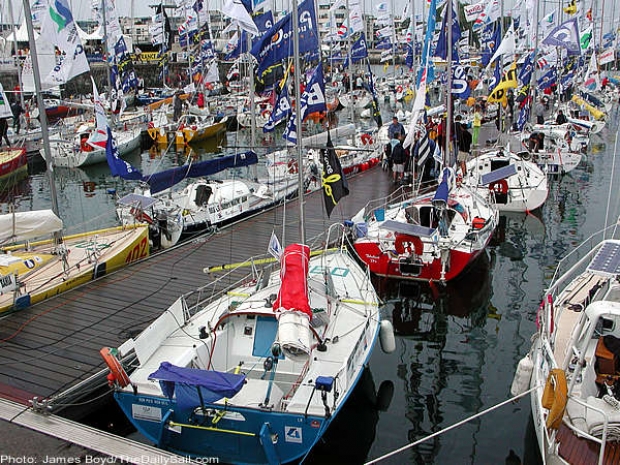
An impressive fleet of seventy 21ft ocean going skiffs will set sail from La Rochelle tomorrow (Sunday) on the first leg the biennial Mini Transat (officially known as the 2003 Transat 6.50 Charente-Maritime/Bahia Race).
The first leg of the race goes from La Rochelle across the Bay of Biscay round Cape Finistere and down to Puerto Calero in Lanzarote, a distance of 1,350 miles which the leading competitors expect to take around 10-11 days. The second leg through the Doldrums and across the Equator to Salvador de Bahia in Brazil, a distance of 2,900 miles and which will take around three weeks, starts on 27 September.
This is the 14th ever Mini Transat since Bob Salmon ran the first race from Penzance to Antigua in 1977. Since then the race has become increasingly French dominated and in 1981 the start moved across the Channel.
Like the Figaro class, the Mini has been the proving ground for many sailors who have gone on to far greater things. French sailing stars who cut their teeth in the Mini include Bruno Peyron, Loick Peyron, Lionel Pean, Isabelle Autissier, Yves Parlier (winner in 1985), Laurent Bourgnon (second in 1987), Yvan Bourgnon (winner in 1995), Michel Desjoyeaux and from the UK the likes of Ellen MacArthur, Mark Turner, Sam Davies, Brian Thompson, Alex Bennett have competed.
Like the Figaro the bond between competitors is un-naturally great, born of a common challenge to race a small boat singlehanded several thousand miles across the Atlantic Ocean, a voyage that is on the one hand exhilarating and inspiring and on the other that can be miserable and terrifying.
However the Mini class is a very different affair to the Figaro. While the Mini class has its fair share of hotshots, it has a much more corinthian spirit to it. The archetypal Mini sailor has often worked as a shore crew previously either on the Mini or one of the bigger classes and has built (and - for real cred - designed) his own boat and spends what little money he or she has or raises in sponsorship entirely on the boat, living in the scant space on board between races.
Adding to the corinthian spirit, the fleet is divided in two between the 'protos' ie one-offs and 'series' ie production boats - this year there are 41 of the former and 34 of the latter.
Traditionally the protos have been the hot-shot race boats while the series boats have been slower affairs like the Pogos and older Cocos usually sailed by amateur entries. For the 2003 Mini Transat this dynamic has changed. The archetypal Mini sailor now races a 'Proto' while the Series boats are being campaigned by a worrying number of white collar professionals rather than hairy, unwashed 20 something year olds. This is perhaps best summed by a tour of the boats here on the marina where one white hulled Series boat is sponsored by international accountancy firm KPMG while one of the Protos, inevitably a dayglo orange affair, is covered in screaming protests against paedophilia.
The Series boats are also changing. While a majority of the fleet are Pogos in among them are four of the new Pogo 2s. These new Groupe Finot designs are substantially faster than their predecessors and have all the bells and whistles of the top notch protos. While the Protos are likely to take most of the top spots we can expect at least one of the new series boats to be in the top 10.
There is also a disappointing lack of innovation in the class at the moment. The boats are all pretty radical with giant canting bowsprits, generous sail area and canting keels, but even among the few new builds that have made it into the race the technology is pretty uniform. Previously there have been all manner of mad-cap ideas being tried such as keels that twist or can be hauled fore and aft (as on Jonathan McKee's Team McLube) or one mounted on a huge ball and socket joint that could cant in three dimensions.
It was in this class that canting keels first became acceptible technology for crossing oceans, when Michel Desjoyeaux took one in the 1991 race. What can be tried at relatively little expense in the Mini can subsequently scaled up for Open 60s.
Who will win?
Among the potential winners there are six names which are regularly coming up in The Daily Sail's informal poll of those in the know. Favourite is probably Sam Manuard, a yacht designer who finished fourth in 2001. Manuard is racing one of his own creations Tip Top Too in which he won the two handed Odyssey d'Ulysses from Antibes to Tunisia and back and the Mini Fastnet from Douarnanez around the Fastnet Rock and back. Manuard's previous experience in the race puts him on top of the pile in our view.
If results in the 2003 season are anything to go by another surefire favourite is American Jonathan McKee. Sailing the Simon Rogers design Team McLube which Brian Thompson campaigned two years ago, the two time Olympic medallist has approached his Mini campaign with all the professionalism of a Cup campaign. So far this season he won both legs of the singlehanded Mini Pavois from La Rochelle to Portsmouth and on to Douarnenez and the two handed division of the Open Demi-Cle with his elder brother Bates.
Armel Tripon on his older Groupe Finot design, Moulin Roti is also up there having won the Course de Lions two handed race in the Med as are the Freds - Duthil and Duval both of whom ranked highly in the Mini Transat two years ago and who have been doing well this season.
Who's not here
A lamentable absentee from the 70 strong line-up is British favourite Nick Bubb, who also has been a regular feature of the top five in Mini races this year. It seems incredible that Bubb should show so much commitment to the class - getting the finance together for a new boat, spending every waking moment for a number of months building his new Seb Magnen design, getting qualified in record time and taking part in a majority of this year's Mini program in which he was regularly in the top five - and yet come the ultimate event of the season has found himself still on the waiting list and not the entry list.
Bubb had qualified to sail in the Mini Transat aboard his old boat last year, but felt he needed a new state of the art boat which he built in record time over the course of last winter. As a result he had to requalify which he also did as fast as humanly possible - but not fast enough, proving that it is no longer possible to attempt a Mini Transat campaign in one season. As one observer put it "it's like being in the queue waiting for a bus and then decided to pop into a shop because you want to buy something and then coming back to find that the bus has gone."
In our mind the class association and the Mini Transat's organisers need to reappraise their entry procedure for future events. A system whereby say the top 10 or 20 ranked boats through the season are ensured a place in the Mini Transat would make for a more competitive fleet and a better sporting event, while maintaining a corinthian component to the race. An alternative is that there are enough boats in this class to hold separate event for the Protos and Series boats, so it would perhaps make sense to hold transatlantic races for these classes separately in alternate years.
A man who will agree with this is Kiwi sailor Chris Sayer, who's run-in with the Mini Transat's organisers has been well publicised. If Bubb went to considerable effort to put his campaign together, Sayer had the added struggle of building and financing a boat in New Zealand and having it shipped to Europe. Sayer who finished third in 1999 is here as his boat on which he now has sailed 5,000 miles between New Zealand, New Caledonia, Australia and back to New Zealand.
The organisers feel that Sayer has not completed his qualifications properly and so he is not even on the waiting list. Regardless of his entry status Sayer will crossing the Atlantic alongside the fleet anyway.
One wonders what might have happened if one of the top ranked French sailors had still been on the waiting list. Past experience would suggest that the organisers in conjunction with the Affaires Maritime and maybe the French Minister of Sport/Transport would have conspired to find a way to suddenly let a few more boats into their precious race.
Despite the disappointing lack of Nick Bubb, Britain is represented by Ian Munslow and James Bird. Munslow, 29, originally from Derbyshire like a certain other former Mini sailor, is racing Ishtar, the Owen Clarke design he campaigned in the last race finishing 22nd in the proto division. This summer Munslow has spent repaired his boat since a trawler ran him down in the Mini Fastnet.
20 year old James Bird has taken over from Ellen MacArthur as the nipper of British solo sailing and is the youngster competitor in this year's Mini Transat. He is racing Atomic, the 1991 Berret design which Mike Inglis raced two years ago.
What lies in store...
Of concern for competitors is that, as usual, the September start is coinciding with the first round of autumnal gales, with the added excitment this time round of Hurricane Fabian's tour of the north Atlantic.
While tomorrow's start looks set to be relatively benign, the boats look set to be on the wind as they head out across the Bay of Biscay in a southwesterly direction towards Cape Finisterre, the northwestern tip of Spain. This is always the toughest part of the race as the boats have to cross the continental shelf roughly 100 miles out from La Rochelle in the direction of the Cape.
During Monday the forecast shows a front passing through causing the wind to veer northwest and building to around 35 knots. By Tuesday morning the low to the north looks set to have moved across the UK causing the wind to veer further round to the north.
Tactically it would seem to make sense to go to the right of the course where competitors will be the first to see the favourable shift to the northwest.
Further down the track the weather towards the end of the week looks set to be influenced by the tailend of Hurricane Fabian, although current forecasts indicate that the boats will just be clear of this and will experience reasonable following winds all the way south to the Canaries.
Below: Wind chart for Wednesday showing the rather major effect of Hurricane Fabian on the north Atlantic's weather
Most Read
Most Commented
Comments
Businesses

Pro businesses
Editor's choice
Member blogs
-
 Ned Collier Wakefield: MOD70 round BarbadosWell that was intense. 12 hard fought for seconds for the win. In idyllic conditions, Tony Lawsons MOD ...
 -
 Mini Transat leg 2 reportThe second leg of the Mini Transat started on 31st October, just over a month after ...
 -
Leg 1 reportI’ve been working towards the Mini Transat now for three years. In 2013 I was part ...
Business blogs
-
 The Island Sailing Club in Cowes, Isle of Wight, is delighted that Prince Michael of Kent ...
 -
Peta Stuart-Hunt chats with the 25 year-old British solo sailor Lizzy Foreman before she sets sail ...
-
The 2015 Student Yachting World Cup (SYWoC), an ISAF-recognised event hosted and run by students for ...
Editor's Choice
All time favourites...
-
 Three legs down into Ian Walker’s
 -
 Winning all but two races at
 -
 For the first time in its
Latest Comments
Add a comment - Members log in