

60ft trimaran technology - pt1
Tuesday November 18th 2003, Author: James Boyd, Location: France
Following on from
yesterday's interview with Damian Foxall about how to sail a 60ft trimaran, today Foxall and French naval engineer Antoine Mermod, who looks after the technical side of
Sergio Tacchini, explains some of the gear development and choices on their 60ft trimaran and within the fleet.
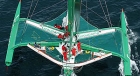
For an extreme development class all the 60ft trimarans have a very similar look, the result of the class maturing and the teams finding out what is fast. The boats are all 60ft (18.28m) long and all have rotating wingmasts standing at the maximum allowed height of 28.5m off the deck.
Beam
One of the principle dimensions left open is beam. The trimarans are mostly around as wide as they are long - the narrowest in the Transat Jacques Vabre was Banque Covefi (originally Alain Gautier's Foncia), with a beam of 17.4m while the widest is Thomas Coville's Sodebo at 18.6m. The trade off is between added power available through wide beam versus the lighter weight and marginally better manoeuvability of the narrower beam boats. For the record TJV winner Groupama, a similar generation boat to Banque Covefi, has a beam of 17.7m.
Beneath the water - foils
One of the most signifcant areas of recent development in the 60ft trimaran class has been that of the retractible foils mounted in the float. Originally conceived by Marc Lombard and fitted on the 2000 generation Banque Populaire, these curved foils, mounted in each float just aft of the forward beam, are considerably more versatile than the older variety that are straight and pierce the float at an angle. For example their curved shape allow them to be used to provide lateral resistance upwind.
"The curved foil gives more progressive," says Mermod. "At the beginning it is more lateral lift and later it is more vertical lift. It is very interesting for racing because upwind we can use them like a daggerboard, and then the more we need lift it becomes like a hydrofoil. And the foil comes out of the bottom of the foil so it is better for the drag."
Another feature of the curved, Lombard foil is that the more it is lower, the more it twists. "It is a very good idea," says Mermod. "The more you go down the more lift it generates. The more it goes down the more the angle of incidence increases and develops more lift."

Another feature of the curved foils are the winglets at the ends. "On Banque Populaire they have two foils one with a winglet and one without and they made a test. Without winglets the boat can’t go at more than 35 knots and with the winglets it can go at 37 knots - so it is really good for the drag," says Mermod.
In terms of their use Foxall says they alter fore and aft trim but also, critically, they help prevent the leeward bow digging in. "The foil is either on or off. You don’t use it all until you get to the critical speed when it starts to work. Then you put it all the way in. Up to 16 knots it is maybe not in at all, because it just drags. Then it starts to work over 16 knots you go full foil and then as speed builds you pull the foil up.
"Upwind we generally wouldn’t put them all the way down because then they are more for lateral resistance, so we normally put down about two thirds. But the minute you crack off and start to go fast and certainly the minute you are starting to put the leeward bow in or half the leeward bow in, you are looking to reduce wetted surface area because you are starting to get a lot of drag, so then we go for maximum foil down. Then close reaching, especially when you are going fast, the foil can get almost the whole boat out of the water except the aft end of the leeward hull." While the foils are in some ways a safety device to prevent tripping over the leeward bow they also allow the tris to be driven harder.
As with many of the dinghy development classes ORMA have reined in foil development to prevent the 60ft trimarans from becoming fully airborne and for 2004 new rules will be introduced limiting the maximum total foil area generating vertical lift to 1.8sqm.
For example a problem with the boat sailing along on the leeward foil and transom is that while fast it is inelegant and in theory potentially very dangerous as it is possible that when fully cranked up the boat could trip over its foil.
"There is the potential for that," agrees Foxall. "But I guess it depends upon how hard you push the boat. The foil will only work for so long and if you push it hard enough you will trip over the foil. For sure it increases your safety margin and allows you to push the boat further but there is a moment when the bow is going to trip in and maybe the foil can have that effect that it could actually work in reverse if you put the bow in far enough. But I think technically the foils would probably break if you did that too often. When we use the foils we have them graduated and at 20 knots we pull up that much and at 25 that much, etc so the faster we go or the more pressure we have on the foil we reduce the amount we have in. We probably err a little bit on the safe side but that is certainly preferable to breaking your foil."
Rudders
As mentioned in yesterday's article one of the main technical issues facing the class now that the structural problems appear to have been resolved, are the breaking of rudders through them colliding at high speed with submerged objects.
Since the late 1980s 60ft trimarans have been fitted with a rudder on each float. Today some boats, most notably the van Peteghem-Lauriot Prevost designs, have conventional spade rudders on the floats and a transom hung rudder with a lifting blade on the main hull. This is lifted to reduce drag when the main hull is flying. (see page two for photos).
Others such as the Irens-designed Bayer CropScience have a dinghy-style transom-hung kick-up system for all three rudders. On Sergio Tacchini they have spade rudders in the floats (last winter they removed the skegs from these because they were creating cavitation problems) and a kick-up rudder on the main hull. The performance benefit of this Mermod says is significant. "It is perhaps one knot beter when we pull it out and on the steering it is perfect - you can steer very easily." They haven't installed lifting rudders on the float because you always need the rudder when it is to leeward and when it is on the weather side it out of the water. The spade rudder also doesn't ventilate. To reduce ventilation on the rudder on their main hull they have fitted a gate just below the waterline to provide an end-plate effect.
Probably the most significant rudder development has been on Michel Desjoyeaux's Geant, where for the last year they have been trying out a T-foil where the angle of incidence could be altered. This year their system has been modified so that, like the latest Morrison International 14, the T foil is fixed to the rudder and the entire rudder can be canted fore and aft to alter the pitch of the foil through the use of a hydraulic ram.

"In lighter air it will increase the drag but later on when you are close reaching and you want to pick the stern up a little bit it has to be a good thing," says Foxall of the Geant system. "Theoretically it may increase the waterline length as well having an end plate on a transom-hung rudder. But things like that - it is fine having it on the drawing board, and saying that in theory is going to be faster but then you have to realise that. We are a long way from America’s Cup-type budets where you have two teams and two boats and the means to push development through like that in a period of weeks or months. We have to work to much longer time scales so you have to measure that out carefully in terms of what you are going to focus your energy on each year."
Daggerboards
Up until about five years ago in the class daggerboards were all straightforward up-and-down affairs the only variation being in their positioning - some were located forward of the mast and angled aft so as the board was dropped so the centre of the lateral resistance moved aft. On one boat the board was mounted beneath the boom making it in theory possible to destroy the top of it in a gybe!
Since then daggerboard technology has undergone a significant revolution with all teams attempting to improve the lift characteristics of the board as well as enabling the maximum flexibility in terms of the balance of the boat. To improve their pointing ability the tris have daggerboards that are must be strong and slender and up to 5m long. The board on Sergio Tacchini has a trim tab to provide more lift but Foxall says that it is quite conservative in its size and they may enlarge it over this winter.
"That it is a very interesting solution, because we have better lift with less drag because of the asymmetric foil," says Mermod. The downside of the trim tab arrangement is the drag from the 'hinge point' and it is harder (and therefore heavier) to build.
An alternative to this, as employed on Geant, Belgacom and Bonduelle is to allow the entire board to turn. "I think this has more drag than us but it is looks like it gives the same lift because when we race in the Grand Prix it seems to be the same - Belgacom wins some races, Tacchini wins some race and Groupama has a trim tab and wins races too."
Some of the daggerboard systems also allow the boards to move fore and aft. "The idea is when you are steering on different angles or with different headsails or with one or two reefs in you can balance your boat and then you don’t have to use the helm so much and then there is less drag again," says Mermod. "Using this system is Groupama, Geant and the old Fuji. The problem with this system is that you have a big hole in the bottom of the boat and for the moment we haven't found a solution to have a good shape." And again, it is also heavy.
Foxall describes how they use them: "With the daggerboard even in light stuff you have it all the way down to increase lateral resistance and apparent wind speed and probably as you get up to around 25 knots of true wind you’re pull up a little bit of daggerbaord and certainly up to 30 knots you only need 2/3 or 3/4 of it."
To download some video footage of Sergio Tacchini - click here . NB: This is video clip is 96MB in size so strictly appropriate for broadband users only.
Tomorrow Foxall and Mermad describe the technology that goes into a 60ft trimarans canting wingmast rig

Most Read
Most Commented
Comments
Businesses


Pro businesses
-
United Kingdom
-
France
-
-
Editor's choice
Member blogs
-
 Ned Collier Wakefield: MOD70 round BarbadosWell that was intense. 12 hard fought for seconds for the win. In idyllic conditions, Tony Lawsons MOD ...
 -
 Mini Transat leg 2 reportThe second leg of the Mini Transat started on 31st October, just over a month after ...
 -
Leg 1 reportI’ve been working towards the Mini Transat now for three years. In 2013 I was part ...
Business blogs
-
 The Island Sailing Club in Cowes, Isle of Wight, is delighted that Prince Michael of Kent ...
 -
Peta Stuart-Hunt chats with the 25 year-old British solo sailor Lizzy Foreman before she sets sail ...
-
The 2015 Student Yachting World Cup (SYWoC), an ISAF-recognised event hosted and run by students for ...
Editor's Choice
All time favourites...
-
 Three legs down into Ian Walker’s
 -
 Winning all but two races at
 -
 For the first time in its
Latest Comments
Add a comment - Members log in