
Figaro cunning
Thursday July 31st 2003, Author: James Boyd, Location: France
Any one design will have its tweaks, clever little widgets which makes some action faster or slicker. Bearing in mind that almost all other singlehanded offshore racing in France outside of the Figaro takes place in development classes it comes as no surprise that the Figaros too are teaming with such ideas, despite the new one design being just a few months ago.
Trimming the boat correctly for the conditions and point of sail can have a profound influence on performance. The boats can carry 1.1 tons of water ballast pumped up to the weather tank. There is a single tank, one on each side, so this can't be used to affect fore and aft trim (as it can through the multiple tank arrangements on Open 60s or Volvo Ocean 60s).
In addition to this there is the inevitable stacking. Down below all the boats have some way of holding gear up to weather. On Skandia there is a simple lee-cloth type arrangement, although they also have them in the bow too, because skipper Sam Davies feels that the new Figaro can be too stern down in some conditions.
Under the race rules you are allowed up to 100kg of extra kit (right). "They weigh your personal kit and cloths, charts, spares, things like handheld GPSes, any extras to the rule - everything that is floating in the boat is weighed and you’re allowed 100kg," says Davies. "So if it is going to be a windy leg you take 100kg of water in six packs and you duck tape them up so they don't split and that is your stacking weight. If it goes light then you pour away what you don’t need. But you are not allowed jerry cans as that would make stacking easy... I’m not looking forward to stacking. I wish the rule was a bit less weight. There is no way you could have 100kg of personal kit."
On board the Figaro boats the electronics package is made by French manufacturer NKE and includes their Gyropilot which compares boat speed and heading with apparent wind info to give true wind information. This has been quite revolutionary in some of the faster singlehanded classes such as the Open 60s as it allows the pilot to steer a better course when the apparent wind is swinging around due to the acceleration of the boat when surfing downwind.
In the Figaro class, having the pilot steering to true wind in fact isn't so useful - the boats are slowerm they don't use asymmetrics and due to the shorter courses skippers tend to helm most of the time, leaving the pilot to steer the boat only when they have to leave the helm. "It is new this year so a lot of skippers don’t use it," says Davies of the new true wind capability of the pilot. "I used true wind in the Mistral in the Med during the few minutes I wasn’t steering and it seemed to be fine."
Probably the coolest innovation this year and one which should have considerably safety iplication in the Solitaire du Figaro is the new man overboard feature built into the NKE instruments.
A problem that has occurred in the Figaro race on more occasions than the class would care to admit is skippers falling overboard. In previous races this has happened to Damien Foxall and Alain Gautier - both of whom were fortunately picked up by other boats - in the case of Gautier it was a complete miracle, because at the time he fell in (while he was cleaning weed off his boat's rudder) there were no other boats around.
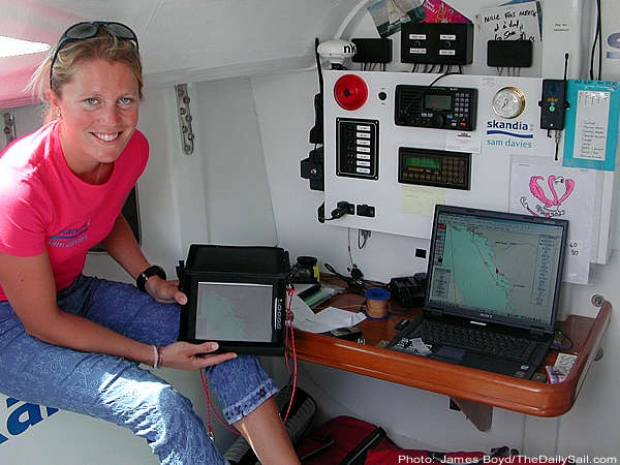
 The NKE package includes a small remote control (as modelled by Sam right) that works by wireless rather than a cable. While this can be used to steer the boat via the autopilot, the NKE gear also includes a proximity alarm. So in theory the skipper falls overboard, the NKE realises the remote is no longer on board and slams the helm down. Alternatively the skipper can activate this manually by holding down the 'Auto' button on the remote for five second, which has the same effect. Either way, the theory is that the boat stops, the skipper can then swim back to the boat, hops back on board and continues racing.
However this is only part of the story. If the skipper is not back on board after three minutes, then the NKE will talk to the VHF and will automatically send a distress message to the rescue authorities with the position of the boat (from the NKE GPS) and the vessel's unique MMSI number, identifying it. The reason for the three minute delay is that it allows the skipper time to cancel transmission of the distress message, in case of an accident.
The race organisation are making great use of modern day VHF's Digital Selective Calling and each Figaro boat comes with an Icom IC-M601 into which all the MMSI numbers of the boats taking part are programmed (see photo below). In theory - although it is forbidden in the race - Davies can decide she wants a chat with Michel Desjoyeaux, can send a message through to Geant that she wants a parlay and the VHF will actually ring on board MichDes' boat. How tempting...

The Icom VHF is also installed with the special channel P5 - which is set-up in such a way that the organisers or the press can interview a skipper without the rest of the fleet hearing their answers. This way a skipper can openly discuss their strategy or that they are having problems of some sort without fear that the other skippers will hear and potentially gain a tactical advantage. Since no other communication with the boats is allowed, this facility, the organisers hope, will encourage the skippers to share what is going on on board.
In terms of weather information the skippers are allowed to receive weatherfaxes. Gone are the old fashioned stand alone units that spew out paper, in favour of dedicated HF receivers and weatherfax software. On Skandia Davies uses an Icom PCR1000 receiver that hooks up to her laptop where weatherfaxes can be viewed using ICS FAX6 software. This software will allow a receive schedule of faxes to be programmed in so that faxes can be pulled in automatically.
Otherwise competitors can get voice forecasts from the radio or VHF while Race Director Denis Horeau also provides a forecast by VHF everyday at midday.
Another useful device most of the skippers are using are remote PCs that they can use in the cockpit. Previously Figaros have had chart plotters where the screens folded out into the companionway. Now most of the top skippers have some form of waterproof PC which acts as a repeater for the PC down below. With this they can bring up their routing software and even look at the latest weather chart without leaving the helm.
While most of these remote computers are hardwired to the PC down below, on Skandia the remote computer (a Panasonic Toughbook- see pic at the top of the page) communicates with the Sony laptop at the chart table via wireless LAN, so no cables are needed. The Toughbook is fitted in a case so that it can be slung for the helm enabling Sam to get a direct view of it (most PC screens are very hard to see in bright sunlight).
With lengthy periods of time spent at the helm, several of the skippers have developed their own helming seats. These have been used for some years in the Mini class where budgets are tighter and the seats tend to be bastardised plastic garden chairs with the legs considerably shortened. On Skandia Sam has something much superior - purpose built in fibreglass and ressembling the kind of helming seats they have on the 60ft trimarans.
To operate the helm almost all the boats have a Spinlock telescopic tiller extension. In addition to this they have a rectangular shaped piece of plastic tubing attached to the top of the tiller. This piece of kit, made by Nautix in France, makes for a much easier grip on the helm when the skipper is sitting in and can extend out from it centre position to port or starboard.
Knowing when it is a good time to sleep or fix something is crucial to singlehanded offshore racing such as this. "I steer as much as possible except when I'm really tired going upwind, especially at night when you can't see the tell tales so well. Sometimes you put a torch on the tell tales but you don’t want to because there might be other boats around and they can see your heading."
Otherwise she says the pilot will do a better job when the wind is medium-light (ie 6-15 knots) and she is tired. "When you’re tired then you tend to wander a bit and having the pilot on a low gain setting works really well I’ve discovered - that is a good time to get some rest. The other time if it is light winds with the spinnaker, the same thing happens, you wander because you're tired and if it’s really hot, especially in Med, you have the pilot on and then you have the spinnaker sheet and you go and sit under shadow of main or the spinnaker and you can trim the spinnaker to the waves and the pilot is steering. So you don’t get any rest but you do get some shade."
On the sailing side there are numerous tweaks. All the Figaros have adopted the bag system for handling their spinnakers. The kite is stored in a bag that hooks on to the pulpit from which it is hoisted directly. To drop the kite they use a double bag system. One bag is mounted so that it can be pulled into place attached to the surround of the main hatch. A second bag is placed into this into which the kite is dropped. Once the kite is contained in the 'inner' bag, bag and kite can then simply be rushed forward and clipped back on to the the pulpit ready for the next hoist. The double bag system saves time as it doesn't require the inner bag to be clipped in place.
On Skandia Sam also has come up with some cunning bungy work on the foredeck. Once her headsail is dropped there is some bungy cord on the deck that is used to keep the dropped headsail from flayling around. The cunning part of Skandia's arrangement is that the bungy cord can be 'tripped' freeing the headsail, from the cabin top without the need to go to the foredeck.
Back to electronics and because of Sam's fear of ships and collisions, Skandia has an ActivEcho radar transponder. This is like a super-radar reflector - if a ship is in the vicinity, its crew may or may not pick up the natural reflection of her boat. An octohedral or any other type of conventional 'passive' radar reflector will go some way to alleviate this but their reflections can be either weak or inconsistent. The ActiveEcho (or Pains Wessex's Ocean Sentry) senses that the boat is being scanned by a radar and sends out its own radar pulse, which, in theory, when it is spotted on a ship's radar screen should leave no doubt that there is a boat there.
The ActivEcho also has a sonic alarm letting the skipper know that there is shipping in the vicinity. Sam also admits that it took her a day and a half to wire up her alarm clock to the same buzzer (she has different alarms for wake up calls and ships).
More pics on the following pages
To read more about the Solitaire du Figaro - see our special section on it here

Most Read
Most Commented
Comments
Businesses

Pro businesses
-
Netherlands
-
Italy
-
-
Italy
Editor's choice
Member blogs
-
 Ned Collier Wakefield: MOD70 round BarbadosWell that was intense. 12 hard fought for seconds for the win. In idyllic conditions, Tony Lawsons MOD ...
 -
 Mini Transat leg 2 reportThe second leg of the Mini Transat started on 31st October, just over a month after ...
 -
Leg 1 reportI’ve been working towards the Mini Transat now for three years. In 2013 I was part ...
Business blogs
-
 The Island Sailing Club in Cowes, Isle of Wight, is delighted that Prince Michael of Kent ...
 -
Peta Stuart-Hunt chats with the 25 year-old British solo sailor Lizzy Foreman before she sets sail ...
-
The 2015 Student Yachting World Cup (SYWoC), an ISAF-recognised event hosted and run by students for ...
Editor's Choice
All time favourites...
-
 Three legs down into Ian Walker’s
 -
 Winning all but two races at
 -
 For the first time in its
Latest Comments
Add a comment - Members log in