
First time winner
Wednesday May 21st 2003, Author: James Boyd, Location: United Kingdom
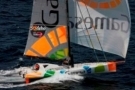
 After leading from the outset of the Mini Pavois singlehanded race which started from La Rochelle on Sunday, American Jonathan McKee has proved that a background as a double Olympic medallist and America's Cup sailor does count in the rarified world of shorthanded offshore racing when winning the first leg into Portsmouth in convincing style earlier this morning.
McKee crossed the line of Portsmouth at 05:02 BST this morning and moored up at Portsmouth's GunWharf Quay described to The Daily Sail how his first ever singlehanded offshore race had gone.
"The breeze started out at 20-25 knots but it was reaching, so it wasn’t too bad the first night," said McKee.
"Then it gradually headed, and ended up being on the nose for about 12 hours on Monday afternoon and evening. That was the toughest part of the race from Penmarch up to Sein." The boats were sailing northwest up the Brittany coast and had to round marks of the headlands at Penmarch and Sein before they could crack off to leave Ushant to starboard.
"There were huge waves and quite a confused sea, and 20-30 knots for a long time," continued McKee. Sailing upwind in these conditions off a lee shore in a lightweight 21 ft race boat is not for the faint of heart. "It is pretty tough. I ended up getting into my survival suit, and you are just hanging on just keep sailing the boat and trying to keep making progress towards the mark. You just keep thinking ‘if I can make it to this mark, then it becomes a reach and it will become a lot easier’ which was true. It was still tough sailing after that but after I got round Sein, it got a lot more comfortable. So I just kept focussing on it and tried to keep it reasonable and not push too hard because it was a long way."
Keeping a lightweight 21 footer going upwind into big seas is none too easy, but McKee felt he'd mastered it. "It was alrright. You are doing 6 knots upwind or pretty close, so if you get the right sail combination and keep the boat going you can do fine." He said during this period he had been helming for around two thirds of the time.
All the positions being beamed off the boats indicated that McKee was in the lead at this stage. However during the race these positions were not relayed to the competitors who are not allowed communications and were effectively sailing blind. "I didn’t know how I was doing. I knew I was doing well early, but then I didn’t see any other boats. I saw two boats 30-40 miles before the mark at Sein, that were ahead of me. I didn’t know I was doing as well as I was.
Passing Ushant the fleet had to head straight across the English Channel and round the Eddystone light off Plymouth before heading along the coast, leaving the Isle of Wight to port before reaching the finish line. "Then I sailed hard the rest of the race just because I didn’t know if I had to or not. It turned out there was another guy who was only an hour behind me so I did have to keep pushing pretty hard. So I set the spinnaker pretty much all the last leg, off the Eddystone all the way home.
"Luckily I had been able to get some sleep a couple of days before so I was in a position to be able to push pretty hard. Also I was a little bit lucky with some of the tide gates around Seine and Ushant. I got ahead of some of them there which was lucky and again at the end I had favourable current when it turned against them [those astern]. But the boat did great. I couldn’t be happier as it’s my first singlehanded ocean race."
Sailing down the Channel was the most exhilarating part of the race - running under spinnaker singlehanded in 15-30 knots. "It was pretty good. There was plenty on! I didn’t know how I was doing and who was behind me and how close they were. But I felt I had to keep pushing hard so I put the chute up and carried it the whole way." Under main and fractional kite Team McLube was sailing at 10-15 knots although McKee said that on one surf the boat speed nearly hit 20.
The Mini Pavois fleet had a pasting since the start with constant winds of more than 20 knots blowing. 12 boats have currently retired mostly with autopilot and sail trouble, including Ian Munslow, who's boat was rammed yesterday morning by a fishing boat and who's sorry looking boat has today been towed to Audierne, where Munslow, completely broke is now scratching his head as to how to come up with the funds to continue. (Any sugar daddies out there can email Ian directly by clicking here).
Possibly one of the reasons for McKee's success is that his boat was well and truly sorted prior to the last Mini Transat by Brian Thompson and Thompson's then shore crew Tanguy de LaMotte [who now has his own Mini]. This Team McLube is a Simon Rogers design with a keel that can not only be canted but can be hauled fore and aft in the boat at the same time.
McKee said that nothing major broke during the leg. "I was lucky. I had a couple of instrument issues, nothing that turned out to be critical . That was lucky and my sails did great. Keel, rudder and all the main stuff was good. Fortunately it is all pretty battle tested now."
Aside from some small tweaks to his jib McKee says he has not changed the sails since the Mini Transat. "It is pretty tested stuff, so we have a good basis to go forward. We are going to make a couple of new sails. I can’t afford all new sails."
Thompson sailed with him in the two handed Course des Lions and McKee says helped him a lot, but since taking the boat to the Atlantic coast of France has been without shore support. "That’s how it is for most of the guys. It is a fact of life on a low budget program."
For someone so new to singlehanded offshore racing McKee seems to have mastered it extremely quickly. "I’d done my 1,000 mile qualifier, so I had some experience of how to handle that sort of thing. I slept quite a bit early in the race which I think was helpful at the end. There were times when you were just going straight for a long time, so there is no reason to put yourself out in the elements when the pilot can do ust as well as you can. So I took advantage of that maybe more than some guys."
Leg two of the Mini Pavois kicks off from Portsmouth on Sunday at 1200. Those wanting to see the Mini fleet on their only visit to the UK this year can visit GunWharf Quay in Portsmouth where they are moored.
To read our previous interview with Jonathan McKee click here .
Most Read
Most Commented
Comments
Businesses
Pro businesses
-
United Kingdom
-
-
United Kingdom
-
Italy
Editor's choice
Member blogs
-
 Ned Collier Wakefield: MOD70 round BarbadosWell that was intense. 12 hard fought for seconds for the win. In idyllic conditions, Tony Lawsons MOD ...
 -
 Mini Transat leg 2 reportThe second leg of the Mini Transat started on 31st October, just over a month after ...
 -
Leg 1 reportI’ve been working towards the Mini Transat now for three years. In 2013 I was part ...
Business blogs
-
 The Island Sailing Club in Cowes, Isle of Wight, is delighted that Prince Michael of Kent ...
 -
Peta Stuart-Hunt chats with the 25 year-old British solo sailor Lizzy Foreman before she sets sail ...
-
The 2015 Student Yachting World Cup (SYWoC), an ISAF-recognised event hosted and run by students for ...
Editor's Choice
All time favourites...
-
 Three legs down into Ian Walker’s
 -
 Winning all but two races at
 -
 For the first time in its
Latest Comments
Add a comment - Members log in